The dishes are piled up again, and nobody remembers whose turn it is. You had a rota. It lasted about nine days. Then someone worked late, someone else's partner stayed over for a week, and the whole system fell apart until the bathroom got bad enough to argue about at 11pm on a Sunday.
Most shared-house chore fights aren't about effort. They come from recurring jobs nobody owns, vague expectations about what "clean" means, and no shared record of what was done. Three people can each believe they do the most, and all three can be wrong in different ways.
The time at stake is real. Adults in OECD member countries spend an average of 116 minutes a day on non-care housework such as cooking, cleaning, laundry and maintenance, and the split inside that figure explains a lot: women average 158 minutes against 72 for men, per OECD time-use data. Households don't need a personality transplant. They need a system that makes recurring work visible and assigned.
This guide reviews 10 roommate chores app options on how well they handle scheduling, shared visibility, and rewards, and where each one falls short for adults sharing a home. I judge each one on the specific roommate problem it solves or creates, and I flag which apps are built for adults sharing a flat and which are really family or couple software wearing a chore-app costume.
Table of Contents
- 1. Benny
- 2. Flatastic
- 3. Tody
- 4. Sweepy
- 5. Nipto
- 6. Muitra
- 7. Chore Team
- 8. ChoreBuster
- 9. Cozi
- 10. Homey
- How the 10 roommate chores app options compare at a glance
- Match the App to the Friction in Your House, Not the Feature List
1. Benny
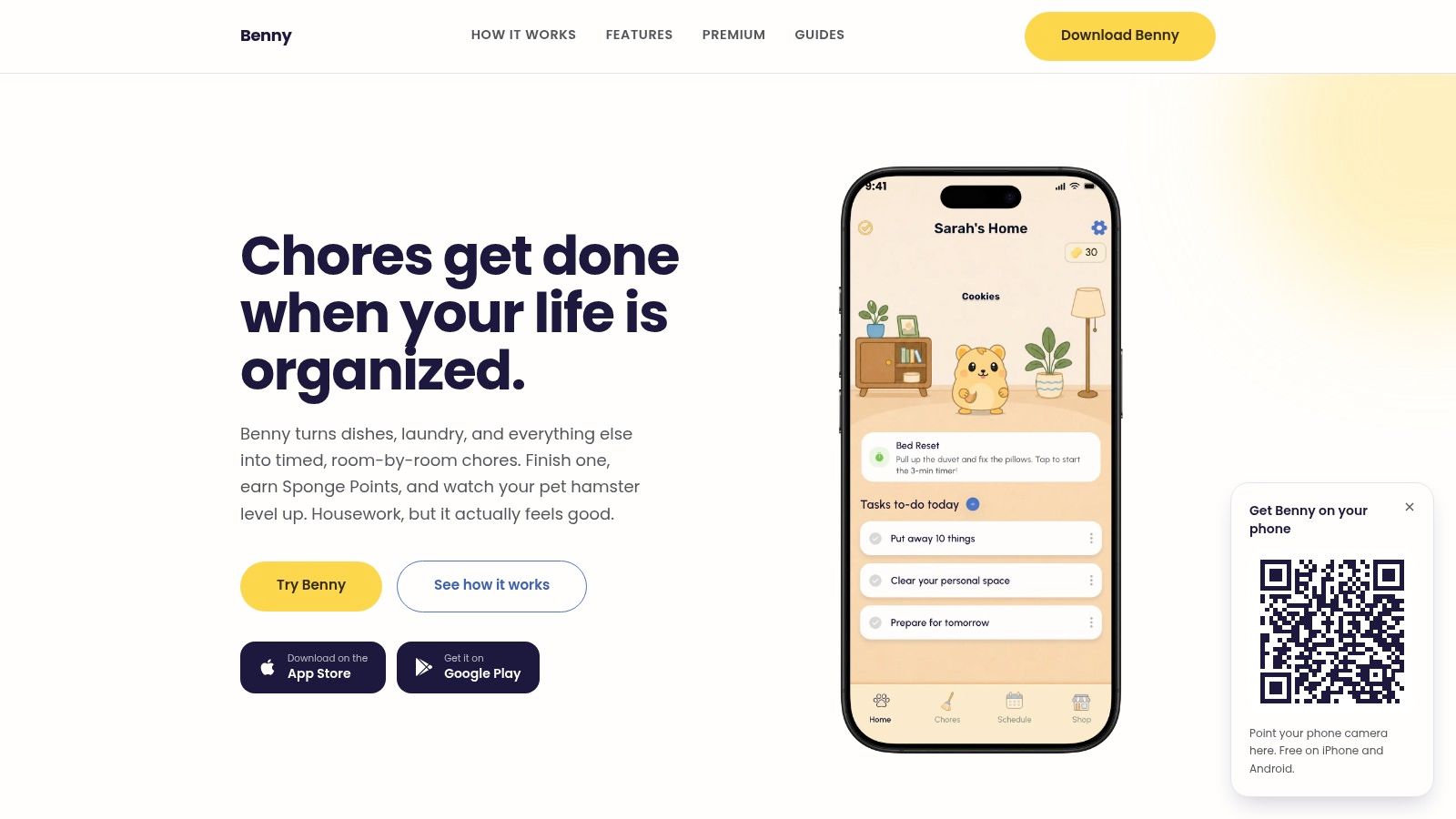
Benny is a room-by-room chore app for iPhone and Android, and it's the one I'd hand to a household that has never agreed on a system. You start with a preset list for the kitchen, bathroom, bedroom, or living room, or you create your own chore and name it yourself. Every chore can carry a timer, so "clean the bathroom" becomes a 15-minute block instead of an open-ended afternoon.
Here's how a shared home looks once the rooms are set up.
How a shared home actually works
You create a home and invite the people you live with. Everyone sees the same list and schedule, including who each chore is assigned to, what's done, and what's still waiting. Chores can be one-off or recurring at any interval you choose, and the schedule shows what's due today next to what's coming up. Because it runs on iPhone and Android, a house with mixed phones doesn't need a workaround.
The reward layer is Sponge Points. Finish chores, level up a virtual hamster, earn accessories in the in-app shop. That sounds slight, and for some households it is. But it's the difference between a tracker people open for a week and one that survives a boring February.
Where it falls short
- Ads in the free version. Scheduling, reminders, timers and shared assignments are free, but removing ads takes the optional subscription.
- No published Premium price. Check the store listing before you commit. Billing runs through the App Store or Google Play, and deleting the app doesn't cancel a subscription.
- The hamster won't land with everyone. Four adults in their thirties may find a virtual pet irrelevant. It costs nothing to ignore, but don't build your pitch to housemates around it.
Practical rule: before you invite anyone, load the jobs that cause real arguments (bathroom, bins, dishes) and give each one a named owner. A shared list with no assignments is a prettier group chat.
Premium adds widgets, room and chore filters, holiday and sick modes, mood-based suggestions, protected snoozing and skipping, and multiple-home management. The full feature set is listed on the Benny app site.
2. Flatastic
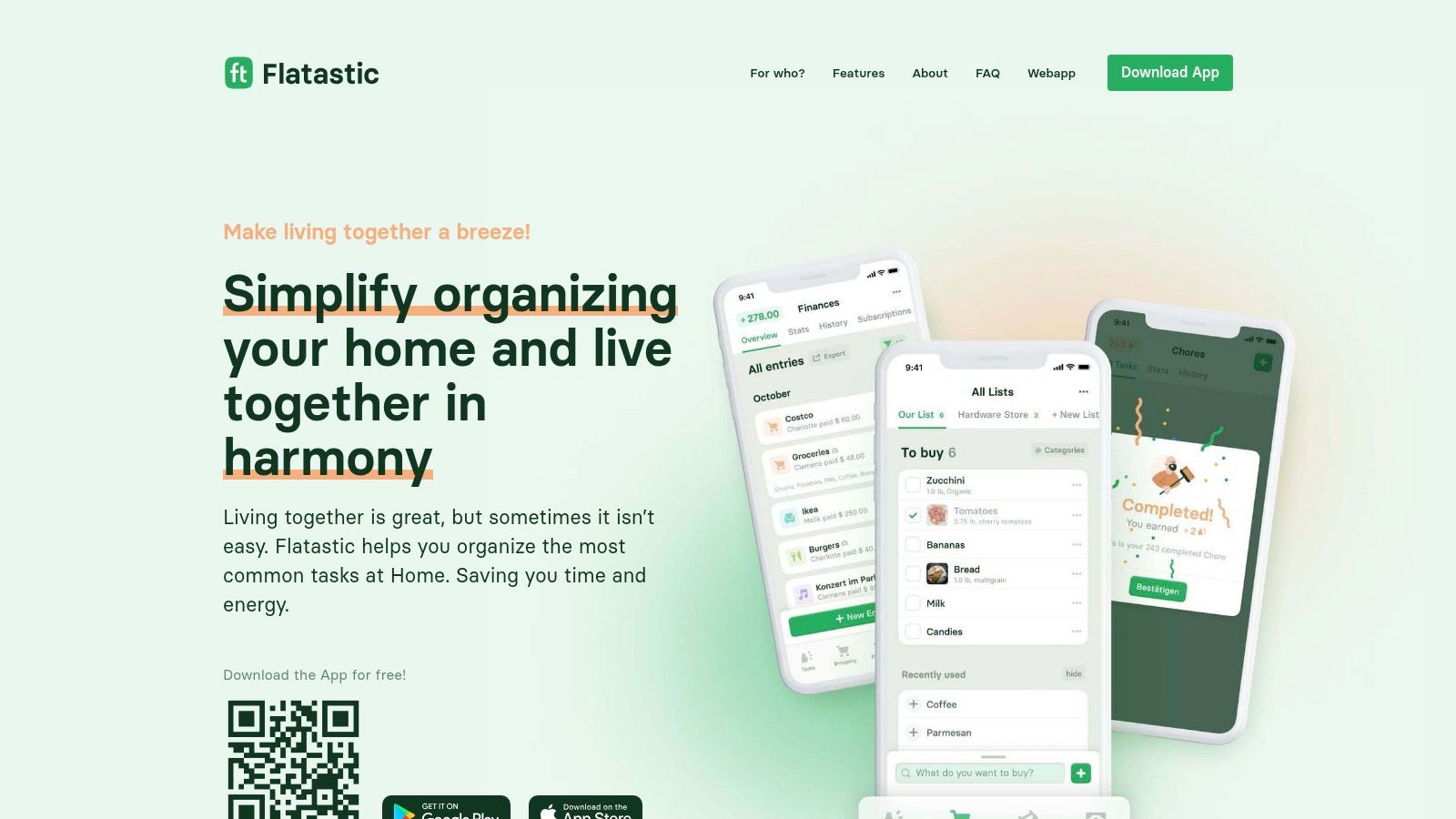
Flatastic is the "one app everyone opens" answer for a shared flat. It bundles a chore rota, a shared shopping list, expense tracking and a household pinboard. That breadth matters because money rows run a close second to cleaning rows in most shared homes, and splitting the two across separate apps means one of them gets ignored.
Cleaning is still the headline problem. In a 2025 U.S. roommate census of 1,257 respondents, 60% named cleanliness as the leading source of tension, ahead of noise at 36% and money or utility bills at 26%, with 18% specifically citing failure to take out the trash (SpareRoom roommate statistics). Flatastic puts those jobs next to the shared bills, so the flatmate chasing the rent split sees the bathroom rota on the same screen.
The mobile interface keeps chores and costs in one feed.
What it handles well
- Chores with reminders and points. Assign tasks, set repeat schedules, track completions, and let points do some of the nagging.
- Shared lists beyond cleaning. Shopping and expenses live beside the rota, which cuts the number of apps a household has to remember to check.
- Built for flatshares rather than families. It treats household members as peers, and it carries a strong install base with generally positive ratings on Google Play.
Where it falls short
One account belongs to one household at a time, so anyone splitting weeks between a flat and a family home hits a wall. The cleaning side is also shallower than a dedicated planner: "deep clean the bathroom" stays a single line item instead of breaking into rooms, intervals and timed jobs. Google Play lists ads and in-app purchases, which sits awkwardly in an app your whole flat is expected to open daily.
If recurring room-based scheduling is the thing your house keeps failing at, a room-by-room chore schedule is the piece Flatastic treats as a checkbox rather than a system. Flatastic's own site is at flatastic-app.com.
3. Tody
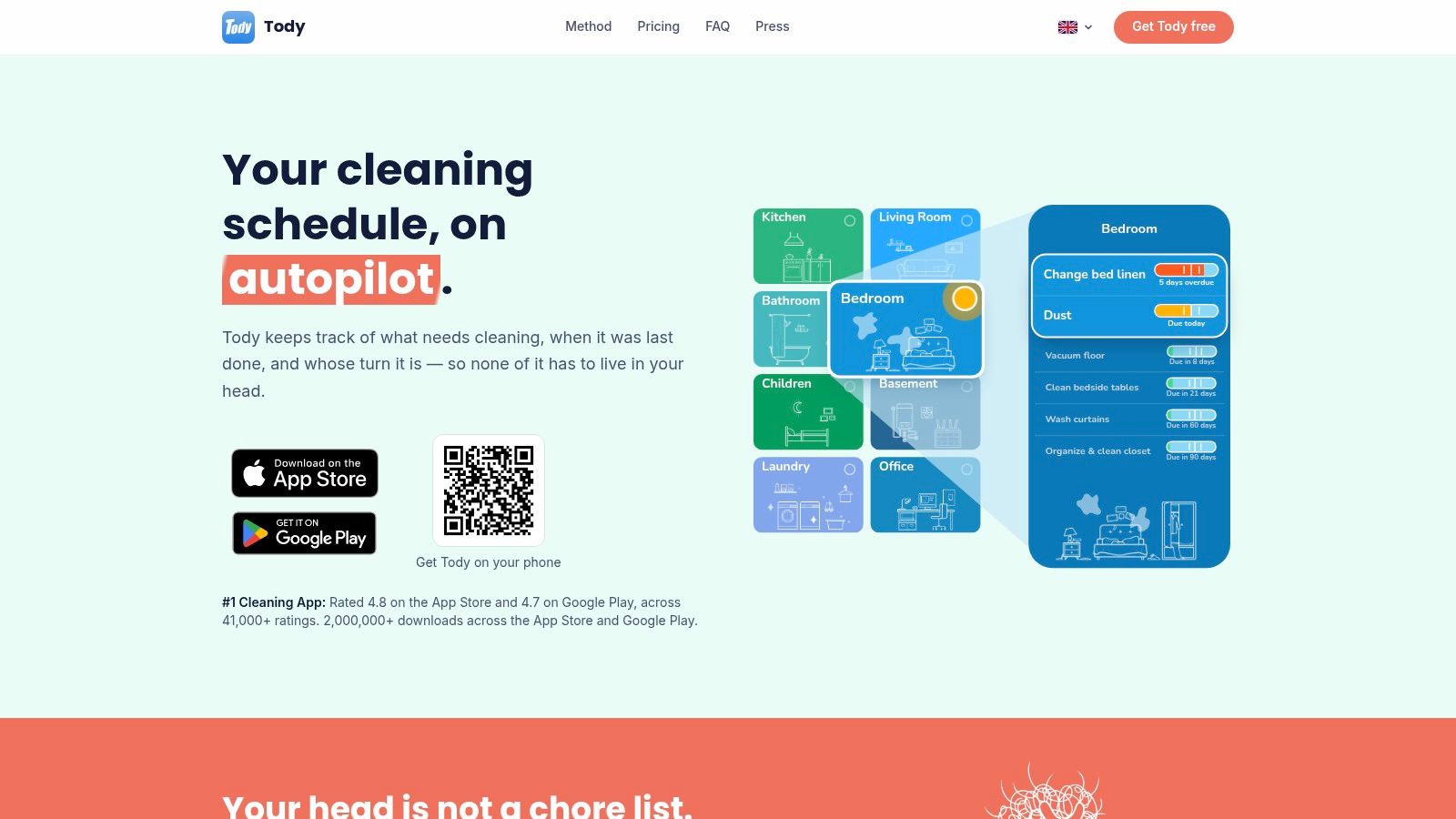
Tody treats cleaning as an interval problem, not a weekday problem. Each room holds tasks with their own frequency, and the app shows how overdue each one is instead of nagging you about Tuesday's vacuuming on a Friday.
That framing fits how cleaning behaves. An OECD comparison of unpaid work across 29 countries put routine housework at an average of 2 hours and 8 minutes a day, covering cooking, cleaning, gardening, pet care and home maintenance. That's not a task set that fits neatly into "bathroom on Mondays".
The due-status view separates urgent from optional work.
The catch for shared houses
The free plan is built for one person. Live household sharing and FairShare contribution goals sit in Premium+, which the official site prices by household size with a 30-day trial, while Premium adds multiple homes and a focus timer.
That paywall placement is the trade-off. Tody is excellent at answering "what's overdue", and it makes you pay before it answers "who's doing it" for anyone but you.
Where it falls short
- Sharing requires the top tier. A free user can't run a shared flat on Tody.
- Setup is front-loaded. Every task needs an interval, and getting those intervals right takes an evening of honest assessment.
- No weekday rota. If your house likes fixed turns, Tody's continuous due-status model will feel slippery.
If your household's real problem is memory rather than fairness, Tody is the most honest tool here. If it's fairness, you'll be paying for Premium+ and still needing a conversation.
Tody's plans and pricing are listed on todyapp.com.
4. Sweepy
Sweepy ties tasks to rooms and then tracks how the work is distributed across the people living there, with daily schedules, progress tracking and a leaderboard. The design decision that matters is that it doesn't treat all chores as equal.
Fairness in a shared house rarely fails on task count. It fails on perceived burden and on different thresholds for what counts as dirty. A Vox review of household labour research notes that roommates often expect the person most bothered by dishes or odors to deal with it, which turns a fair system into a "who cares more" penalty. In one peer-reviewed study cited there, only 53.2% of respondents considered their housework division fair, against 79% who said the same about shared expenses.
That gap is the argument for weighting chores by effort rather than counting them. Wiping a counter and scrubbing a shower are not the same contribution, and a flat that counts tasks will keep having the same fight.
Where the leaderboard helps and where it backfires
- Helps: in houses where people want to see progress, a visible contribution score settles arguments with a record instead of a mood.
- Backfires: in houses with one reluctant roommate, the leaderboard becomes evidence, and evidence becomes resentment.
- Automated daily planning removes the small friction of deciding what to clean, which is where most good intentions die.
Sweepy makes household progress visible and syncs across devices, and its iOS listing notes Premium subscriptions. Check the current store listing for prices and multi-person sharing details before you subscribe, because the sharing mechanics are what you're buying.
Where it falls short
Some features require in-app purchases, and the competitive framing won't suit every group of adult roommates.
If your house responds better to a shared record than a scoreboard, look at something less leaderboard-driven. If your house is three competitive people who'd happily race each other to the bins, this is your app. Details at sweepy.com.
5. Nipto
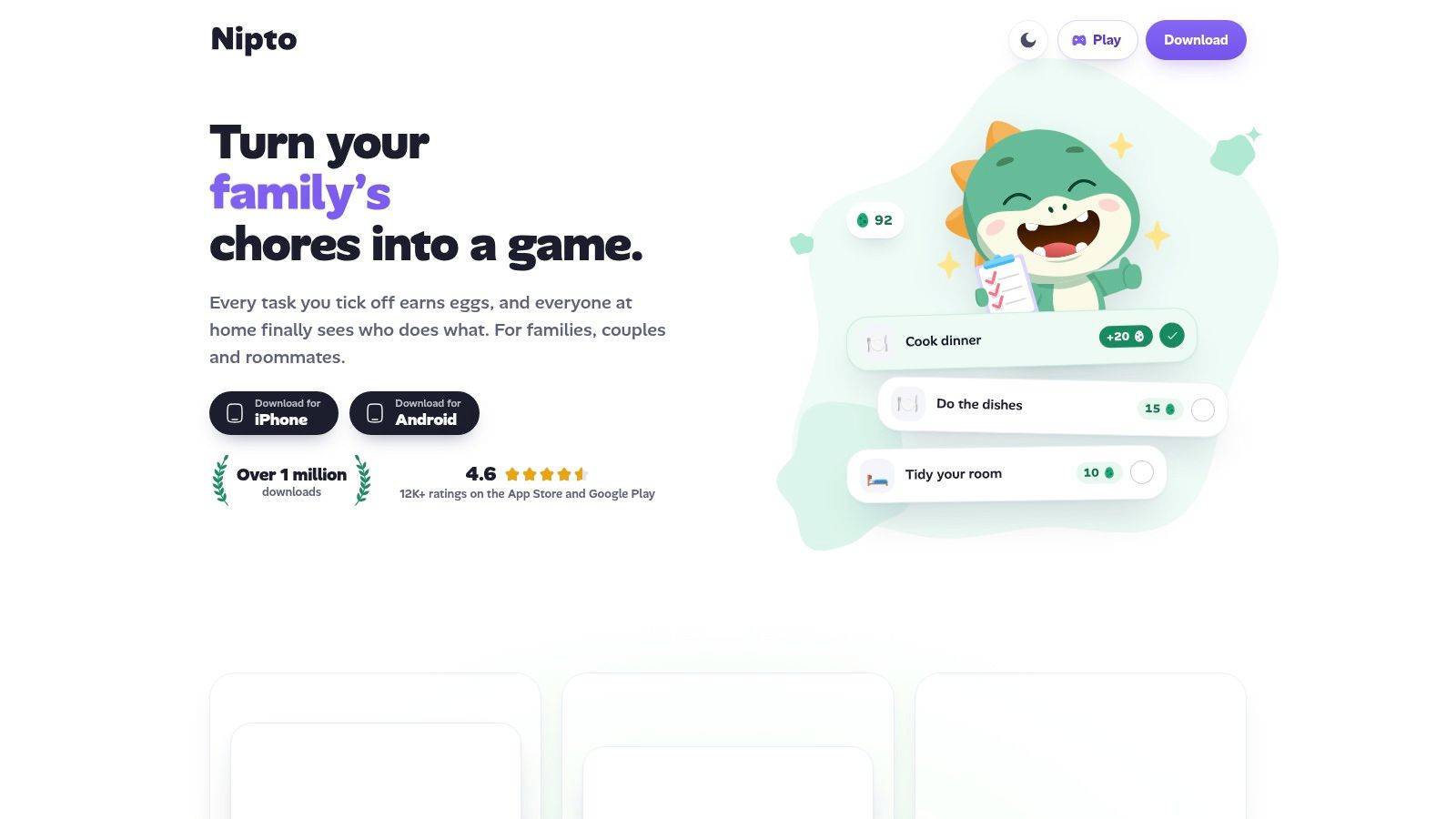
Nipto turns shared chores into a points game with weekly scores, custom schedules and automatic turn-taking on shared jobs. It runs on iPhone, Android and the web, and the core app is described as free, with Premium providing additional planning features.
The weekly score is the selling point and the trap. For a house where one person swears they do everything, a visible tally is the closest thing to proof. For a house where one person avoids the bathroom, the same tally becomes a league table nobody agreed to.
Automatic turn-taking deserves credit too. Shared jobs cycle to the next person on their own, so recurring tasks keep moving without anyone remembering to reassign them.
Here's the scoreboard view.
The risk nobody warns you about
Competitive scoring assumes everyone opted in. Shared houses often run on quieter habits: the cleaning conversation gets sidestepped, promises get made and dropped, and nobody wants to be the one who raises it. A public ranking can make an avoidant housemate feel singled out, and a housemate who feels singled out tends to withdraw further. If the same name sits at the bottom of the table every week, the app has made one person's private struggle the whole house's business.
Where it falls short
- Built for the willing. The game only functions if every housemate signed up for it, and the app doesn't check.
- Public ranking can harden conflict. Points work when the competition is voluntary and collapse when it isn't.
- Light on cleaning planning. There's no room condition tracking or scheduling based on what's overdue.
- Premium terms need checking. Confirm what sits behind the paywall before your household builds a habit around it.
Use Nipto where housemates already joke about the scoreboard. Houses that need quiet private nudges should pick something gentler. Nipto's details are at nipto.app.
6. Muitra
Muitra is built around rotation. It handles personal and shared recurring routines for solo homes, couples and roommate households of up to six people, and it automatically passes shared chores to the next person in the turn order.
For a house that keeps failing at "whose turn is it", that single behaviour is worth more than a dozen features. The weekly plan shows whose turn is next, so the question gets answered by the app rather than by whoever is angriest.
What a rotation-first app gets right
- Turn order is the default. Shared chores move on without anyone reassigning them, which is exactly where manual rotas die.
- Personal and shared tasks coexist. Your own routines don't get buried under household jobs.
- Both platforms. The official site lists iPhone and Android availability.
Where it falls short
The six-person limit is real. A five-bedroom share with a rotating cast of partners and subletters will hit it. Pricing details weren't apparent in the official information I reviewed, so check the app stores before committing. It also skips the extras some flatshares want, like bill tracking and shopping coordination, which means running a second app alongside it.
Rotate the unpleasant jobs explicitly rather than hoping goodwill distributes them. The bins are the obvious test case, and rotation beats negotiation every time.
Muitra's product details are at muitra.com.
7. Chore Team
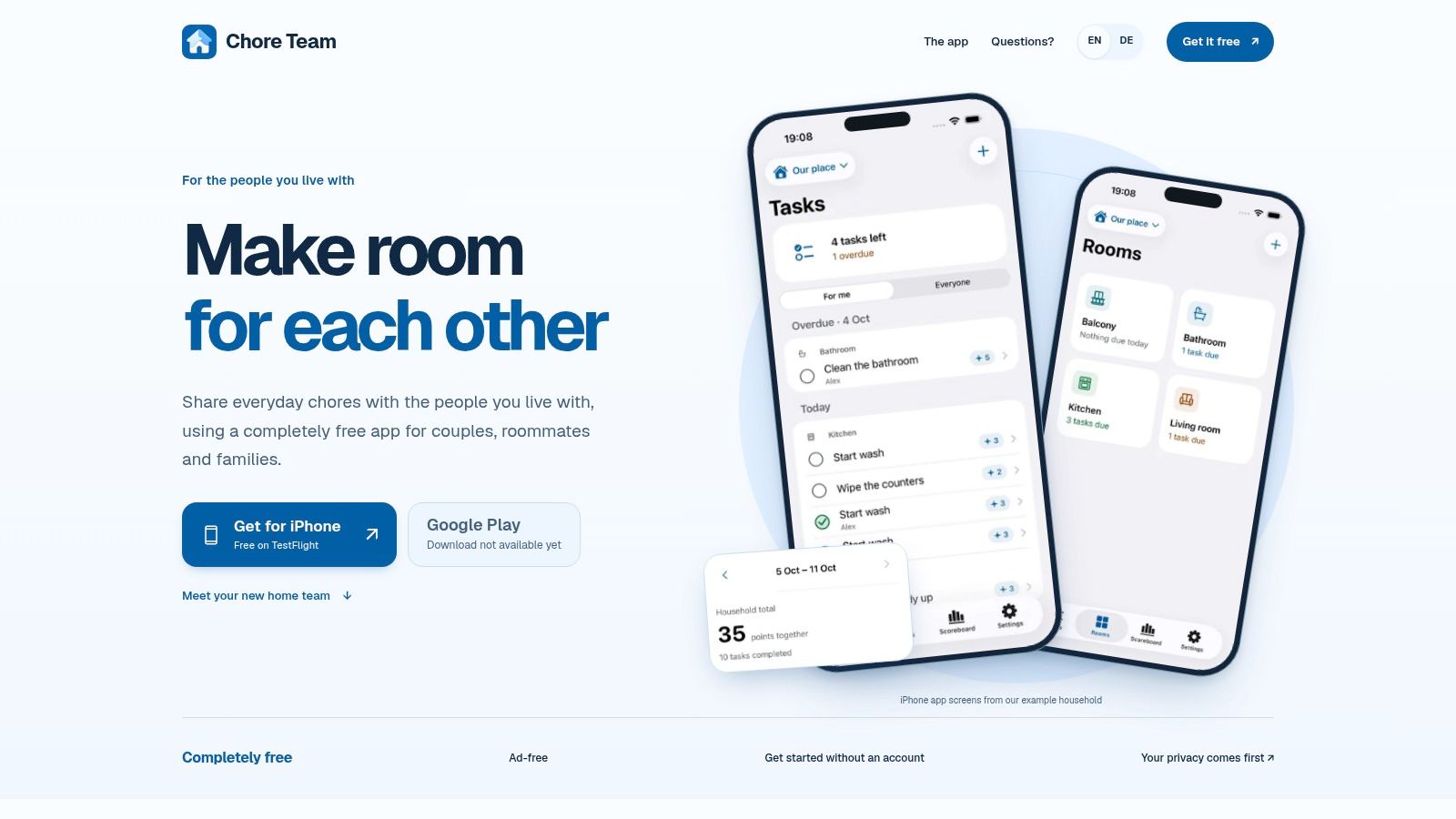
Chore Team organises chores by room and shows housemates recurring tasks, assignments and points together. Its site describes native iPhone and Android apps and says access is free, without ads or subscriptions.
Free and ad-free is a genuinely different offer in this category. Most apps here fund themselves by gating sharing, history or extra homes behind a subscription, so a house that just wants a rota and no upsell has a short list to choose from.
The shared list groups tasks by space.
What it does well
- Room-based lists for the kitchen, bathroom and the rest, which is how cleaning gets discussed.
- Invitation links so a new housemate joins in a minute rather than an evening.
- Recurring chores with assigned people and points, plus native apps on both platforms.
Where it falls short
It's a newer option with less established user feedback, so you're an early adopter. The listed iOS requirement is iOS 26 or later, which excludes anyone on an older device, and that's a household-level problem rather than a personal one: if one housemate can't install it, the shared list is broken for everyone.
Before you set anything up, agree how you'll handle the jobs that aren't equal in effort. A guide to splitting chores with roommates is worth ten minutes of a house meeting, because the app records whatever system you've already agreed, including a bad one. Chore Team's site is at chore.team.
8. ChoreBuster
ChoreBuster is a web-first service that distributes chores among household members automatically, according to rules the household sets. Members view and check off their assigned chores, and schedules can be emailed or printed.
That print and email output is the feature most apps skip, and it solves a real problem. Plenty of adults would rather skip another notification stream entirely. A weekly rota on the fridge, or an email landing Sunday evening, suits a household where one person lives in the app and another lives in their inbox. The automatic allocation also addresses the classic roommate dispute directly: the rule decides who cleans the bathroom, not the loudest person in the group chat. For adults sharing a home rather than a family running reward charts, that's a sensible model.
Why reminders need restraint
Reminders do change behaviour, but the effect depends on how often people are nudged. An occasional, well-timed alert gets a chore done. A constant stream trains everyone to ignore it. Four people receiving duplicate alerts about one bin is four people muting the app within a fortnight.
Where it falls short
- Setup lives on the website. The mobile app is a companion viewer, so this is not a phone-first tool.
- The four-week trial ends. After that you pick between monthly, annual or one-time payment options, which at least offers a way out of subscriptions.
- Automatic allocation needs good rules. Feed it vague inputs and it will produce a schedule that ignores how uneven the jobs are, so nobody follows it.
Don't optimise for maximum notifications. Optimise for one reminder, at the right moment, to the person who actually owns the job.
Details at chorebuster.net.
9. Cozi
Cozi isn't a roommate chores app. It's a family organiser with chores attached, and that's the honest way to evaluate it for a shared house. Each household member can have their own list, chores repeat daily or weekly, and everyone sees completion status.
If your actual problem is a shared calendar and a shopping list, Cozi can absorb chores into work you were already doing. If your problem is three adults disputing the bathroom, you're using family software for a governance problem.
What works
- Chores sit in the free plan, alongside calendars, shopping lists, to-dos and meal planning.
- Simple repetition is enough for houses with low complexity and high tolerance.
- One place for everything, which raises the odds someone opens it at all.
Where it falls short
The chore feature is aimed at families rather than roommate workflows. Documented repetition is daily or weekly, which is a poor fit for fortnightly or monthly jobs like cleaning the oven or washing the duvet. Chores also live in the iPhone and Android apps but not on the Cozi website, so desktop users are out.
The honest verdict: fine as a household hub, weak as a fairness tool. See cozi.com/chores for the chore specifics.
10. Homey
Homey is a family chore-and-allowance app where adults assign tasks to children and can connect completed work to payment or rewards. For adult roommates, it's the wrong tool, and that's worth saying plainly.
Where it earns a place on this list is the shared household that includes children. A parent's house with a rota and an allowance system needs both in one place, and Homey handles the allowance side rather than bolting a payment ledger on afterwards.
Who it suits
- Parents linking chores to money. Allowance and commissions are the core of the product, not an add-on.
- Families with a shared routine rather than peer-to-peer coordination.
- Both platforms, with iOS and Android availability.
Where it falls short
Allowance and parent-child management make it awkward for adults sharing a flat. It isn't a room-based cleaning scheduler either, so the bathroom still needs a plan. App-store feedback differs by platform, so read the recent reviews for the version your household runs.
If you're splitting a house with peers rather than raising children, a shared chore list with assignments and visibility is the feature you need, not an allowance engine. Homey's details are at homeyapp.net.
How the 10 roommate chores app options compare at a glance
Scan this table before you download anything. For a flatshare, the middle two columns do most of the deciding: whether the free tier covers the whole household, and whether everyone sees the same list.
| App | Free option | Shared household | Best for |
|---|---|---|---|
| Benny | Free core features; Premium is optional | Shared chores, schedules, reminders, and progress tracking | Room-by-room chores with playful rewards |
| Flatastic | Free download; in-app purchases | Chores, shopping lists, expenses, and household updates | Roommates coordinating household tasks and costs |
| Tody | Free plan for one person | Live sharing requires Premium+ | Room-based cleaning plans with task urgency |
| Sweepy | Some features require in-app purchases | Household syncing across devices | Automated room-based cleaning schedules |
| Nipto | Free core app; Premium adds features | Shared chores, turn rotation, and weekly scores | Households motivated by points and friendly competition |
| Muitra | Free tier unclear; paid tiers offered | Shared routines and chore rotation for up to six people | Small households that want automatic chore rotation |
| Chore Team | Free, with no ads or subscriptions | Room-based chores, assignments, and points | Roommates seeking a straightforward free chore app |
| ChoreBuster | Four-week free trial, then paid options | Automatic chore distribution among household members | Households that want schedules emailed or printed |
| Cozi | Chores included in Cozi Free | Shared chore lists, plus calendars and shopping lists | Households wanting a simple organizer with recurring chores |
| Homey | Paid family plans; free tier unclear | Parent-managed tasks and allowances | Families connecting children's chores with rewards |
Match the App to the Friction in Your House, Not the Feature List
Every app above works for somebody, and none of them works for everybody. The difference between a rota that survives the year and one that dies in a fortnight isn't the feature list. It's whether the app solves the argument your house has.
Start with the problem, not the download button. If recurring jobs get forgotten, you need scheduling and recurrence that reassigns itself: Muitra's rotation, ChoreBuster's automatic allocation, or any app where the chore comes back without a human deciding it should. If responsibilities are vague and disputed, you need a shared record that everyone can see, which is the core of Flatastic, Benny and Chore Team. If workloads feel uneven, you need effort weighting rather than task counting, and Sweepy's whole design leans that way. If motivation is the failure point, points, leaderboards and virtual pets do real work, and that's where Nipto and Sweepy earn their keep.
Then read the labels carefully. Cozi and Homey are family organisers. They'll run a household with children well and feel strange in a flat of four adults. Tody is a solo cleaning planner whose sharing features sit on a paid tier. ChoreBuster is a website first and a phone app second, which is either the point or a dealbreaker depending on who's in your house.
Practical rule: pick the app that solves your biggest problem, then accept a second-best answer for everything else. Households that try to solve scheduling, fairness, money and motivation in one download end up abandoning all four.
The two-to-four week test
Don't judge a chore app by how it looks on day one. Judge it by what's still being missed in week three.
- Get every housemate on their own phone. A shared system with one person locked out isn't shared. Check platform requirements before you commit, including things like Chore Team's iOS 26 requirement.
- Load only the jobs that cause arguments. Six assigned chores that stick beat forty that nobody reads. Bathroom, bins, dishes, shared surfaces.
- Run it for two to four weeks without changing the rules. Mid-rotation tinkering hides whether the system works.
- Review what's being missed, not who's being blamed. If the same job keeps slipping, the schedule is wrong or the standard is unclear. Fix the assignment, not the person.
- Adjust once, then leave it alone. A schedule edited weekly becomes a project nobody wants to own.
The last thing worth saying is about fairness. No app settles whether a division of labour feels fair, because that's a conversation about standards, effort and changing circumstances, not a tally. What an app can do is give that conversation something concrete to sit on: a record of who took what, what got done, and what keeps getting left. That's the whole value. It moves the argument from memory and mood to a list everyone can read at the same time.
Benny gives everyone in a shared home the same chore list and schedule, with room-based presets, timers, recurring chores and due-date reminders, so the bathroom doesn't depend on anyone's memory. Sharing a home is free on iPhone and Android, and Sponge Points with a virtual hamster give the routine jobs a reason to get ticked off. Set up your rooms, invite your housemates, and give the rota four honest weeks at Benny.