Clean a normally used household bathroom about twice a week, and wipe the high-touch fixtures daily if anyone else shares the room. That's the short answer, and it holds up better than the weekly routine most of us inherited.
Ask how often should you clean your bathroom and nearly every answer comes back the same: once a week. The weekly clean is a convenient unit of time, not a finding about how dirt and germs behave. A bathroom is a stack of surfaces that fail at different rates. The toilet seat is touched by every person who walks in. The shower wall only turns into a problem when it stays wet. The floor collects whatever came in on shoes. Bundling all three into one Saturday job means the seat goes too long between wipes while the shower gets scrubbed harder than it needs.
Splitting the room by risk fixes that, and it makes the work smaller rather than bigger. A daily wipe of six fixtures takes about a minute. The fuller clean every few days covers what a wipe can't reach, and nothing gets scheduled on a hunch.
Table of Contents
- Recommended Cleaning Frequency for Every Bathroom Surface
- Daily Touchpoints to Wipe Between Full Cleans
- Weekly Full Clean, Step by Step
- Signs a Bathroom Needs Cleaning Sooner
- When to Disinfect and When Cleaning Is Enough
- Set Your Schedule for Your Household and Reminders
Recommended Cleaning Frequency for Every Bathroom Surface
A normally used household bathroom needs a full clean weekly, rising to twice a week when the room is shared, with a daily wipe of high-touch fixtures whenever more than one person uses it. Between those intervals, each surface gets its own schedule, and every row earns its frequency for a specific reason.
| Surface or task | Recommended frequency | Why it matters |
|---|---|---|
| Toilet seat, flush handle and faucet | Daily in shared bathrooms; every 2-3 days when one person uses it | High-touch surfaces that collect hand contact |
| Doorknob and light switch | Daily in shared bathrooms; weekly when one person uses it | Touched often with unwashed hands |
| Toilet bowl and base | Twice weekly | Highest bacterial load of the fixtures |
| Sink, vanity and counter | Weekly | Toothpaste, hair and soap residue build up |
| Shower and tub | Weekly, plus a wipe after use | Moisture drives mold growth |
| Shower glass and tracks | Weekly | Soap scum and hard water spots form here |
| Bathroom floor | Weekly; twice weekly when shared | Tracks in germs from outside and from the toilet area |
| Exhaust fan cover | Monthly | Dust reduces airflow, so surfaces dry more slowly |
The twice-weekly step for shared bathrooms is the part of this schedule with a trial behind it. A 2025 study sampled sinks, vanity areas, toilet surfaces, floors, doorknobs and toilet bowls in patient rooms, long-term-care facilities and households with at least four occupants, testing at 1, 2, 3 and 7 days after cleaning. Bacterial recovery was highest at three days, and a three-day cycle, roughly twice weekly, produced the largest reduction in recovered heterotrophic bacteria and E. coli, significant on both measures (P = 0.00898 and P = 0.01). The authors' quantitative microbial-risk assessment estimated that schedule could cut norovirus infection risk from commonly touched restroom surfaces by 91.5%, as reported in the NCBI/PMC record of the restroom-surface trial.
Read that number with its limits attached. The study evaluated cleaning and disinfection together, so 91.5% isn't proof that a soap-and-water wipe alone achieves the same reduction, and it measured pathogen recovery rather than shine, grout or mold.
Start every row where the table puts it, then move a row up one step when the bathroom has several users, frequent visitors or someone sick at home. Move down a step for a bathroom used by one person that stays dry and odor-free. In practice, stepping up means the sink joins the twice-weekly pass and the floor gets mopped mid-week, while stepping down means the counter and glass wait for the weekly clean.
The glass is the row most households get wrong. Soap scum lifts with detergent, but the cloudy white film needs an acid, and a method for hard water stains on shower glass keeps both under control without an hour of polishing.
Daily Touchpoints to Wipe Between Full Cleans
The daily wipe isn't a smaller version of the full clean. It's a separate task aimed at the six or eight things hands touch on the way in and out, which is exactly what the U.S. Centers for Disease Control and Prevention means when it recommends cleaning high-touch household surfaces regularly, often daily, naming toilets, faucets, sinks and handles, while other surfaces wait until they're visibly dirty. The same CDC household cleaning guidance is clear that disinfection is generally unnecessary in ordinary circumstances unless someone is sick, at higher risk of severe illness, or has recently been ill. So the daily pass is detergent and water, roughly a minute of work.
Run it in this order:
- Take one cloth and one detergent wipe. A microfiber cloth wrung out in warm water with a drop of dish soap covers the whole room. Keep a second cloth for the toilet so you never carry bowl bacteria back to the faucet.
- Start at the door and move inward. Door handle on both sides, then the light switch, then the towel rail. You're following the trail hands leave, so the path a person walks is the path you clean.
- Do the toilet seat, lid and flush handle next. Handle last, because it's the surface the previous user touched on the way out. Then swap or rinse the cloth before you touch the sink.
- Finish at the faucet and sink edge. Handle, spout, the rim of the basin and the counter edge where water pools. Leave everything to air dry rather than buffing it with a damp towel.
For a bathroom one person uses, a touchpoint wipe every two or three days is enough while nobody in the house is ill. You'll know the job is done when the handles have no visible grime, the faucet doesn't feel tacky under your thumb, and the sink edge is dry. Water that keeps reappearing there is a slow leak to fix, not a cleaning problem to scrub at.
Weekly Full Clean, Step by Step
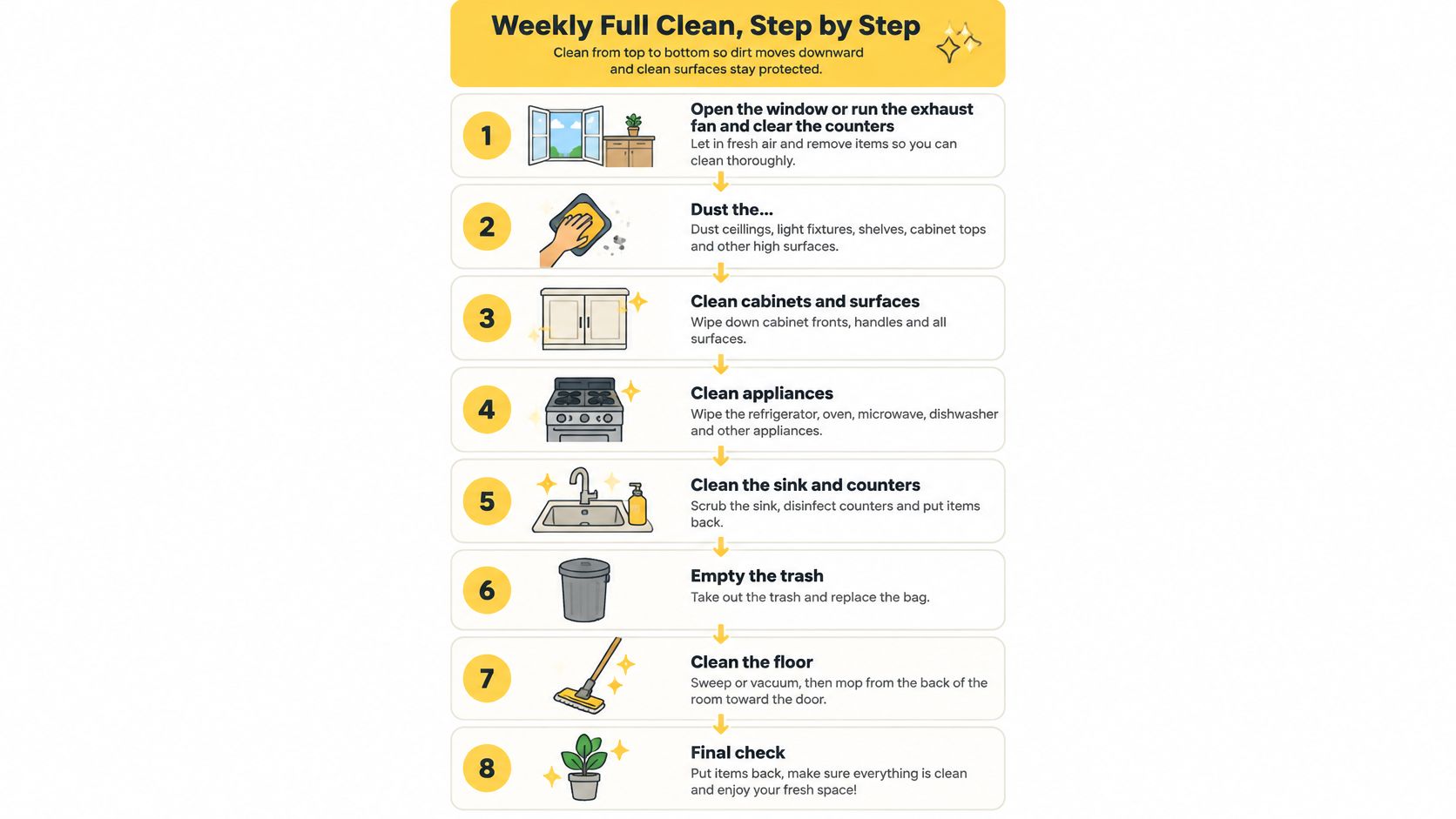
Order does most of the work in a full clean. Work from the driest, highest surfaces downward, and finish by drying, so you never push grime onto something you've already done.
The sequence looks like this in practice:
- Ventilate and empty the room. Open the window or start the exhaust fan before you spray anything, and take out bottles, towels and the bath mat. Cleaning around objects leaves a ring of grime behind every one of them.
- Dust the dry surfaces first. Fan cover, light fitting, mirror top edge, the tops of the door frame. Dust settles downward, and doing this while everything is dry means it lands on porcelain you haven't cleaned yet instead of on wet detergent.
- Spray the shower walls, glass and tub, then leave them. Detergent needs dwell time to break the soap scum bond. Spray, then go and do the sink while it works, which is why this step comes before scrubbing.
- Scrub the shower, tub and glass tracks. Lift the drain cover and pull out hair before you rinse, otherwise you're washing it back into the trap. Rinse top down with the shower head and use a jug for the corners the spray misses.
- Do the sink, vanity and taps. Faucet base, the soap dish, the counter edge and the front lip of the vanity, which collects more splashes than the top does.
- Clean the toilet bowl first, then the outside. Bowl cleaner or detergent under the rim, brush through, and leave it while you wipe the seat, lid, base and the floor bolts. The common slip is scrubbing the bowl last and dripping on everything you just finished.
- Mop the floor last. Vacuum or sweep hair first, then mop from the far corner toward the door so you're not standing on wet floor. Floors go last because everything above them has been dropping on them.
- Dry the room. Squeegee the glass, wipe the tub edge, the faucet and the shower caddy, and leave the fan running for half an hour after you finish.
Here's the full routine laid out as a checklist you can follow in order.
The moisture rule that outranks the calendar
Moisture, not the date, is the key control variable in a bathroom. The U.S. Environmental Protection Agency's guide to mold, moisture and your home advises running an exhaust fan or opening a window during showering, keeping indoor relative humidity at 30 to 60 percent, and drying wet materials within 24 to 48 hours, because persistent dampness is what promotes mold growth. If mold keeps returning, the EPA points to better ventilation, more frequent cleaning and fixing the underlying leak rather than treating the growth as cosmetic.
That's also the honest argument for cleaning weekly even when the room looks fine. A surface that stays damp is feeding something you can't see yet. If two of you share the work, splitting the steps by person gets a full clean down to a few minutes each and removes the argument about whose turn it is.
Signs a Bathroom Needs Cleaning Sooner
The calendar sets a baseline. The room overrides it, and it usually tells you before the schedule does.
- Damp that won't clear. Walls, grout or a bath mat still wet hours after the shower ran points to airflow, not laziness.
- Mildew in the same corner twice. Repeat growth in one spot means the moisture source is still there.
- An odor that survives a full day of use. A smell that lingers near the toilet after a normal day means the base, bolts or floor seam need attention.
- Grime you can feel. Tacky handles, a gritty sink edge or a slippery tub floor all say the wipe has been skipped too often.
- A jump in traffic. Guests, a party, a new roommate or a house full of children for an afternoon.
The five minute check
- Look up at the shower ceiling and the grout corners.
- Press the tub edge and the bath mat to feel for damp.
- Note any odor after a full day of use, not right after cleaning.
- If any check fails, bring the next full clean forward instead of waiting.
Fix the cause, not the stain. Mildew that returns to the same grout line is a ventilation or leak problem wearing a cleaning costume.
A cheap humidity gauge on the shelf answers the dampness question faster than your nose does. Watch it after a shower and see whether it drops back into a normal range within a few hours. One more thing worth knowing: a study on household restrooms found that closing the lid before flushing did not reliably prevent viral contamination of bathroom surfaces, as reported by the International Scientific Forum on Home Hygiene. Rely on cleaning the rim, floor and touchpoints, not on lid discipline alone.
When to Disinfect and When Cleaning Is Enough
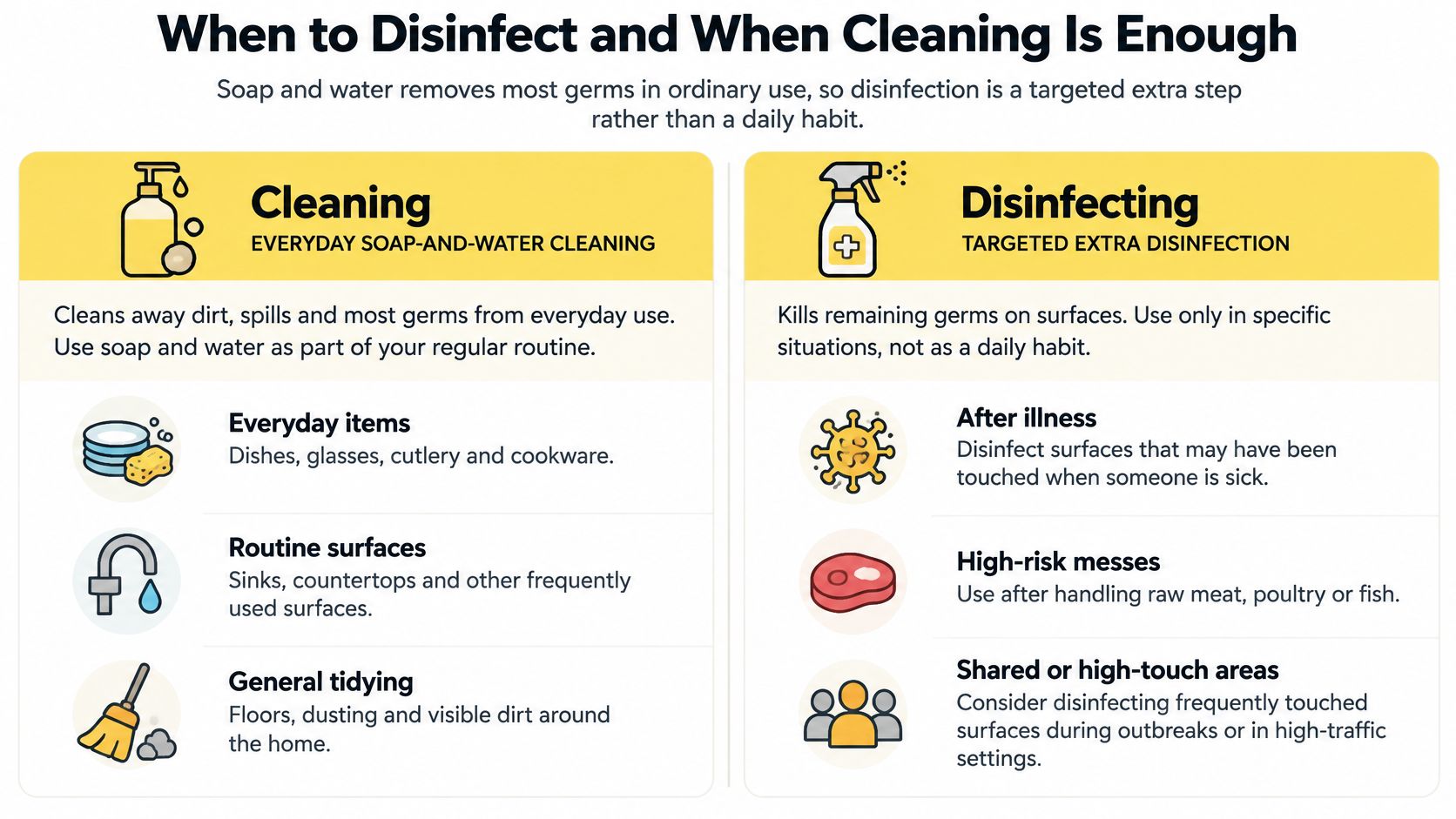
Soap and water removes most germs in ordinary use, which makes disinfection a targeted extra step rather than a daily habit. The two tasks do different jobs, and confusing them is how households end up bleaching a bathroom every night while the toilet brush sits in a puddle.
| Task | What it does | When to use it |
|---|---|---|
| Cleaning | Detergent lifts soil and removes most germs | Routine weekly clean and daily touchpoint wipes |
| Disinfecting | Label-approved product, such as a hypochlorite cleaner, kills remaining germs | Shared high-touch fixtures, after illness, or when an at-risk person uses the room |
| Duration of effect | Reduction fades; contamination only marginally below pre-treatment levels 3 to 6 hours later | Repeat as a recurring task, not a one-off fix |
The research here is a warning against treating disinfection as a finish line. A review in the Journal of Applied Microbiology on bathroom cleaning and disinfection reports that fecal bacteria can persist on residential bathroom surfaces even after homeowners' regular cleaning, and that hypochlorite-based cleaners reduce fecal-bacterial levels. Domestic-environment testing in the same review found the protective reduction was short-lived, with contamination only marginally below pre-treatment levels 3 to 6 hours after disinfection. The lesson isn't to disinfect more, it's to disinfect on a rhythm and keep cleaning in between.
The order that actually works
- Remove soil with detergent and a cloth or brush. Dirt and residue block disinfectants from reaching the surface.
- Apply a suitable disinfectant and keep the surface wet for the full contact time printed on the label. Read the label rather than guessing; wipes and sprays differ.
- Ventilate the room while you work, and leave the fan running afterwards.
- Never mix bleach products with ammonia or acidic cleaners such as vinegar or limescale removers. The reaction produces a gas that will clear the room faster than any cleaning job.
Label contact time is the whole job. Spraying and wiping ten seconds later is a cleaning step, not a disinfection step.
Set Your Schedule for Your Household and Reminders
Two people in the same bathroom touch the same flush handle many times a day. One person touches it a few times. That difference, more than square footage or how the room looks, should set your interval. Most households fit one of four patterns.
One person, bathroom used alone
A touchpoint wipe every two or three days and a full clean weekly is enough. Soil builds slowly with one user, and the room rarely reaches the traffic that drives the twice-weekly pace. Move it up if you've been ill or the shower has been running long.
A couple sharing a bathroom
Add the daily wipe, because both people now touch the same handles, taps and light switch. Keep the full clean weekly and bring it forward after a weekend of guests. This is the household that benefits most from a shared list, since two people assuming the other one cleaned the sink is how grime builds for a month.
A family with young children
Daily wipes and a full clean twice a week, plus an extra clean after a cold or stomach bug moves through the house. Children miss the bowl, leave wet towels on the floor, splash the counter and put their hands on everything on the way out. Treat towels and bath mats as part of the job rather than decoration.
Roommates sharing one bathroom
The cleaning isn't the hard part here; agreeing on it is. Fix a rota and a checklist that names the surfaces, keep a full clean twice weekly, and add one after a house party. When the rota slips for two weeks, the room tells you.
| Household | Daily touchpoint wipe | Full clean | Add a clean when |
|---|---|---|---|
| One person, bathroom used alone | Every 2-3 days | Weekly | Visible dirt or after an illness |
| Couple sharing a bathroom | Daily | Weekly | After a weekend of guests |
| Family with young children | Daily | Twice weekly | After a cold or stomach bug in the house |
| Roommates sharing one bathroom | Daily | Twice weekly | After a house party or when the rota slips |
| Frequent guests or hosting | Daily | Twice weekly | The day before and the day after visitors |
| Someone ill in the home | Clean and disinfect after each use by the ill person | Daily while symptoms last | Once symptoms clear, return to the household schedule |
The illness rule
If a sick person uses a bathroom that can't be dedicated to them, clean and disinfect it after each of their uses rather than waiting for the next scheduled clean. Once symptoms clear, go back to the household schedule, wash the towels and mats on the hottest setting the fabric allows, and replace toothbrushes.
Turning the schedule into reminders
The schedule only works if it survives a busy week, so put it somewhere that reminds you rather than somewhere you have to remember.
- Create the daily touchpoint task and set it to repeat daily, with a short timer so it can't expand into a full clean.
- Create the full clean on a repeating interval, weekly for one or two people and twice weekly for a family or shared flat.
- Add the monthly fan-cover dust as its own task. It's the one that disappears from every list.
- Assign each task to a person. A list nobody owns is a list nobody does.
A chore app earns its keep with this kind of routine, and Benny's chore schedule is built for exactly this shape of work. Our bathroom preset breaks the room into named tasks instead of one vague job, every chore can carry a timer such as 15 minutes for a touchpoint wipe, and recurring chores come back on any interval you choose, so the twice-weekly clean returns without anyone rebuilding the list.
Benny is a household chore app for iPhone and Android that organizes cleaning by room, so the daily wipe, the twice-weekly clean and the monthly fan dust live as separate tasks with their own intervals rather than one job that gets postponed. You can set a timer on each chore and see, in a shared home, who is doing what and what is still waiting. Visit Benny to set up your bathroom schedule once and let the reminders carry it from there.