It's Sunday evening. The bins are full, a school form is due Monday, and there's barely enough milk for breakfast. Someone notices all of it, starts making a list, and wonders why keeping the house running still depends on what they happen to remember.
The missing piece isn't necessarily more effort. It's a household management system that includes the remembering, anticipating, and following up, not just the visible chores.
Table of Contents
- What a Household Management System Is
- The Five Parts Every Household System Needs
- How Routines, Responsibilities and Schedules Work Together
- Building Routines and Schedules Step by Step
- Adjusting the System When Capacity Changes
- Where to Keep Your System
- Start Your Household System This Week
What a Household Management System Is
A household management system is the set of routines, responsibilities, schedules, and reminders you use to keep recurring work visible and finished. It can live in a notebook, on a shared whiteboard, or in an app. The format matters less than whether everyone knows what needs doing and how to respond.
Think of air-traffic control. Household tasks are planes arriving at different times: dinner needs attention tonight, a permission slip needs signing before school, and a maintenance appointment needs booking before something breaks. The control tower holds the arrival information so nobody has to keep looking at the sky.
In a home, that means recording upcoming work, deciding who's responsible, and making completion clear. Remembering to do the work is itself part of the work.
More than a cleaning checklist
The workload is substantial. The U.S. Bureau of Labor Statistics' 2024 American Time Use Survey found that 80.4% of people aged 15 and over performed household activities on an average day, while the population averaged 2.01 hours daily on activities including housework, cooking, lawn care, and household management.
That's a broad measure, not a cleaning target for every household. Its practical significance is that running a home involves many different kinds of recurring activity.
A cleaning checklist might tell you to wipe the kitchen counter. A household system also captures checking whether there's cleaning spray, replacing it when it runs low, and deciding who handles the shopping.
Practical rule: If a job only exists in someone's memory, the household hasn't fully recorded that responsibility.
You don't need an elaborate command center. You need a dependable place for tasks, clear agreements about ownership, and a way to adjust when ordinary life interrupts the plan.
The Five Parts Every Household System Needs
Use this table to check whether your setup contains the information people need to act without asking for instructions.
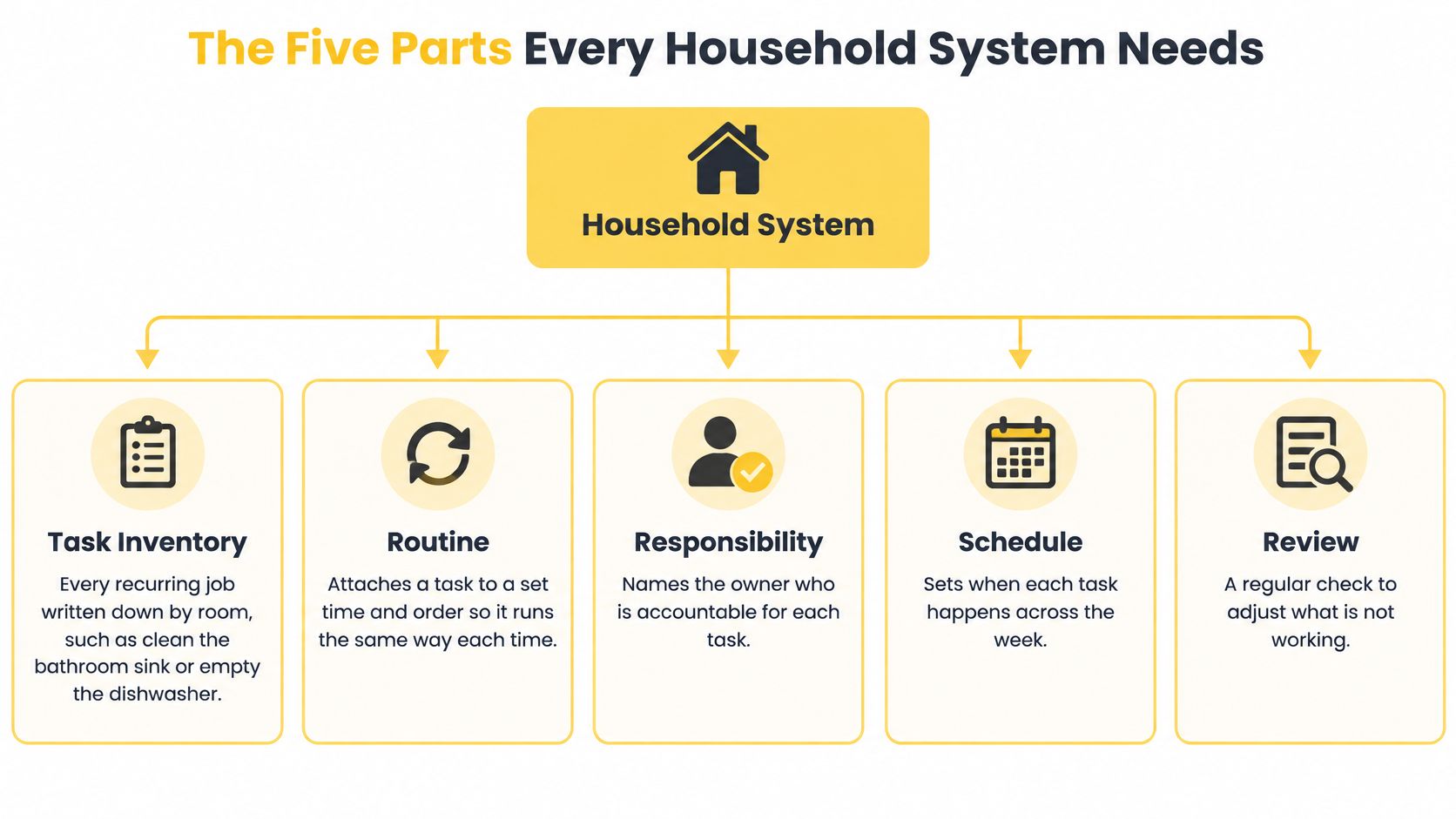
The five parts of a household management system
| Component | What It Holds | Example | What Breaks Without It |
|---|---|---|---|
| Task inventory | Every recurring job, listed by room | Clean bathroom sink, empty dishwasher | Work exists only in people's heads |
| Routine | A task tied to a fixed time or sequence | Sunday: meal plan, then grocery list | Tasks happen at random or get skipped |
| Responsibility | One named owner for each task | Partner A owns groceries | Two people wait on each other |
| Schedule | Due dates and frequency | Bins every other Thursday | Tasks drift past their window |
| Reminders and completion log | Notifications and a record of who finished what | Tuesday alert, check-off recorded | Work is repeated or goes unnoticed |
Build from the inventory upward
The task inventory is the foundation. List jobs by room where that helps, but don't stop at cleaning the bathroom sink. Include these household domains:
- Cleaning and tidying: Surfaces, floors, clutter, and shared spaces.
- Laundry and bedding: Washing, drying, putting away, and replacing linen.
- Meals and meal planning: Choosing food, preparing it, and managing leftovers.
- Groceries and consumables: Food, toiletries, cleaning products, and other replenishment.
- Appointments and school admin: Bookings, forms, transport arrangements, and deadlines.
- Bills and paperwork: Payments, renewals, filing, and incoming correspondence.
- Home maintenance: Repairs, appliance care, and service appointments.
- Seasonal tasks: Weather preparation, outdoor upkeep, and holiday-related work.
Routines and schedules sit on that inventory. The routine establishes the sequence; the schedule supplies the timing. Responsibility connects the work to a person, while reminders and completion records help everyone follow through.
Keep reminders and logs together as the feedback part of the system. Review is the habit of examining that feedback and changing what isn't working, rather than another list of chores.
Identify the missing part
Some households also need a supplies list, especially when several people use the same consumables. Record a replenishment trigger, such as adding detergent to the shopping list when the spare bottle is opened.
The most revealing failure is a task with no owner. If someone must repeatedly ask another person to act, adding another calendar notification may not solve the underlying responsibility gap. A useful shared-chores arrangement makes that assignment explicit.
For a quick diagnosis, write down recently missed tasks and identify what was absent: the task itself, a routine, an owner, timing, or a completion signal. Fix that missing component before replacing the whole system.
How Routines, Responsibilities and Schedules Work Together
A routine is like a recipe: it explains what happens and in what order. Responsibility identifies the cook. The schedule is the timer that tells the cook when to begin.
For example, suppose bins must go out Thursday evening. The routine is to gather household rubbish, sort recycling, replace liners, and move the bins to the collection point. Partner B owns the job, with an evening reminder before the collection deadline.
That's a complete working agreement. A calendar entry saying bins leaves much more open to interpretation.

Recognize where coordination breaks
Different gaps produce different problems:
- Timing without a routine: Someone moves a reminder to tomorrow, but hasn't decided what preparation the task requires.
- A routine without an owner: Everyone understands how the dishwasher should be emptied, yet everyone assumes someone else will do it.
- An owner without timing: Someone accepts responsibility for bedding, but never identifies a workable washing and drying window.
Make the task description specific enough to avoid these ambiguities. Deal with laundry might mean starting the machine to one person and returning clean clothes to drawers to another. Agree on the endpoint before judging whether someone finished.
Avoid turning every small action into a separate assignment, though. If one person sorts, another washes, and a third puts away, someone must still coordinate the handoffs. Use subtasks for clarity while keeping an accountable owner for the overall outcome.
Transfer the planning, not just the execution
The invisible-manager problem starts when one person still notices every need, builds every schedule, and reminds everyone else.
In a study of 322 mothers of young children covering 30 household tasks, mothers reported approximately 73% of cognitive household labor, compared with 27% for partners, according to USC Dornsife's account of the study. The same account reports that greater concentration of cognitive labor was associated with depression, stress, burnout, poorer mental health, and weaker relationship functioning, an association rather than proof of causation.
The broader imbalance also extends beyond planning: the United Nations' 2025 Goal 5 report states that women and girls spend 2.5 times as many hours on unpaid domestic and care work as men.
Those findings don't tell you how any particular couple divides work. They do explain why counting completed chores alone is an incomplete fairness check.
A person hasn't fully handed over groceries if they still check the fridge, write the list, and remind the shopper to leave.
For a meaningful ownership transfer, agree on the following:
- Choose the outcome, such as a stocked kitchen with ingredients for the agreed meals.
- Name the owner, including responsibility for noticing shortages and arranging replenishment.
- Give decision rights, with agreed boundaries around budget, dietary needs, products, and timing.
- Define done, including putting purchases away and resolving missing items.
Decision rights matter. Someone can't independently own groceries if another person rejects every reasonable substitution after the shopping is finished. Agree on firm requirements, then allow different methods.
Make exceptions and fairness visible
Write down trigger events as well as calendar dates. Opening the last packet of rice can trigger a shopping-list entry; receiving a school email can trigger an admin task. This captures work that doesn't arrive neatly on a weekly schedule.
In our shared homes, people add chores room by room and assign each chore to a specific person. Every member sees the same list and schedule, including assignments and completed work. Chore names, schedules, and completion activity are visible to other members, so keep sensitive information out of shared task titles.
At a regular fairness review, ask each person to identify the mental tasks they initiated, reminders they sent, and exceptions they resolved. Also consider urgency, interruption, and effort, not just totals.
The working agreement should be simple: the owner also manages the reminder and any necessary rescheduling. Other household members can help without becoming that person's permanent supervisor.
Building Routines and Schedules Step by Step
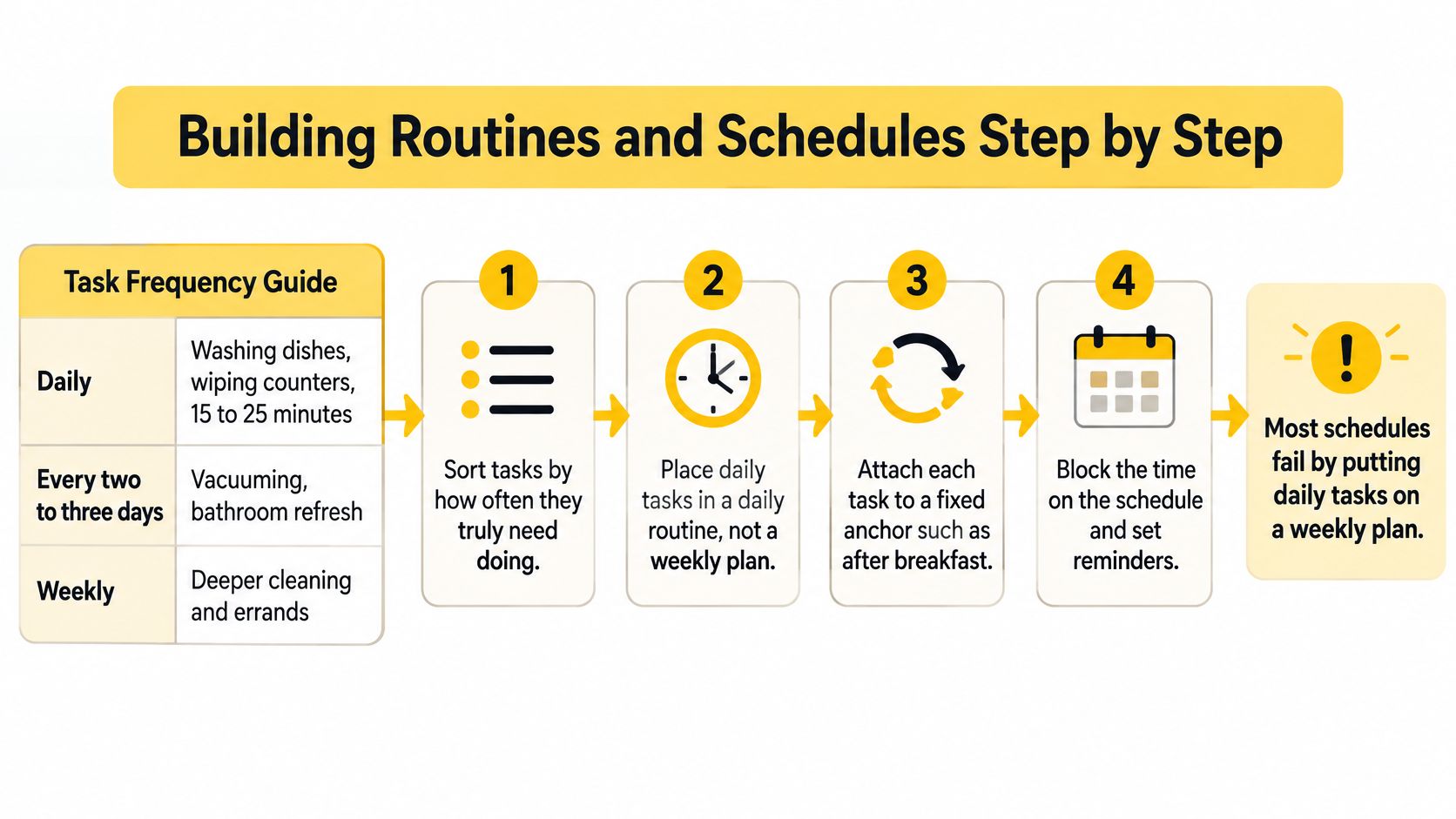
Begin with frequency, not a crowded calendar. The table below is a starter template, not a cleanliness standard or a set of measured task durations; replace its suggested slots with your own timings.
Typical task frequency and session length
| Frequency | Typical Tasks | Session Length | Schedule Anchor |
|---|---|---|---|
| Daily | Wash dishes, wipe counters, clear surfaces | Until dishes and food-contact surfaces are ready for use | After dinner or breakfast |
| Every few days | Empty bins, sort laundry, check the fridge | A brief check and collection round | A fixed weekday slot |
| Weekly | Bathroom, vacuum, mop, change bedding | A reserved block based on timed tasks | Saturday morning |
| Monthly | Oven, fridge deep clean, baseboards, filters | Separate appliance and room sessions | First available weekend |
| Quarterly | Windows, cupboards, upholstery, gutters | Separate projects, with safe access arranged | Change of season |
For context, the U.S. Bureau of Labor Statistics reports that people in the United States spent an average of 0.33 hours daily, about 20 minutes, on interior cleaning in 2025. That population average isn't a prescription for your home, and it doesn't include every kind of household work.
Turn the template into a workable schedule
- List recurring tasks room by room, then add administrative and replenishment work so the inventory includes more than visible dirt.
- Assign a frequency or trigger, because washing dishes after meals needs a different plan from checking an appliance filter.
- Time a real session with a timer, including gathering supplies and putting them away, so the calendar reflects the whole job.
- Attach the task to an existing habit, such as wiping the table after clearing dinner, to give it a recognizable starting point.
- Assign an owner who accepts the slot, rather than allocating work around availability you've assumed.
- Place the reminder before the working window, allowing enough lead time to finish the current activity and gather equipment.
- Review after a short trial, moving repeatedly missed tasks instead of repeatedly dismissing their notifications.
Separate deadlines from preferences
A collection deadline is fixed. Your preferred vacuuming day usually isn't. Mark that distinction so people know which tasks can move and which need an explicit handoff.
Also decide whether recurrence follows the calendar or completion. Bedding might belong on a chosen weekend, while another maintenance task may reasonably recur after it was last finished. Don't let postponing a task accidentally create an immediate repeat.
A practical chore schedule leaves space for transitions and interruptions. Avoid booking every available minute, especially around meals, school departures, and bedtime.
If the weekly cleaning block is consistently skipped, inspect the block itself. It may be too large, badly placed, or filled with tasks that should happen in smaller daily rounds. Split bathroom cleaning from floors, or move bedding to a day when someone can handle the drying and putting away.
A usable schedule fits the household's actual week, not the week everyone wishes they had.
Adjusting the System When Capacity Changes
Suppose one partner gets flu. By Friday, the shared list is full of overdue chores, and the sick person feels responsible for clearing them. The household now has a recovery problem and an unnecessary guilt problem.
A good system expects capacity to change. Classify the work before deciding what to carry forward.
Task classes and low-capacity actions
| Task Class | What It Means | Low-Capacity Action | Example |
|---|---|---|---|
| Essential | Health, safety, and food | Keep at minimum viable level | Safe fridge food, medication refill |
| Deferrable | Can wait a few days | Move the due date without penalty | Deep cleaning, window washing |
| Delegable | Someone else can do it | Hand off with a written note | Grocery order, bin day |
| Optional | Nice to have | Pause until recovery | Decorating, elaborate meal prep |
Use a recovery reset
Start by classifying outstanding work, then define a minimum-viable-home routine: safe food, necessary medication, usable dishes, essential clothing, and clear access through the home. Record accepted handoffs with their due dates.
After recovery, rebuild the schedule from current needs rather than demanding completion of every missed occurrence. Nobody needs to perform several historical bathroom cleans.
For shared homes, a roommate chore agreement should include temporary cover and what happens when nobody has spare capacity. Sometimes the answer is simpler meals or postponed cleaning, not a more determined reminder.
Keep rewards proportionate
A systematic review of computerized cognitive-training studies found gamified tasks more motivating or engaging, but also more demanding or difficult, than non- or less-gamified tasks. That finding isn't evidence that household points improve cleaning quality.
Treat rewards as optional encouragement. Use effort weights that distinguish a demanding job from a quick check-off, keep completion records visible, and allow pauses for illness or travel.
Capacity principle: Planned incompletion is a valid household decision, not a hidden failure.
An agreed pause is more useful than repeated alerts for work nobody currently has the capacity to do.
Where to Keep Your System
Choose the format people will consult, not the format that looks most organized.
| Format | Best Fit | Upkeep Required | Main Limitation |
|---|---|---|---|
| Paper notebook | A simple personal plan or early draft | Rewrite changes and carry the notebook | Others may not see updates; no automatic alerts |
| Kitchen whiteboard | A household that checks a shared physical space | Update assignments and preserve anything needed before erasing | No built-in reminder or lasting history |
| Shared spreadsheet | People already comfortable tracking dates, supplies, and budgets | Maintain rows, permissions, and completion entries | Reminders usually need additional setup |
| Dedicated shared app | Members coordinating from separate phones | Configure tasks and keep assignments current | Everyone must adopt the app |
Account for the maintenance work
Paper is quick to start, but the person holding the notebook can become the default information desk. A whiteboard gives everyone a visible weekly plan, although you'll need a way to preserve unfinished items before clearing it.
A spreadsheet can combine the task inventory with supplies and budget information. Use clear columns for owner, due date, status, and notes, rather than relying on color alone. Protect formulas if accidental edits would disrupt the plan.
A dedicated app can put recurrence, timers, reminders, and completion activity together. It still requires agreement about who creates tasks and resolves outdated entries; software doesn't negotiate household standards.
Test before migrating
Start with paper or a whiteboard while the task list is changing rapidly. Once owners and frequencies settle, move the active plan into the format you intend to maintain.
For an ongoing shared system, make access to the same current schedule essential. If people need to check it away from home, each person should be able to view it on their own device without asking someone to send a photograph.
The final test is practical: choose the format the least engaged household member will check. A setup that only its creator opens leaves the coordination work with that creator.
Start Your Household System This Week
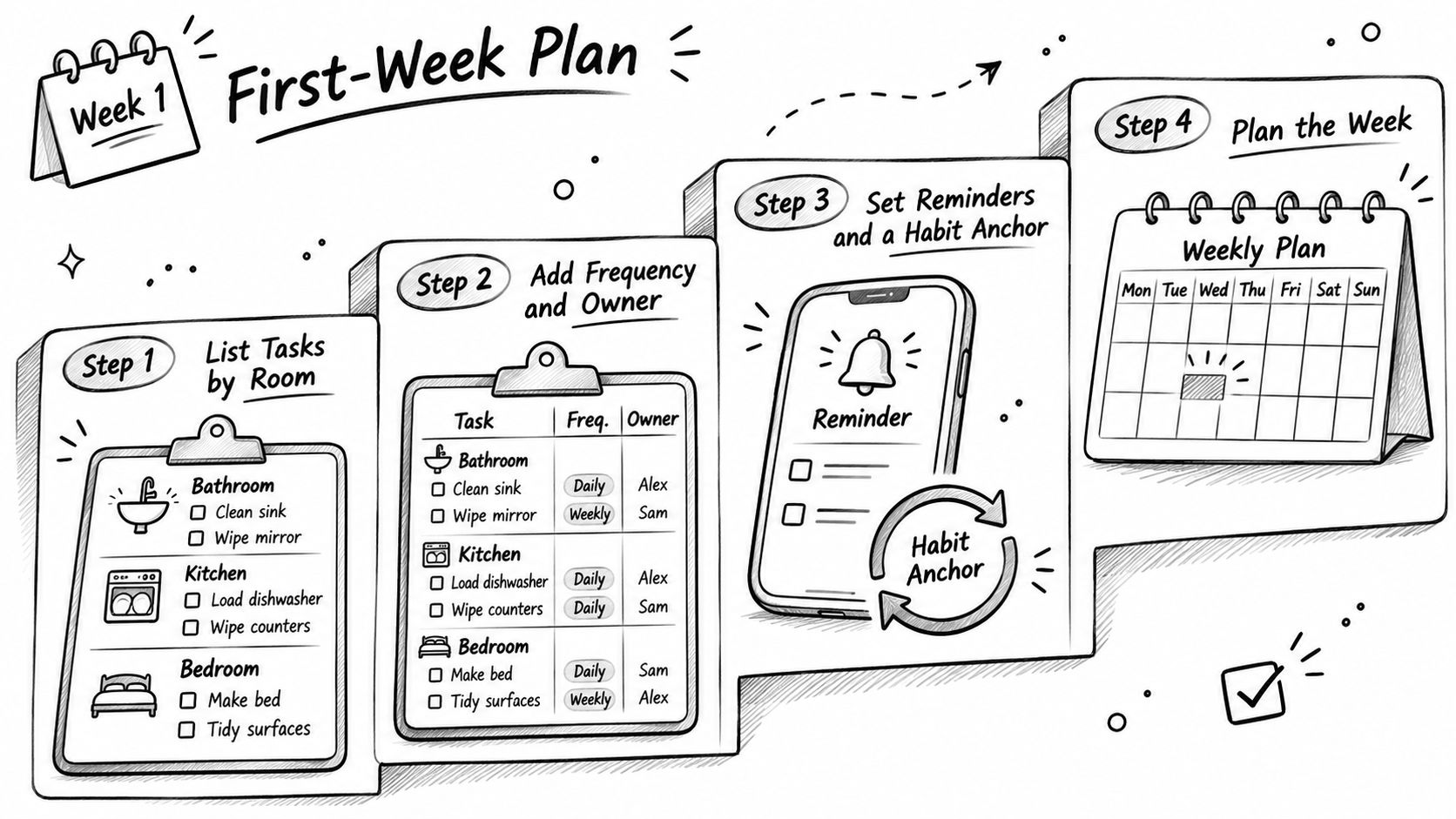
Use this suggested trial plan to get started without redesigning your whole home at once:
- Opening day: List recurring work by room, including supplies and household admin.
- Next session: Give each task a frequency, an owner, and a clear endpoint.
- Before the first workday: Attach tasks to familiar habits and set useful reminders.
- Before the weekend: Reserve a realistic cleaning slot.
- At a household check-in: Resolve disagreements about what done means.
- During the trial: Note skipped tasks and the reasons, without treating the record as a scorecard.
- At the reset: Move impractical slots and remove work nobody needs.
Paper, a whiteboard, or a spreadsheet is enough to begin. If you want a dedicated option, Benny is a free household chore app for iPhone and Android: create a shared home, invite the people you live with, and add preset or custom chores room by room, with timers, reminders, and one-off or recurring schedules included. The shared list works even when members use different phones.
By the end of your trial, check that you have:
- A usable inventory, including work people previously remembered privately.
- Accepted ownership, with agreed outcomes and decision rights.
- Realistic timing, plus a plan for disruption.
- A shared record, accessible without asking the household's usual organizer.
Benny brings room-based chores, shared assignments, timers, and recurring reminders into one household plan. Visit Benny to create your shared home and give everyone a clear place to see what needs doing.