It's Thursday night, the counters are sticky, the bathroom hasn't been touched since last weekend, and the list in your head keeps getting longer. You don't need a spotless house. You need a cleaning schedule template that fits the minutes you have, splits the work so one person isn't carrying it, and still works the week someone gets sick.
A schedule that lasts sets frequency from real time and energy, keeps everyday wiping separate from germ-killing, and treats a fair split as a planning problem rather than a pile of room names.
Table of Contents
- A Starter Cleaning Schedule Template You Can Copy
- How to Build Your Own Template in Five Steps
- Keep Routine Cleaning Separate From Disinfection
- Adjust Frequencies to Your Time and Energy
- Share Chores Fairly Across Everyone in the Home
- Run the Template for Two Weeks Before You Change It
A Starter Cleaning Schedule Template You Can Copy
Copy this grid before you redesign anything. Each row is one job. The minutes are estimates to test in your own kitchen and bathroom, not promises. Daily work lands each evening. The weekly block sits on Saturday morning. Monthly jobs sit on the first Sunday of the month.
| Frequency | Task | Estimated minutes |
|---|---|---|
| Daily | Wipe kitchen counters and table | 5 |
| Daily | Wash or load dishes, same night | 10 |
| Daily | Empty bin when full | 2 |
| Daily total | Three daily tasks | 17 |
| Weekly | Clean toilet, sink and shower | 40 |
| Weekly | Vacuum and mop shared floors | 35 |
| Weekly | Change bed linen, start laundry | 20 |
| Weekly | Wipe microwave and stovetop | 10 |
| Weekly total | Four weekly tasks | 105 |
| Monthly | Clean fridge shelves | 25 |
| Monthly | Clean oven | 30 |
| Monthly | Wipe baseboards and light switches | 20 |
| Monthly total | Three monthly tasks | 75 |
| Quarterly | Windows and inside cabinet doors | 60 |
Read the totals, not the individual lines. Seventeen minutes a day covers the mess that otherwise piles up. The weekly block is 1 hour 45 minutes. Monthly work is 75 minutes. Quarterly windows and cabinet doors are an hour when you get to them. If the shower glass is already etched with mineral spots, deal with that as its own job using a method for hard water stains on glass shower doors, not as part of the Saturday wipe.
A template that asks for four hours a day fails in week two. The U.S. Bureau of Labor Statistics' 2024 American Time Use Survey found that 80.4% of people did household activities on an average day, spending an average of 2.01 hours. That pot already includes cooking, laundry, and tidying, so cleaning has to take a slice of it, not the whole afternoon every day. The same survey splits interior cleaning, laundry, and kitchen and food cleanup into separate activities. Your rows should do the same.
Practical rule: If the weekly block fits in one afternoon, and every daily task has a fixed moment, the template is usable. If it doesn't, cut tasks before you add any.
How to Build Your Own Template in Five Steps
The starter grid is a floor, not your house. Build the sheet you will open, then stop adding rows once you have run it.
List what you really clean
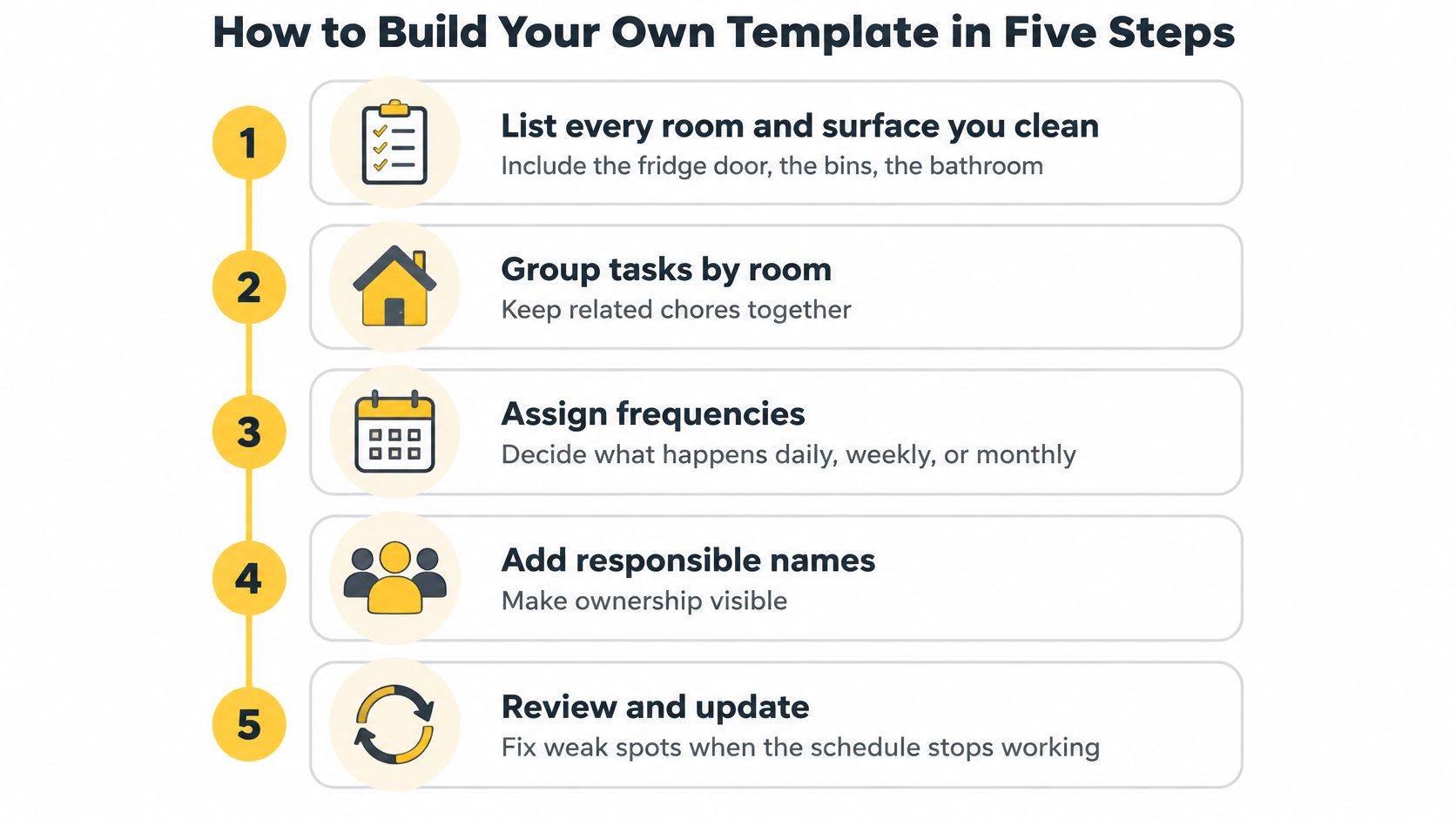
1. Write every room and surface, including the forgotten ones. Fridge door, bin lids, the bathroom extractor fan, and the skirting by the front door all count. A template only tracks what you list. The common slip is a pretty room list that never names the surfaces that get dirty.
2. Sort each item as high-touch, visibly soiled, or low-risk. Use decides frequency, not the room name. Door handles and the kettle get more traffic than the top of a wardrobe. The slip here is giving the bathroom a weekly slot and the front-door handle a monthly one.
Set the cadence and the product
3. Assign frequency from how often the surface is used and who lives there. A home with a toddler, or with someone recovering from illness, moves high-touch items up a tier. A spare room that nobody enters can stay monthly. Don't copy a blog's "every Sunday" if your busiest day is Sunday.
4. Record the product and check it suits the surface. Stone, sealed wood, and glass don't take the same chemistry. Write the dilution on the row if the bottle isn't ready to use. The expensive mistake is a spray the maker says to keep off natural stone, used because it was already under the sink.
5. Add a last-done date, an owner, and a notes column for missed days. Leaving blanks is how a skipped week turns into a silent backlog. Notes should say "ill, moved to Wednesday," not a guilty blank.
Your finished columns are task, room, frequency, minutes, owner, product, last done, and notes. Minutes stay honest only if you time two runs. I would start with the cheapest fix, a kitchen timer on the phone, before buying any new cleaner.
Keep Routine Cleaning Separate From Disinfection
Routine cleaning lifts soil. Disinfection is meant to kill germs, and it only works on a surface you have already cleaned. Soil left behind gets in the way of the product. Clean first. Disinfect second. Don't put both jobs on the same row with the same minute count.
The CDC guidance on cleaning and disinfecting at home recommends regularly cleaning high-touch surfaces such as doorknobs, light switches, counters, faucets, and electronics. Other surfaces can generally be cleaned when they look dirty or as needed. Raise that pace when young children, immunocompromised people, or illness are in the home.
| Surface | Routine cleaning | Disinfect when | Wet contact time |
|---|---|---|---|
| Doorknobs and light switches | Daily | When someone in the home is ill | From product label |
| Kitchen counters and faucets | Daily | After raw meat or egg spills, and when ill | From product label |
| Electronics and remotes | Weekly | Only when visibly soiled or ill | Use a wipe rated for electronics |
| Toilet, sink and shower | Weekly | Weekly, and daily when ill | From product label |
| Floors | Weekly | Only when visibly soiled | From the label, and only if that product is made for floors |
The wipe that undoes the product
The failure I see most often is a scheduled wipe-and-immediately-dry. CDC training materials warn against wiping or blowing a surface dry before contact time is finished. That habit can cancel the effect the label claims. Each disinfection row needs the wet contact time printed on that bottle, not a number you remember from a different brand.
On those rows, add four fields and nothing more: start time, required wet time, completion time, and a verified checkbox. The person doing the job writes the start, leaves the surface visibly wet for the full period, then ticks verified. If the label says the surface must stay wet for several minutes, a 30-second swipe is not that task. For electronics, skip a dripping spray. Use a wipe the maker rates for screens and remotes, and don't flood the seams.
If nobody in the home is ill and the surface isn't a food-spill zone, routine cleaning is the job. Disinfection is the exception, not the daily default.
Adjust Frequencies to Your Time and Energy
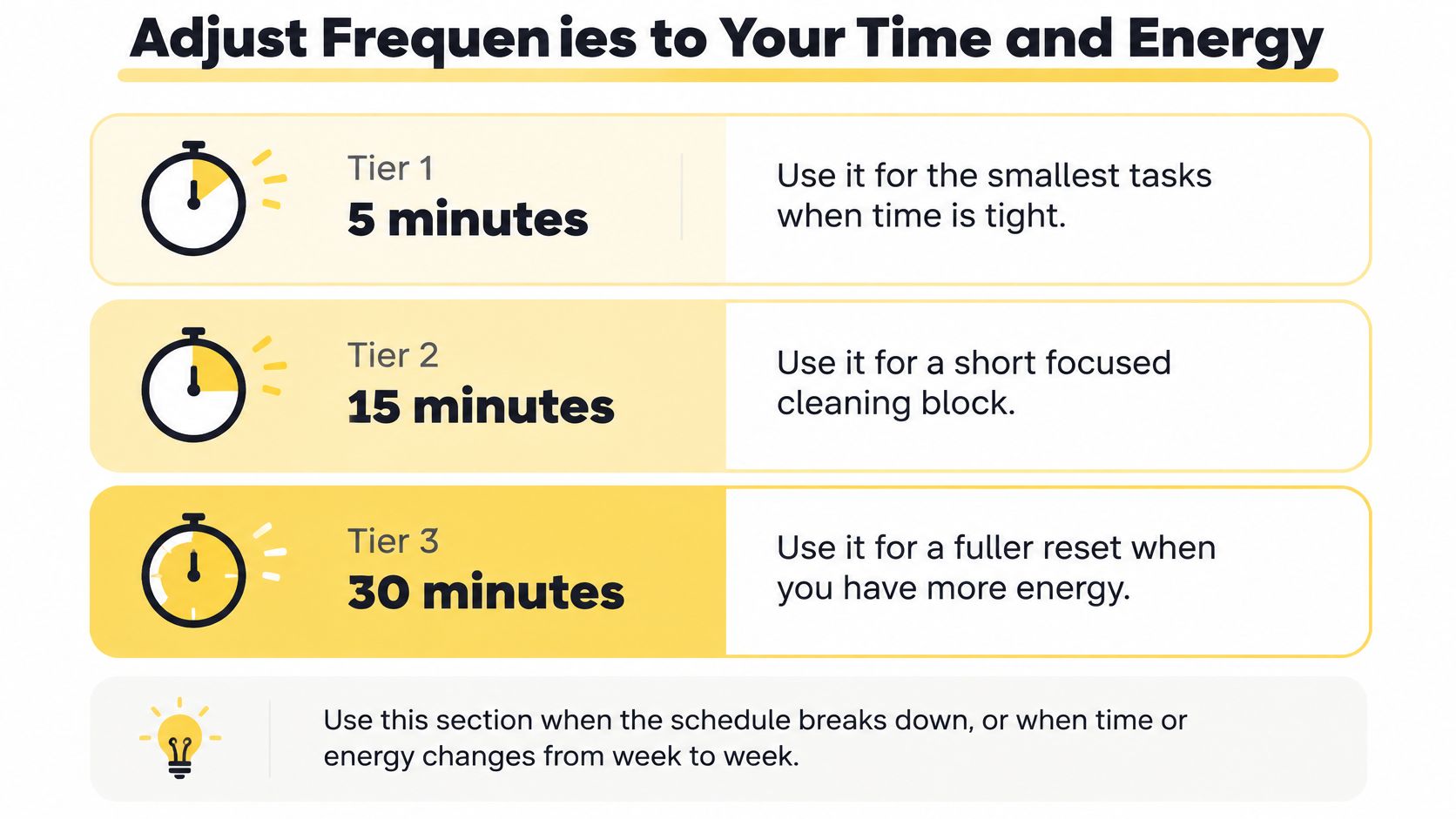
A fixed Saturday fails the week you work late, care for someone, or run out of energy by Thursday. Keep three block sizes ready, 5, 15, and 30 minutes, and do the protective jobs first so a short day doesn't become a whole-house rescue later.
| Time available | Do first | Defer to next slot |
|---|---|---|
| 5 minutes | Wipe kitchen counters, empty bin, clear sink | Floors, bathroom, dusting, fridge |
| 15 minutes | Everything in the 5-minute tier, plus wipe toilet seat, sink and high-touch surfaces | Mopping, oven, baseboards |
| 30 minutes | Everything in the 15-minute tier, plus vacuum main floor and clean shower | Windows, cabinets, monthly tasks |
What stays, what waits
Split the work into essential, protective, and deferrable. Essential is food mess and a full bin, the jobs that attract smells and pests within a day. Protective is high-touch points and the toilet seat. Deferrable is baseboards, the oven interior, and inside cabinets, where a skipped week costs you nothing visible. A missed week should leave you with one 30-minute catch-up, not a Saturday marathon.
Capacity isn't a character flaw. A UN Women brief on Bangladesh's household production account found women there spend 7.3 times as much time as men on unpaid domestic and care work, with cleaning alone accounting for 237 hours a year for women. A template that assumes a steady week, like "clean the whole room weekly" with no fallback, will break in the exact households that need it most.
Timers keep the tiers honest. In Benny, every chore carries its own timer, so a 15-minute bathroom clean stays a 15-minute bathroom clean instead of slowly expanding into the rest of the evening.
When bending or standing is the limit, change the method rather than lowering the standard:
- Seated or low-bending work: Use a long-handled tool for floors and shower walls so the job doesn't require kneeling.
- Batching: Group every wipe that uses the same cloth into one pass instead of walking room to room.
- Hand-off: Give the heaviest job, often the vacuum or the oven, to someone else that week.
Park deferred rows in a single 30-minute slot the following week. Don't paste them all onto Saturday on top of the normal block. If illness or a holiday wipes out several days, the 5-minute tier is the minimum that still protects the kitchen and the bin. For a longer gap, Benny Premium's holiday and sick mode pauses the schedule for a set period without losing streaks, tokens or XP, so a bad week doesn't reset the whole plan.
Share Chores Fairly Across Everyone in the Home
A list of room names can look even and still dump the work on one person. OECD time-use analysis finds adults spend about 8% of their available time, roughly 116 minutes a day, on unpaid household services such as cleaning and cooking. Women average 158 minutes a day on non-care housework, against 72 minutes for men. That gap is 86 minutes a day, roughly 10 hours a week. Unpaid household services are generally left out of GDP and poorly measured, so the extra load stays invisible at the kitchen table too.
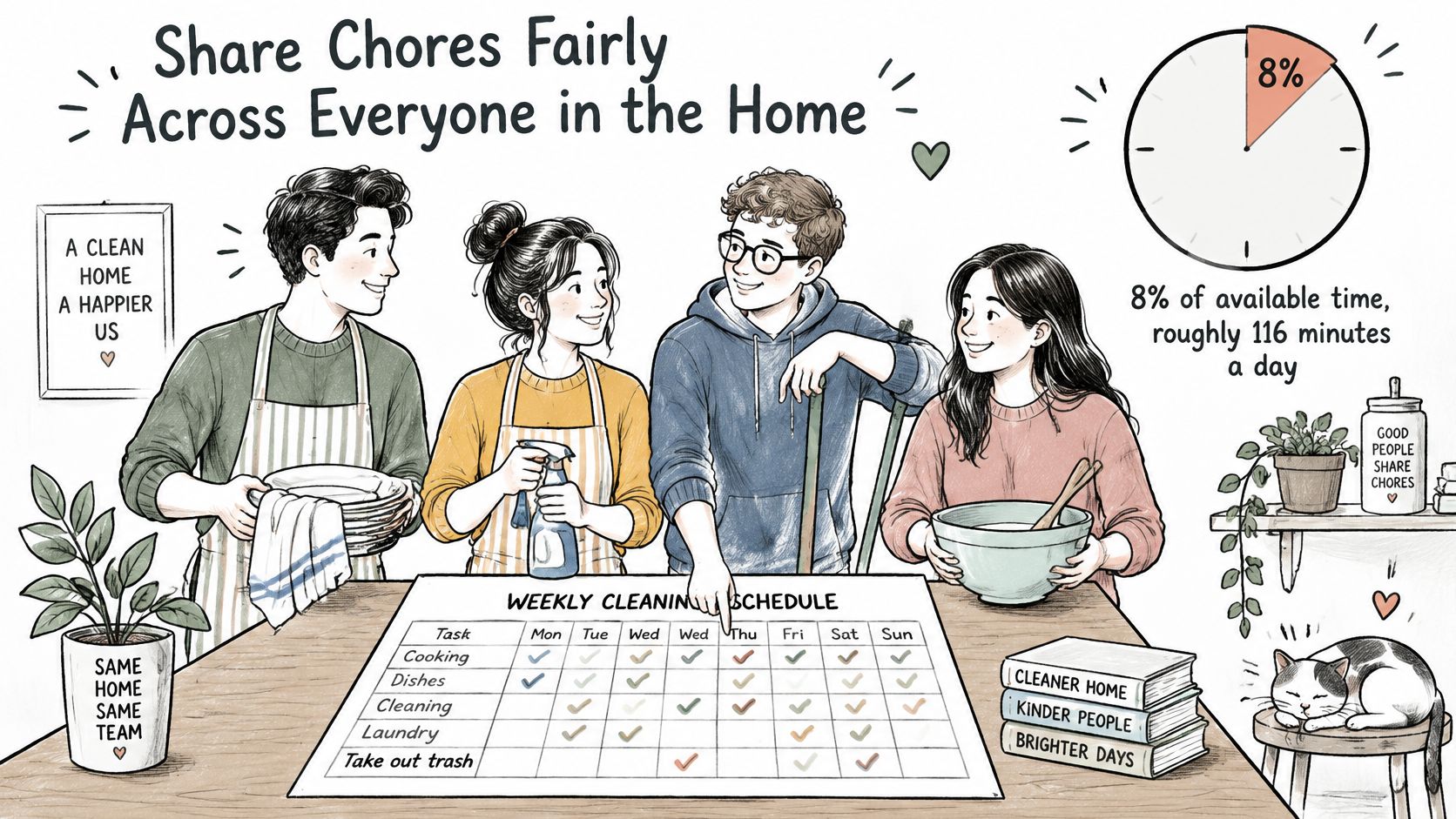
Counting tasks hides the difference. "Bathroom" and "take out the bin" are both one row. They are not the same effort, the same unpleasantness, or the same mental load.
- Name the management work. Noticing what needs doing, restocking soap, booking a repair, and keeping the list current are chores. Give them an owner.
- Weight by effort, not by count. A shower clean is not equal to emptying one bin. Put a heavier point value on the longer, messier jobs.
- Rotate the heavy jobs every four weeks. The same person shouldn't own the oven and the bathroom for a whole season.
- Review actual minutes once a month. Adjust the template from the log, not from who complained loudest.
In a shared home, every member should see the same chore list and schedule, including who each chore is assigned to and what is done. Add chores room by room and assign each one to a named person. A written owner beats a memory of who "usually" does it. Roommates hit the same trap, and a clear method for splitting chores with roommates keeps the first month from turning into a standoff.
If the split still feels unfair after two months of logged minutes, change the weights, not the argument.
Run the Template for Two Weeks Before You Change It
Run the sheet exactly as written for two weeks. Log which tasks slipped and which nobody did. Two weeks shows the weekly pattern. A check at four weeks catches anything that only shows up once a month. Changing rows on day three just hides the pattern.
In that review, make three moves:
- Move any task missed twice to a new day or a longer slot.
- Drop any task nobody does. Guilt is a bad reason to keep a row.
- Promote any surface that caused a real problem, a smell, a spill, a complaint, into a higher tier.
Pick a format you will open. A paper sheet on the fridge works. So does a shared app. Benny's chore schedule shows what is due today and what is coming up next, and it sends a reminder when a chore is due, so you aren't rebuilding the week from scratch. You can keep that chore schedule next to the same list everyone else sees.
Save the template with today's date. Put the first review on the calendar for 14 days out, and the second for day 28. If you skip the calendar hold, the review becomes another chore nobody owns.
Benny turns this cleaning schedule template into a shared list you can run by room, with recurring chores, timers, and reminders so the plan doesn't live in one person's head. Everyone in the home can see who a chore belongs to and what's still waiting. Set yours up in Benny and put the first two-week review on the calendar today.