A pan soaks in the sink, the stovetop wears a film from last night's stir fry, and you can't remember the last time the fridge handle got wiped. You have a plan. It lives in your head, and it loses to the evening every time.
The problem usually isn't effort. It's that most kitchen plans are lists of surfaces with a frequency stapled on, and frequency alone doesn't decide what needs doing tonight. Raw chicken on a Tuesday changes the job. A week of toast crumbs doesn't.
A short daily core, one weekly block, a monthly rotation, and a set of event tasks that override all of it. That gap is what a cleaning schedule in kitchen practice has to close, and it also keeps two decisions apart that most lists blend into one: cleaning and sanitizing.
Table of Contents
- Daily, Weekly and Monthly Kitchen Tasks at a Glance
- Event Triggers That Override the Calendar
- Keeping Sponges, Cloths and Hidden Surfaces on Track
- Catch-Up Rules for Busy Weeks and Shared Kitchens
- Build and Start Your Kitchen Cleaning Schedule
Daily, Weekly and Monthly Kitchen Tasks at a Glance
Sunday, nine at night. A pan soaking, a sticky ring on the hob, a fridge handle with a week of fingerprints on it. Nothing here needs a deep clean. It needs the right jobs at the right intervals.
Here's the whole plan sorted by frequency, with a time and a reason attached to every row.
| Task | Frequency | Time | Why it matters |
|---|---|---|---|
| Wipe counters and sink after cooking | Daily | 5 min | High-contact surfaces collect raw food residue |
| Clean stovetop and hob | Daily | 5 min | Grease and spills harden if left |
| Wipe fridge handles and cabinet pulls | Daily | 2 min | Hands touch them constantly |
| Replace or launder dishcloths | Every 2 to 3 days | 3 min | Reusable cloths carry bacteria |
| Sweep and mop the floor | Weekly | 15 min | Crumbs and spills attract pests |
| Clean microwave interior | Weekly | 10 min | Splatter builds up and smells |
| Empty and wipe bins | Weekly | 10 min | Odours and leaks start here |
| Wash sponge holder | Weekly | 3 min | Wet holders grow mould |
| Clean inside the fridge | Monthly | 20 min | Spills and expired food hide at the back |
| Clean the oven | Monthly | 45 to 60 min | Baked-on grease smokes and burns |
| Wipe cabinet fronts and backsplash | Monthly | 15 min | Grease film collects near the cooktop |
| Clean range hood and dishwasher filters | Monthly | 15 min | Clogged filters reduce airflow and rinse quality |
The 12-Minute Daily Core
Add the daily rows and you land on 12 minutes: five for counters and sink, five for the stovetop, two for handles and pulls. That's short enough to finish when you're tired, which is the only test that matters for a daily task.
The countertop wipe carries the most weight, because that's where raw food residue, packaging drips and hand contact all land. A survey of 150 U.S. households found that 72% reported cleaning countertops at least daily (Food Protection Trends study of household kitchen hygiene), so daily cleaning is already the norm rather than an aspiration. The same study found that people who described their cleaning as regular generally had kitchens with lower microbial contamination than people who cleaned only when a surface looked dirty.
Frequency wasn't the whole story. Some participants who cleaned very often still had substantial bacterial populations on tested surfaces, which is why each row in the table needs a method attached rather than just a tick. Put the daily rows on a recurring chore schedule and they show up whether or not you remember them.
The Weekly Block and the Monthly Rotation
Weekly work adds up to roughly 38 minutes: 15 to sweep and mop, 10 for the microwave interior, 10 for bins, 3 for the sponge holder. Give it one fixed slot, Saturday morning or Wednesday evening, and the rest of the week stays light.
The monthly rotation is heavier at 95 to 110 minutes, and the oven is the row most households drop. In 2024, 61% of respondents in a Whirlpool-commissioned survey said they cleaned their stove or oven two or fewer times per month (StudyFinds report on the Whirlpool survey), which is how baked-on grease turns into a smoke alarm problem instead of a cleaning task. Give the oven an hour on the first Sunday of the month and it never gets away from you.
By Friday the check is short: counters dry, sink clear, and the room smells neutral when you walk in.
Event Triggers That Override the Calendar
A calendar can tell you the counters are due Thursday. It can't tell you that you jointed a chicken on Tuesday night and that the board, the knife and the faucet handle all need attention now. Routine cleaning handles the average day. Triggers handle the days that make people ill.
The order matters as much as the cleaning itself. Wash your hands before prep. After each raw item, wash the board, utensils, dishes and counters in hot soapy water. Apply a sanitizer where the label calls for one and respect the stated contact time, because a product sprayed on and wiped off five seconds later has done very little. Keep raw meat equipment away from anything touching ready-to-eat food.
Washing and sanitizing do different jobs. Cleaning removes soil, sanitizing reduces what's left on the surface. A board that looks clean after a hot rinse can still carry pathogens, and a sanitizer applied to a dirty surface can be wasted effort. Moving from the raw-meat zone straight into salad prep spreads the problem across the whole counter.
The gap between what people believe they do and what happens in the kitchen is measurable. In a 2023 USDA observational study, 87% of participants said they washed their hands before cooking, yet 34% contaminated the kitchen sink during meal preparation, making it the most frequently contaminated surface observed, and 26% contaminated a cantaloupe while cutting it (USDA study on consumer kitchen behavior). USDA also reported that only 32% cleaned and sanitized the surface used to prepare raw meat.
| Trigger | What to do | When |
|---|---|---|
| Raw poultry, meat, seafood or eggs | Wash hot and soapy, then sanitize board, utensils and counter | Right after prep, before any ready-to-eat food |
| Produce cut on the counter | Wash and sanitize board and counter | Before moving to salads or fruit |
| Allergen food prepared | Clean every food-contact surface thoroughly | Before the next meal for someone with that allergy |
| Raw juice spill | Clean and sanitize the spot | Immediately |
| Household member ill with a stomach bug | Sanitize sink, handles and counters | Same day, then daily until symptoms clear |
Three principles come out of that. Clean high-contact areas daily, because sinks and counters collect contamination faster than anything else in the room. Clean straight after raw meat, rather than parking it until the weekly reset. And treat cleaning and sanitizing as separate decisions, because wiping away visible residue doesn't finish the food-safety job.
Hard rule: a trigger task is never deferred. If raw poultry hits the board, the cleanup happens before anything else is prepped, even if the counters were wiped an hour ago.
Keeping Sponges, Cloths and Hidden Surfaces on Track
Most schedules list counters and floors. Almost none say what to do with the sponge, the tea towel and the fridge door seal, which is where cross-contamination occurs.
The UK Food Standards Agency's Kitchen Life 2 research examined when and how often cloths, tea towels and sponges were washed, and noted that these behaviours were frequently outside the camera's field of view (Kitchen Life 2 technical report). If cameras in the kitchen can't reliably capture it, a checklist on the fridge won't either.
Hidden touchpoints show up in the data as well. In USDA observational sessions, contamination reached spice containers in 48% of sessions and refrigerator handles in 11% (FSIS guidance on preventing cross-contamination). Both are items people rarely think to wipe.
The rotation that works is simple and cheap. Keep two dishcloths per person in use, one for surfaces and one for hands, and bag the used ones for a hot wash every two to three days or straight after raw meat. Replace sponges every one to two weeks, or immediately if they've handled raw juices. A sponge that smells is well past due, and a sponge that doesn't smell can still be loaded, so smell is a backup signal rather than the rule.
A cloth that wipes the cutting board and then the counter has moved bacteria around rather than removed them.
Work the hidden surfaces into the weekly block: run a dedicated cloth around the fridge door seal, the dishwasher door edge where water pools, and the lids of jars you handle with sticky hands.
| Item | Replace or launder | Trigger |
|---|---|---|
| Kitchen sponge | Replace | Every 1 to 2 weeks, or after raw meat use |
| Dishcloth | Launder hot | Every 2 to 3 days, or after raw meat use |
| Tea towel | Launder hot | Daily when used for hands or drying raw food |
| Scrub brush | Dry fully and sanitize | Weekly |
| Sponge holder | Wash | Weekly |
Catch-Up Rules for Busy Weeks and Shared Kitchens
A schedule that collapses in the first hard week was never a schedule. Set the exception rules before you need them.
Risk, not tidiness, sets the frequency. FDA guidance is explicit that food-contact surfaces must be cleaned as often as necessary to prevent contamination and allergen cross-contact (FDA food safety guidance), which is a different instruction from "once a week". The gap between intent and practice is wide: in a household kitchen study cited in that guidance, 96.2% of respondents said food safety was very important, yet only about half used separate chopping boards for vegetables and meat. People care. The schedule has to carry the care.
Here are the rules worth writing down:
- Busy week: keep the daily core of counters, sink, handles and cloths. Move cosmetic weekly work to the next free slot, no later than a week past its due date.
- Children or pets in the house: add a daily floor pass and a bin check, and put a name against each one. Shared jobs without an owner drift until nobody remembers agreeing to them.
- Shared kitchen: one person owns the weekly block for a month, then hands it on. Rotating ownership beats voluntary enthusiasm, which lasts about two weeks. How you split chores with roommates matters more than how long the list is.
- Allergies in the house: keep dedicated cloths and boards for allergen-free prep, and clean every food-contact surface before cooking for the allergic person, not after.
- Illness with a stomach bug: sanitize sink, handles and counters the day symptoms appear, then daily until they clear.
Catch-up rule: a skipped weekly task rolls forward once. A skipped trigger task gets done now.
Once a month, spend ten minutes with the list and be honest about it. Remove the two tasks nobody has done since you wrote them, and add the ones you keep doing off-schedule. That review is the difference between a plan and a wish.
Build and Start Your Kitchen Cleaning Schedule
Setting this up is a one-time job of about half an hour, and it's a smaller task than expected. The three moves below are the whole build.
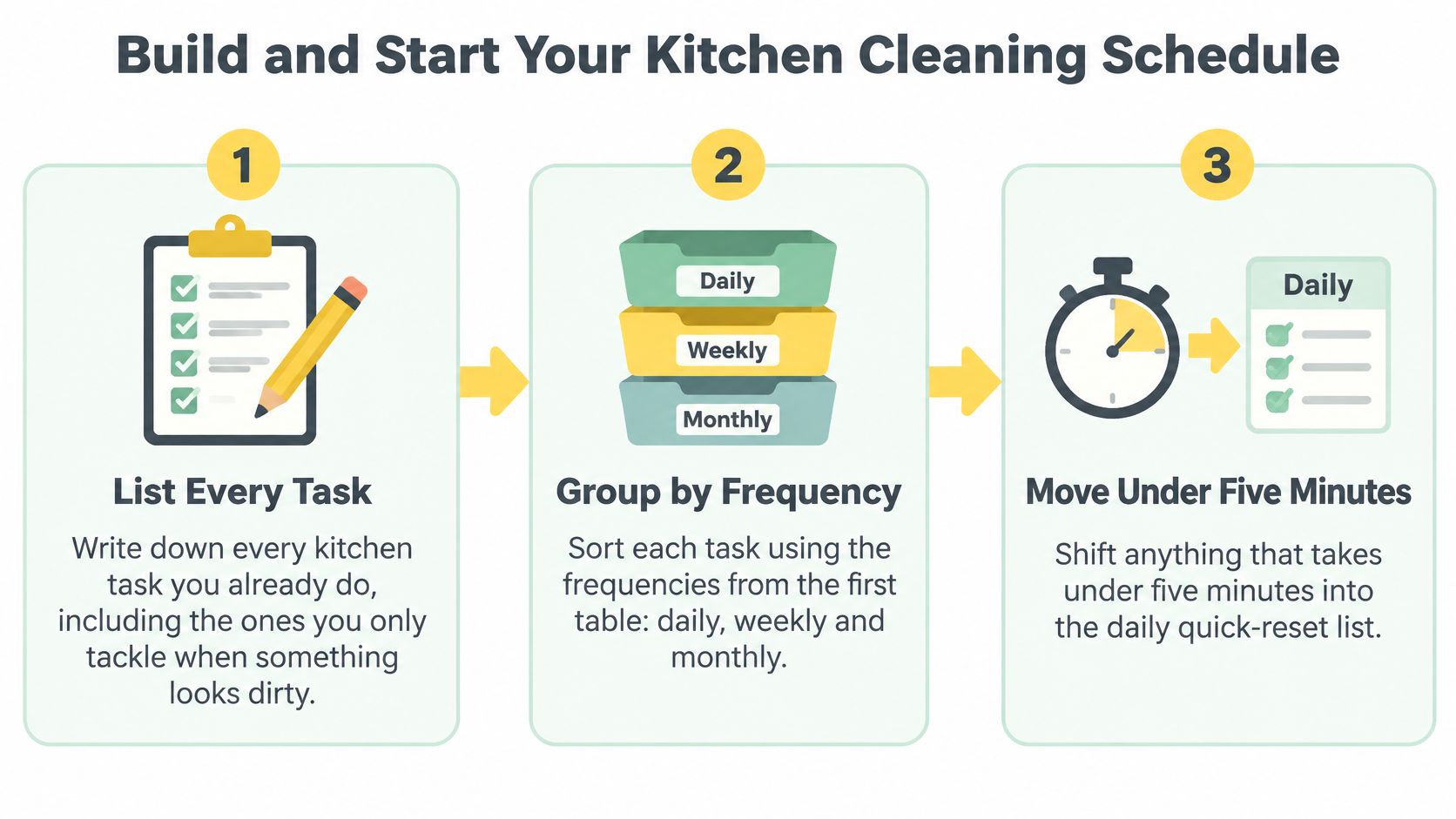
- Write down what you already do. Include the jobs you only tackle when something looks dirty, because those are the ones that need a trigger rather than a date. A list of what's happening is the only honest starting point.
- Sort every task into daily, weekly or monthly. Use the first table as the filter. Anything that takes under five minutes belongs in the daily group, and jobs that need heat, drying time or equipment go monthly.
- Estimate minutes and cap the daily total. Fifteen minutes is a sensible ceiling for most homes. A daily list that runs to 40 minutes gets abandoned by the second week, and an abandoned list is worse than a short one because it resets your expectations every Monday.
- Assign every task to one person and one room. Add the kitchen as a room, add chores room by room and put a name against each one so the list shows who owns what, using shared chore lists for the whole household. Two people "doing the kitchen" means neither of them wipes the handle.
- Set one reminder per daily task and one fixed weekly slot. Saturday morning suits most households; if your Saturdays are gone, take Wednesday evening. Put the oven and the fridge on the first Sunday of the month and stop renegotiating with them. The schedule should show what's due today and what's coming up, not a wall of everything.
- Define done for each task. Counters are done when they're wiped, sanitized where needed, and dry. The oven is done when the racks are back in and the door is shut. If the finish line is vague, the job gets redone or never finished at all.
- Start with three daily tasks and one weekly slot. Not the monthly list, not the full plan. Three tasks finish most days, and finishing is what builds a routine.
The Two-Week Check
Run the routine for two weeks, then audit four things. Do the daily tasks finish on most days? Does the weekly slot complete without a rush at the end? Are the monthly jobs scheduled rather than rediscovered? And are the trigger tasks happening when raw meat hits the board?
Then move or remove whatever you keep skipping. The plan serves the kitchen, not the other way round.
Two Slips That Kill a Kitchen Plan
The first is putting the oven on the weekly list. It gets skipped once, twice, then it drops off entirely, and the row you needed most disappears. Monthly work belongs on a monthly slot with an hour on the clock.
The second is a 40-item daily list. Nobody finishes it, so everybody stops reading it. A healthy routine shows completed daily tasks and a weekly block that rarely runs past 40 minutes.
Benny's room presets shorten the setup: add the kitchen, pick the preset chores for counters, sink and floor, set a timer on each, and reminders arrive when chores are due. A cleaning schedule in kitchen use is a small system, and it should look like one.
Watching a quick reset in real time is often faster than reading about it.
A kitchen schedule works when it's short enough to finish and tied to the events that make the kitchen unsafe.
Benny organizes kitchen cleaning by room, gives every chore a timer, and reminds you when each one is due, so the daily core and the weekly block run without a list taped to the fridge. Room presets and recurring chores mean you set the plan up once, and everyone in a shared home sees the same schedule and who owns what. Start with three tasks tonight and build the rest from there by visiting Benny.