It's Thursday night. The laundry basket has been sitting on the bedroom chair since Sunday, the sink holds two days of dishes, and the bathroom mirror has reached the stage where you notice the toothpaste flecks only when someone's coming over.
That isn't a discipline problem. It's a scheduling problem, and most apartment advice answers the wrong question. It tells you how often to clean the bathroom, but not where those 25 minutes come from in a week that's already full, or who owns the job when two people split the lease. A cleaning schedule apartment dwellers can reliably keep does three things at once: it matches tasks to the free time you really have, it sequences them so you aren't breathing product fumes all evening, and it makes completion visible so nobody keeps score from memory.
Table of Contents
- Room-by-Room Cleaning Frequency at a Glance
- How to Build Your Schedule in Five Steps
- A Sample Week for a One-Bedroom Apartment
- Quarterly and Seasonal Deep Cleans
- When to Disinfect and How to Ventilate
- Splitting Shared Apartment Chores Fairly
- Set Up Your Schedule Before Next Week
Room-by-Room Cleaning Frequency at a Glance
Start with the grid. The time labels matter more than the task names, because a job that doesn't fit the slot you've got is a job that won't happen.
| Room | Daily (5-10 min) | Weekly (30-60 min) | Monthly (1-2 hours) |
|---|---|---|---|
| Kitchen | Wipe counters, load dishes, sweep crumbs | Clean stovetop and microwave, mop floor, wipe fridge shelves | Deep clean fridge, wipe cabinet fronts, check under appliances |
| Bathroom | Hang up towels, squeegee shower glass | Clean toilet, sink, mirror and tub, mop floor | Scrub grout, wash shower curtain and bath mats, clean exhaust fan cover |
| Bedroom | Make the bed, clear floor clutter | Dust surfaces, change sheets, vacuum | Rotate mattress, wash pillows, wipe baseboards |
| Living areas | Fluff cushions, quick tidy | Vacuum or sweep, dust electronics, wipe high-touch surfaces | Wipe light switches and door frames, clean window sills, spot-clean upholstery |
The daily row is a reset, not a clean. Nothing there removes embedded dirt; it stops dirt from setting. Ten minutes in the kitchen after dinner and five in the bathroom with a squeegee are what keep the weekly hour from becoming a two-hour scrub.
The weekly row is load-bearing. The stovetop, the toilet and tub, the floors, the sheets. These are the tasks that degrade fast and visibly. Miss one week and the monthly list absorbs the backlog, which is how people end up spending a whole Saturday on a one-bedroom.
The monthly row is what nobody remembers. Fridge shelves, grout, light switches, baseboards, bath mats, the exhaust fan cover. Put them in a single block on the first Sunday of the month rather than scattering them.
Seasonal Jobs Belong Off the Weekly Grid
Window tracks, the oven interior, ceiling fans, cabinet interiors. These aren't weekly work and pretending otherwise is why so many plans collapse in week two. Seasonal resets are mainstream behavior: the American Cleaning Institute's 2024 National Cleaning Survey, conducted by Wakefield Research, found that 80% of U.S. adults reported spring cleaning at least once a year, while 6% said they never spring clean.
The 15-minute test. If a task can't be finished in 15 minutes or less, it doesn't belong in the daily reset. Move it to a weekly or monthly block and give it a real slot.
How to Build Your Schedule in Five Steps
The grid tells you what needs doing. It doesn't tell you where the minutes come from. These five steps turn it into something your week can absorb.
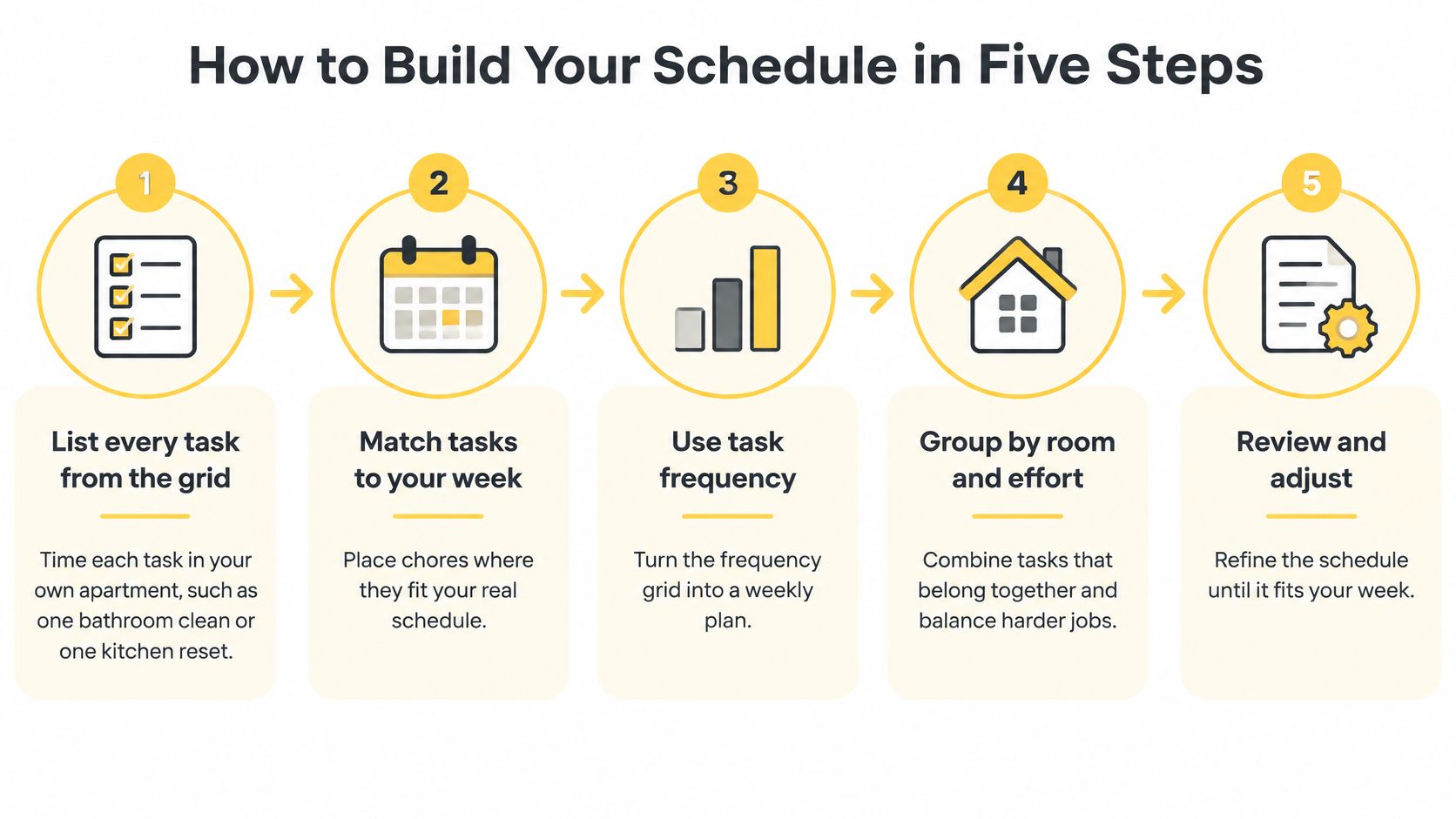
- Time each task in your own apartment. One bathroom clean in a flat with a single sink and no tub is a different job from one with a separate shower and bath. Run a stopwatch the first time instead of guessing.
- Sort into daily, weekly and monthly, then move anything over 30 minutes to a weekend block. A long task squeezed into a weeknight gets skipped, and skipping is contagious.
- Count the free time you have. Not the hours you hope for. Look at last week's calendar and find the evenings that end before 9pm.
- Assign each block to a named day. Bathroom on Tuesday, floors on Saturday, fridge on the first Sunday. A block without a day is an intention.
- Set reminders and review after two weeks. The task that keeps slipping gets a different slot, not more willpower.
The split between light and heavy work is where most plans break. The American Cleaning Institute's 2018 National Cleaning Survey of 1,000 U.S. adults found that 74% most frequently performed "light cleaning", general surface-level work, while 26% most frequently performed deep cleaning of floors, furniture and surfaces. In the same survey, 28% spent more than seven hours a week on cleaning, 26% spent three to four hours, and 10% spent under an hour. Decide which bracket you're in before you build the plan.
| Available time | Daily work | Weekly block | Monthly block |
|---|---|---|---|
| 10 minutes a day | Kitchen reset only | Bathroom and floors split over two evenings | Move one monthly task into each week |
| 20 minutes a day | Kitchen and bathroom resets | Bathroom on Tuesday, floors on Saturday | One 1-hour block on the first Sunday |
| 45 minutes on weekdays, weekends free | Light tidy each evening | Two 20-minute weeknight blocks, bathroom and floors first | One 1-hour block on the first Sunday |
| Busy weeks, under 15 minutes | Make the bed and clear counters only | Bathroom and kitchen only | Skip and move to the next open weekend |
A short daily habit is entirely ordinary. The U.S. Bureau of Labor Statistics' American Time Use Survey recorded that 23.4% of people in the United States did interior cleaning on an average day in 2025, so ten minutes after dinner puts you inside the normal range rather than at the obsessive end of it.
Practical rule: a weekly block that needs more than 30 minutes is really two blocks. Split it across two evenings before you conclude you're bad at this.
Once the pattern holds for a fortnight, move the recurring blocks into a chore schedule that repeats them automatically, so the plan survives a week when you don't think about it at all.
A Sample Week for a One-Bedroom Apartment
Picture a one-bedroom with a galley kitchen, a single bathroom and a living room, shared by two adults who both work weekdays. The weekday load stays deliberately light because tired evenings kill plans faster than busy weekends do.
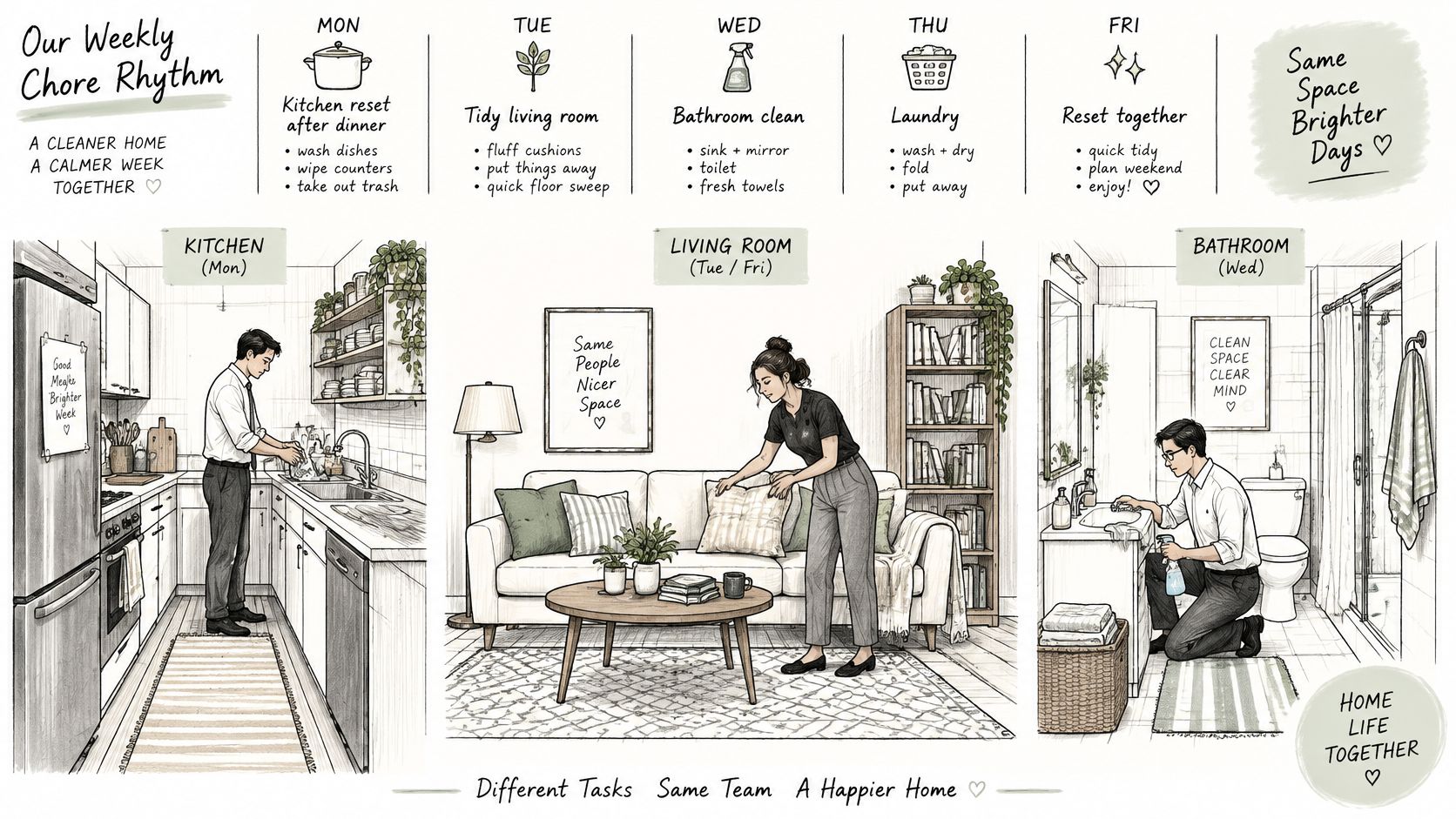
Monday is the kitchen reset after dinner: counters wiped, dishes loaded, crumbs swept. Ten minutes, no negotiation. Tuesday is a bathroom touch, squeegee the glass and wipe the sink, because the shower is the first thing in the flat to look neglected. Wednesday takes the bedroom: bed made, floor cleared, nightstands dusted.
Thursday handles the stovetop and microwave, then one quick vacuum pass through the living room. Friday is a 15-minute bathroom check, toilet and mirror only. Saturday carries the bulk of the work, an hour to vacuum, dust and mop every floor, plus changing the sheets. Sunday is 30 minutes of laundry, and on the first Sunday of the month you add the monthly task, such as wiping the fridge shelves.
The rhythm isn't unusual. A 2020 YouGov survey of 7,050 U.S. adults found that 24% cleaned daily, 27% cleaned a few times a week and 21% about once a week. That middle band, several times a week, is exactly where this plan sits.
Here's where it breaks. Thursday gets missed. The instinct is to double up on Friday, and a doubled slot is the first thing people abandon, because it turns a 15-minute evening into 40. Move the stovetop to Sunday instead. Nothing piles up, and Friday stays short enough to happen.
If a week leaves you one free evening, do the bathroom and nothing else. A schedule that survives bad weeks beats a thorough one that dies in week three.
Quarterly and Seasonal Deep Cleans
Some jobs sit outside every row in the grid: window tracks, the oven interior, ceiling fans, cabinet interiors. Cramming them into a weekly block is what makes the whole plan feel impossible, so give each one a month and a slot.
- March, spring: window tracks and screens. Dry-brush the grit out first, then wipe with a damp cloth, because wetting dust just makes mud you have to dig out of the corners.
- June, summer: ceiling fans and the tops of wall cabinets. Dust before the heat arrives, not while a fan is blowing it back into the room.
- September, autumn: oven interior and the range hood filter, on a day with a free two-hour window and no one expecting dinner.
- December, winter: cabinet interiors and drawers, emptied and wiped while the kitchen is quiet.
Put each one on the first open Sunday of its month and record it in the same shared list as the weekly tasks. A seasonal job kept in a separate document is a seasonal job forgotten by the second week of the month.
If a seasonal task gets missed, move it to the next month rather than pushing it into the current week's blocks. The weekly structure is the thing worth protecting; a skipped deep clean costs you a clean oven, a broken weekly rhythm costs you the schedule.
Ventilate the kitchen while you clean the oven, and keep children and anyone with asthma out of the room until the air clears. If your shower glass has gone cloudy from months of hard water, that's a separate job from soap scum and needs a different approach, covered in this guide to removing hard water stains from glass shower doors.
Keep the frame simple: one seasonal task per month, on a date, in the same list as everything else.
When to Disinfect and How to Ventilate
Daily disinfecting sounds like the thorough option. It usually isn't. Routine cleaning with soap or detergent and water removes the dirt and oils that disinfectants can't cut through, and the CDC guidance on cleaning and disinfecting your home reserves disinfection for the situations that call for it: someone is sick, recently ill, or medically vulnerable. The rest of the time, detergent and water is the correct tool.
What the Label Actually Requires
An EPA-registered disinfectant works only at its stated concentration, with its stated application method, for its stated contact time. The surface has to stay visibly wet for the whole dwell period. Wiping immediately after spraying, which is a common habit, cuts the effect.
If you use bleach and the label gives no dilution instructions, CDC guidance specifies 5 tablespoons (one-third cup) per gallon of room-temperature water, or 4 teaspoons per quart, with at least 1 minute of wet contact time. Mix it fresh each day, never combine it with other cleaners, and open a window.
Cleaning Products Change the Air
A 2025 residential monitoring study found that full-scale cleaning increased levels of numerous volatile and semivolatile organic compounds, with some pollutants remaining high for more than five hours, and fine particles rising by about 4 µg/m³ during the event, according to the published findings on indoor exposure during cleaning. A 2024 review cited in the same work reached a similar conclusion: products and disinfectants add chemical and particulate load, while ventilation and simpler product choices reduce it.
Working order: dust or vacuum first, wet clean second, disinfect only where it's warranted, then ventilate during and after product use.
Schedule intensive cleaning for a time when children, older adults or anyone with asthma can be in another room. In a studio, that means doing the oven and bathroom at different times rather than back to back. The measurable quality check isn't "did I finish the list", it's whether the surface stayed wet for the full contact time when disinfection was needed.
Splitting Shared Apartment Chores Fairly
Shared flats rarely collapse over frequency. They collapse over definitions and visibility. Two people can both believe they're pulling their weight and both be right, because nobody agreed what "clean" means.
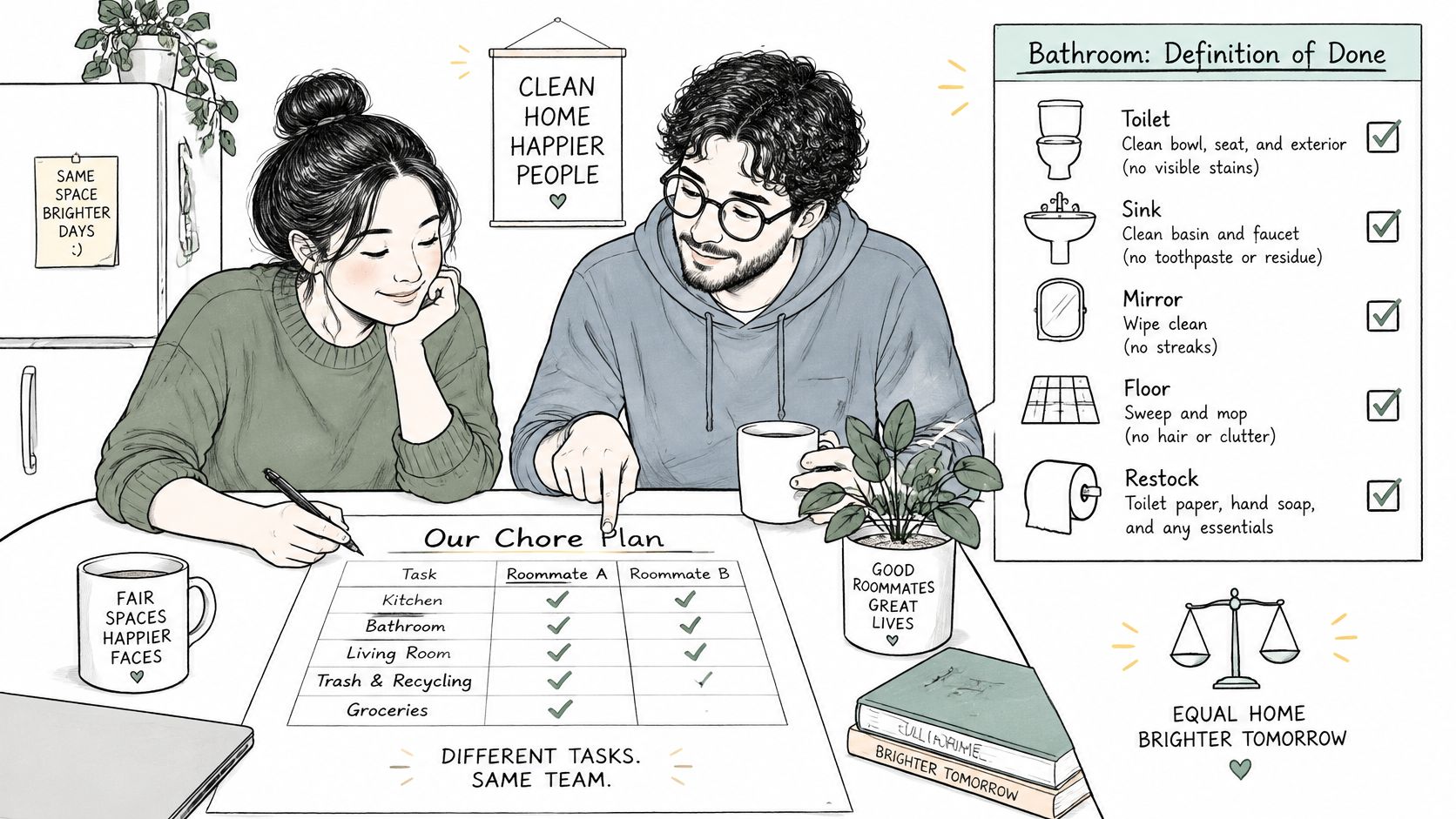
Start with observable endpoints. "Bathroom cleaned" means toilet, sink, mirror, floor and restocked paper, not a quick wipe of the basin. Write that standard down once and the argument about who did what mostly disappears.
Then weight tasks by effort rather than counting them. A 10-minute bin run and a 40-minute bathroom aren't equal units of work, and a list that treats them as equal guarantees resentment. Rotate the high-friction jobs, the bathroom and the fridge, on a fixed cycle.
The Imbalance Is Normal, Which Is Why It Needs a System
Among people living with others, 35% said they do more than their fair share of household tasks, compared with 18% who said they do less, according to a YouGov poll of 2,226 U.S. adults on household chores. The gap isn't only execution. Research involving 322 mothers of young children found mothers reported responsibility for about 73% of cognitive household labor (anticipating, planning, delegating and tracking) versus 27% for partners, while physical labor split 64% to 36%, as reported in coverage of the household labor study.
That's the part a chore list alone can't fix. If one person always notices, plans and reminds, an equal-looking list still leaves them managing the whole thing.
Rotate the planning role too, not just the scrubbing. The person who assigns this month's tasks is doing work the list doesn't show.
Build a weekly reset for missed work, illness and travel: a skipped task moves to the next open slot rather than piling up or vanishing. Then hold a 15-minute monthly review. Compare actual time spent, change one task, and keep the plan written where everyone can see it. If you're setting this up from scratch with new flatmates, this walkthrough on how to split chores with roommates covers the negotiation step by step.
Set Up Your Schedule Before Next Week
Three actions this weekend, and nothing more.
- Circle what you already do. Copy the room-by-room grid and mark the tasks that happen without thinking. A schedule built from existing habits survives; one built from aspiration doesn't.
- Pick your time budget row and place week one on the calendar. One task per block, real dates, named days. If you're sharing the flat, add the tasks room by room and put a name against each one.
- Set a review date two weeks out. Compare what you finished against the grid. Anything that slipped twice gets a new slot, not a lecture.
Benny is one option for the shared part: every member of a home sees the same chore list and schedule, with each chore assigned to a person and marked done or still waiting, chores can carry timers and room-based presets, and the schedule, reminders and timers are all in the free app. That visibility matters more than any particular frequency you land on, because it removes the daily "did anyone do the bathroom" conversation.
Run it for two weeks, then adjust the grid to match what you did rather than what you planned to do.
Benny turns this plan into something that runs without you remembering it: room-based chore lists with timers, recurring chores that return to the schedule on their own, and one shared view so everyone in the apartment sees who owns each task and what's already done. Set up the kitchen, bathroom, bedroom and living room once and let the schedule carry the weekly rhythm while you get your evenings back. Start at Benny and put next week's blocks on the calendar tonight.