
It's Sunday evening. Nothing in the apartment is dirty enough to be urgent, and nothing is clean enough to feel calm. Someone says they'll handle the bathroom this week. Nobody writes it down, and by Thursday two people are keeping score.
The usual fix is a list. Tasks split down the middle, printed, stuck to the fridge. It holds for about nine days. What fails isn't the list itself. It's that the list counts tasks instead of minutes, ignores who notices what needs doing, and assumes next week will feel exactly like this one.
A chore schedule for adults that survives past the second week is built on two things most templates skip: real minutes and real capacity. Get those two numbers right and the rest is administration. Get them wrong and you're back to a fridge list nobody reads.
Table of Contents
- Weekly Chore Template With Time Estimates
- How to Build Your Schedule Step by Step
- Splitting Chores Fairly Between Adults
- Schedules for Low-Energy and Unpredictable Weeks
- Why Your Chore Schedule Keeps Slipping
- Set Up Your First Week Today
Weekly Chore Template With Time Estimates
Chores aren't a weekend project in most homes. The Bureau of Labor Statistics' 2024 American Time Use Survey found that 80% of people did household activities on an average day, and those who did spent about 2 hours on them, a bucket that includes housework, cooking, lawn care and household management. The work is daily, and it's measured in hours. A plan built around one heroic Saturday clean collapses by Wednesday.
So scan the template below rather than obeying it. Frequency is the column that matters most, then minutes, then the slot where each job fits.
| Chore | Frequency | Time estimate | Suggested slot |
|---|---|---|---|
| Make beds and tidy shared rooms | Daily | 5-10 min | Morning or evening |
| Load or wash dishes | Daily | 10-15 min | After dinner |
| Wipe kitchen counters and table | Daily | 5 min | After dinner |
| Empty bins and take out trash | Every 2-3 days | 5 min | When the bin is full |
| Clean bathroom (toilet, sink, shower) | Weekly | 30-45 min | Weekend morning |
| Vacuum or sweep floors | Weekly | 20-30 min | Weekend |
| Mop kitchen and entryway | Weekly | 15-20 min | Weekend |
| Laundry (wash, dry, fold one load) | Two loads weekly | 60-90 min total | Two fixed days |
| Change bed linens | Weekly | 15 min | Same day as laundry |
| Clean fridge and sweep pantry | Monthly | 30-45 min | First weekend of the month |
| Dust, wipe switch plates and baseboards | Monthly | 45-60 min | Monthly reset |
| Deep clean oven and shower grout | Quarterly | 60-120 min | Season change |
How to read the template
Daily rows total 20 to 30 minutes a day and are the rows that keep a home livable. Weekly rows carry the main load, and the bathroom plus two laundry loads account for the biggest single block. Monthly and quarterly jobs belong on their own day, usually the first weekend of the month or the turn of a season, so they never compete for the same slot as the weekly block.
Quarterly work is the row people abandon first. If 60 to 120 minutes never materialises in one piece, split the oven and the grout across two sessions three or four weeks apart.
Fit test: add your weekly minutes, then compare them with the free time you honestly have. Schedule no more than about 70% of it. The remaining 30% absorbs lateness, a bad night's sleep and the week the boiler leaks.
Add the daily, bin and weekly rows and the template lands around 5 to 7 hours a week before the monthly and quarterly jobs, with daily upkeep, laundry and the bathroom making up most of it. Use your own total, not this range, for the fit test. If your number exceeds the 70% ceiling, the answer isn't trying harder. It's cutting a row or moving it to a fortnightly rotation.
How to Build Your Schedule Step by Step
A schedule built in one sitting and never revisited is a wish list. The method below borrows from implementation-intention planning: you don't decide to "keep the house cleaner", you decide that when a specific cue happens, a named person does a specific thing for a specific number of minutes.
The National Cancer Institute's summary of implementation-intention research cites a meta-analysis of 94 independent tests reporting a medium-to-large effect on goal attainment (d = 0.65). A good intention without that structure is a weak predictor on its own.
Structure is the whole difference.
Each step below takes minutes. Skipping one usually costs weeks.
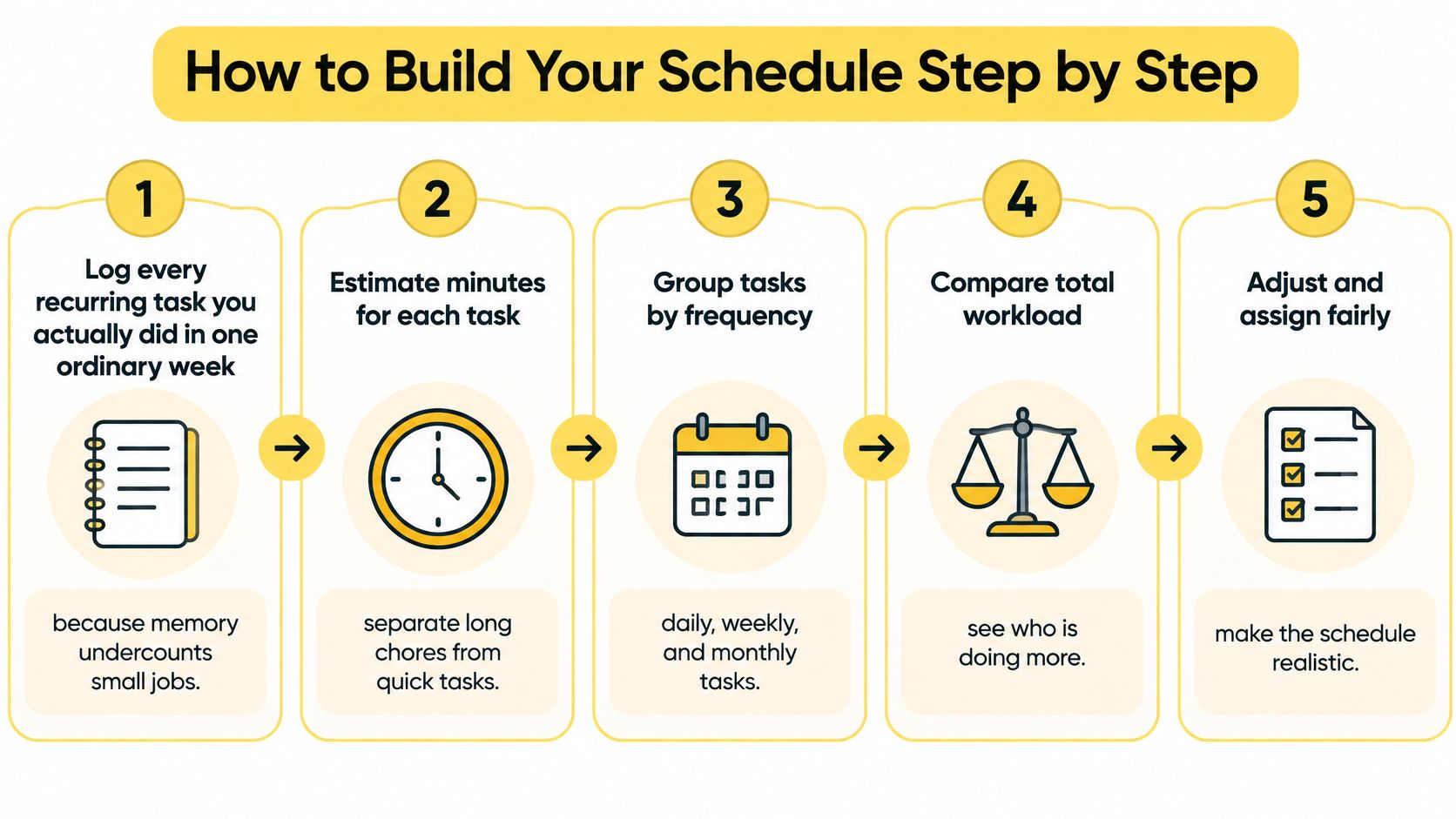
Seven steps that hold up
- Log one ordinary week first. Write down every recurring job you did, not the ones you meant to do, and include the invisible layer: noticing the bin is full, remembering which night is linen night, tracking what is running low. Memory undercounts small work, and it undercounts the planning most of all. The log is the only honest input the rest of the method has.
- Attach minutes to each job. Estimate in five-minute blocks and separate high-frequency maintenance from occasional deep cleaning. They fail differently. Maintenance goes quiet; deep cleaning announces itself.
- Hold the weekly total up to real free time. The schedule has to fit the week you get, with its late meetings and bad sleeps, not the week you wish you had. If the number exceeds what a normal week allows, move or cut rows now rather than discovering the gap in week three.
- Rewrite each task as an if-then rule. "If dinner ends on a weekday, then the assigned person loads the dishwasher for 10 minutes." The rule names location, cue, duration and owner, the four things a vague instruction like "keep on top of the kitchen" leaves out.
- Give every task one owner and a definition of done. "Counters wiped, sink empty" is a standard two people can check without negotiating. One owner also means one person carries the remembering, so the mental load lands somewhere instead of floating. A shared chore list the whole household can see makes that ownership visible rather than remembered, since everyone can see who has what and what is already done.
- Anchor the task to a stable event. Waking, a meal, leaving work, the kettle going on. Clock times fail because the clock doesn't notice you're running late.
- Review at two to four weeks. Track three things per task: completion rate, average lateness and the number of reschedules. Keep what clears consistently. Shorten, split or hand over what keeps slipping, and rebalance as soon as someone's week changes rather than waiting for the schedule to break.
A worked ninety-minute Sunday block
One block beats five scattered intentions. Put the bathroom (35 minutes), linens (15) and mopping (20) inside a 90-minute Sunday morning window, with the remaining 20 minutes as buffer for the load of laundry you forgot to start.
Write the owner's name on each line. "Bathroom, 35 min, Sam" is a schedule. "Bathroom" is a suggestion.
The rule that makes it stick: no cue, no owner and no minute count means no schedule. What's left is a hope with a deadline.
Splitting Chores Fairly Between Adults
Three chores each sounds fair. It rarely is, and the arithmetic explains why: three ten-minute jobs and one two-hour job are the same count and wildly different loads. Equal task counts are the most common way a household convinces itself the split is settled when it isn't.
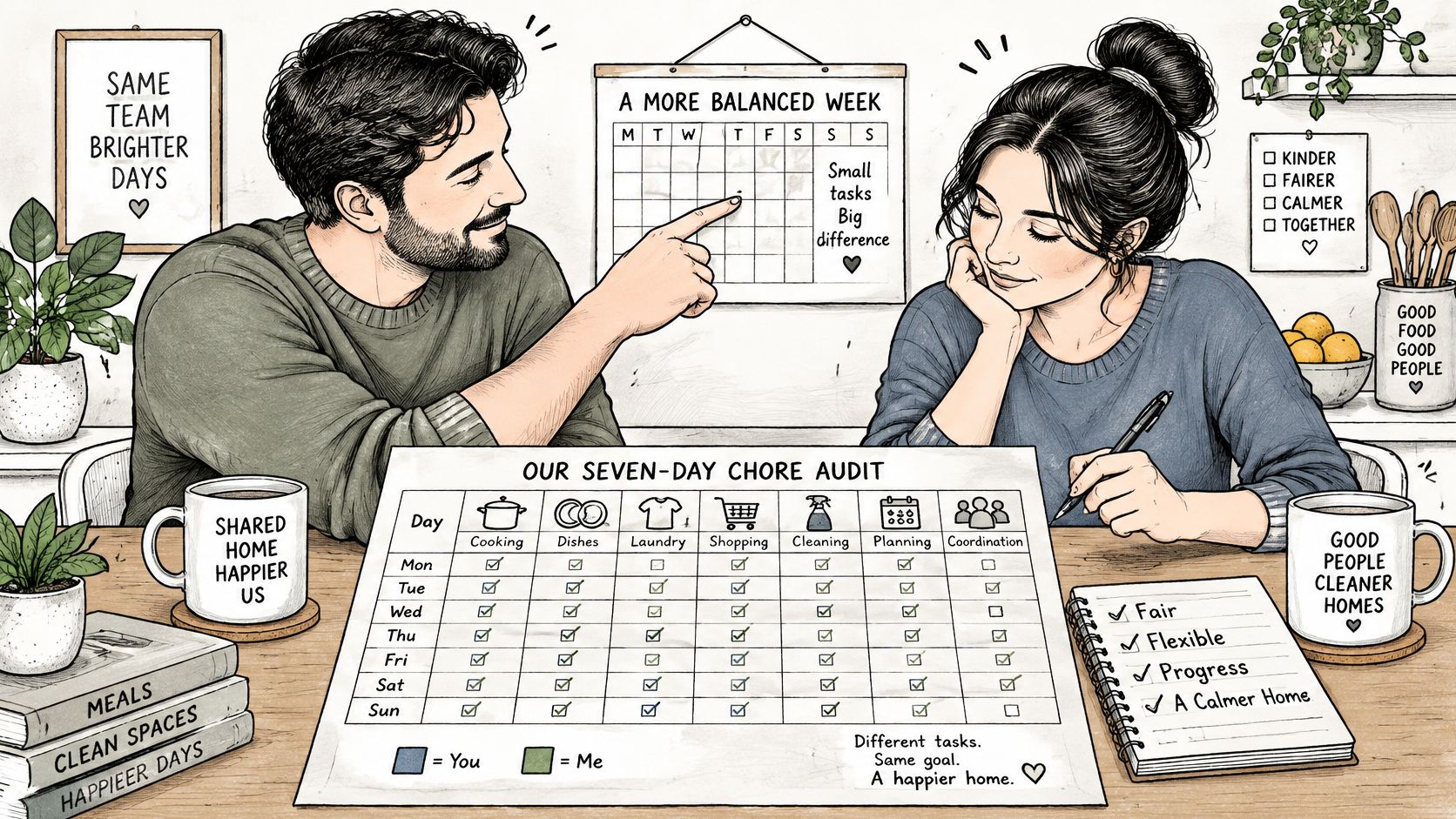
Replace the count with a seven-day audit drawn from the same log you kept in step one. Cover cooking, dishes, laundry, shopping, cleaning, planning and the coordination that holds it together. Record frequency and minutes for each area, not just a tick mark. Then assign a primary owner per area and keep a few shared tasks on rotation so nobody is permanently trapped in one job.
The time gap is measurable. OECD analysis of unpaid housework across member countries puts non-care housework at about 158 minutes a day for women and 72 minutes for men, an average gap of 86 minutes a day, or roughly 10 hours a week if it holds across all seven days. That gap is why the review conversation needs minutes on the table rather than a tally of jobs completed.
Here's the walk-through on how to run the audit and the conversation that follows it.
The invisible half of the work
Noticing that the dishwasher salt is low, remembering the school form, checking whether the shower was scrubbed: none of that shows up in a task count. Research on the household mental load summarized by the British Psychological Society found mothers handled about 71% of household tasks requiring mental effort, compared with 45% for fathers.
The structure that fixes this is end-to-end ownership. One person notices the need, plans it, does it, restocks and verifies the result. A grocery owner who only drives to the store is doing half the job if someone else builds the list in their head.
Close the loop with a 15-minute weekly review that compares estimated minutes, late tasks and handoffs, and rebalance when one adult repeatedly carries more than the agreed share. If you're coordinating roommates rather than a couple, the same rules apply with one addition: write it down where everyone can see it, which is what this guide to dividing chores with roommates without the weekly argument covers in detail.
Schedules for Low-Energy and Unpredictable Weeks
Most templates assume next Tuesday will feel like this Tuesday. Illness, caregiving, injury, a heavy work stretch or a bad mental-health week all break that assumption, and a schedule with no fallback gets abandoned rather than paused. U.S. time-use data shows how much circumstances move the number: adults living with children who were not employed spent 3.1 hours a day on household activities, against 1.7 hours among employed adults, according to the Bureau of Labor Statistics' American Time Use Survey.
That's the case for capacity-based planning. Before a bad week arrives, sort every chore by effort, physical demand, noise or sensory load and how much its deadline can flex. Then agree on what happens at each level.
| Capacity level | What gets done | What rolls forward | Pause rule |
|---|---|---|---|
| Full capacity | Every daily, weekly and monthly task | Nothing | Keep the normal schedule |
| Medium capacity | Daily tasks plus one weekly task | Remaining weekly and monthly tasks | Choose one weekly task to protect |
| Low capacity | Dishes, bins and visibly needed bathroom work | All other weekly tasks move to next week | Mark tasks paused without penalty |
| Recovery from illness | Hygiene and food safety only | Everything else | Pause the schedule until recovered |
Set the rules before you need them
Write the levels down on a good day, when nobody is deciding under duress. That way a missed bathroom clean in a rough week reads as a planning decision instead of a personal failure, and nobody spends Sunday feeling guilty about a rule they never agreed to.
Streaks deserve a specific warning. Points and streak counters motivate plenty of people, but rigid streak pressure punishes anyone managing chronic illness, caregiving, pregnancy, injury or fluctuating mood. Decide in advance whether a pause protects your progress or resets it. If the answer depends on how bad the week was, you've built a system that adds stress on the days you can least afford it.
Minimum viable routine: dishes, bins and anything that affects hygiene or food safety. Everything else can wait a week without consequence.
Why Your Chore Schedule Keeps Slipping
Schedules rarely fail for lack of effort. They fail in one of five predictable ways, and each has a specific correction.
- Symptom: everything lands on Saturday and half of it doesn't happen. Cause: one overloaded block. Fix: split it into two shorter sessions, one midweek and one at the weekend, and let each carry three or four tasks instead of nine.
- Symptom: one person remembers everything and resents it. Cause: the planning work was never assigned. Fix: give that person ownership of the list itself, and move the reminders onto the other adult's phone so remembering stops being one person's job.
- Symptom: the job never starts. Cause: it feels too big to begin. Fix: break it into 15-minute pieces and run a timer. A finished timer is a cleaner win than a finished room.
- Symptom: the schedule creates guilt and gets abandoned. Cause: it was designed for an ideal week. Fix: cut back to a minimum routine you can hold, run it for two good weeks, then add one row at a time.
- Symptom: reminders get ignored. Cause: they fire at arbitrary clock times. Fix: attach the task to an existing anchor, like the kettle going on or the last plate going in the sink, so the cue is something you already notice.
Timelines matter when you're judging whether a fix worked. Moving a block or splitting a task shows a result within a week; rebalancing who owns what needs a full month before you can tell whether it took. Judge the second kind too early and you'll undo a change that was about to start working.
Set Up Your First Week Today
Pick the five to seven daily and weekly rows from the template that matter in your home. Pull their minutes from your one-week log and confirm the total fits under your 70% ceiling. If it doesn't, drop a row now instead of in week three.
Then hold a single 20-minute conversation with everyone you share the space with. Agree on what "done" means for each task, assign one owner per task using the audit rules, and put each one on the calendar at its anchor: waking, dinner, leaving work. Run the schedule for one full week before you change anything. Mid-week tinkering hides which parts were working.
If you want the list in one place everyone can see, Benny is one option. Each chore can be one-off or recurring so it returns to the schedule by itself, and you set one up by picking a room, adding the chore and setting a timer from a preset or your own wording.
Book the review now, two to four weeks out. At that meeting you'll decide what to keep, what to shorten and what to move, and the schedule stops being something you maintain by willpower.
Benny keeps the whole plan in one place the household can see. You pick a room, add a chore and set a timer, choose whether it's a one-off or a recurring job that comes back on its own, and everyone in the home sees the same list, who each chore is assigned to and what's still waiting. The chore schedule, reminders and timers are all included in the free app, so the first week costs nothing to test. Visit Benny and set up your first room tonight.