
There's a sticky note on the kitchen cupboard listing dishes, floors, and bins. Nobody's name is beside any of them. The bathroom gets cleaned when someone finally can't stand it, and the bins stay inside because you both thought the other person had taken them out.
The problem usually isn't effort. It's that the list doesn't say where the work starts, when it's due, or who owns it. A tidy-looking checklist can still leave someone responsible for noticing every mess and reminding everyone else.
Housework also deserves more planning than a spare scrap of paper suggests. People in OECD member countries spend an average of 116 minutes per day on non-care household tasks, including cooking, cleaning, laundry, and gardening, according to the OECD's household services report.
A useful chore list doesn't just name the work. It gives someone a clear next action and a finish line.
These chore list ideas offer different ways to organize location, recurrence, and responsibility. Room lists and zones define where to work. Recurring schedules define when. Rotations and shared assignments clarify who's responsible, while timers, rewards, random picks, and adjustment modes help the routine fit ordinary life.
You don't need all of them. Start with the combination that solves the argument or bottleneck you're having right now.
Table of Contents
- 1. Room-Based Chore Lists
- 2. Recurring Chore Schedules
- 3. Shared Household Chore Rotation
- 4. Game-Based Chore Rewards
- 5. Timed Cleaning Sessions
- 6. Zone or Routine Cleaning (FlyLady Method)
- 7. Chore Picker or Random Assignment
- 8. Holiday and Illness Adjustment Modes
- How the eight chore list systems compare
- Pick Two Systems to Start With This Week
1. Room-Based Chore Lists
Best for households where broad instructions lead to unfinished rooms. A room-based list keeps related jobs together, so nobody has to work out what cleaning the kitchen includes.
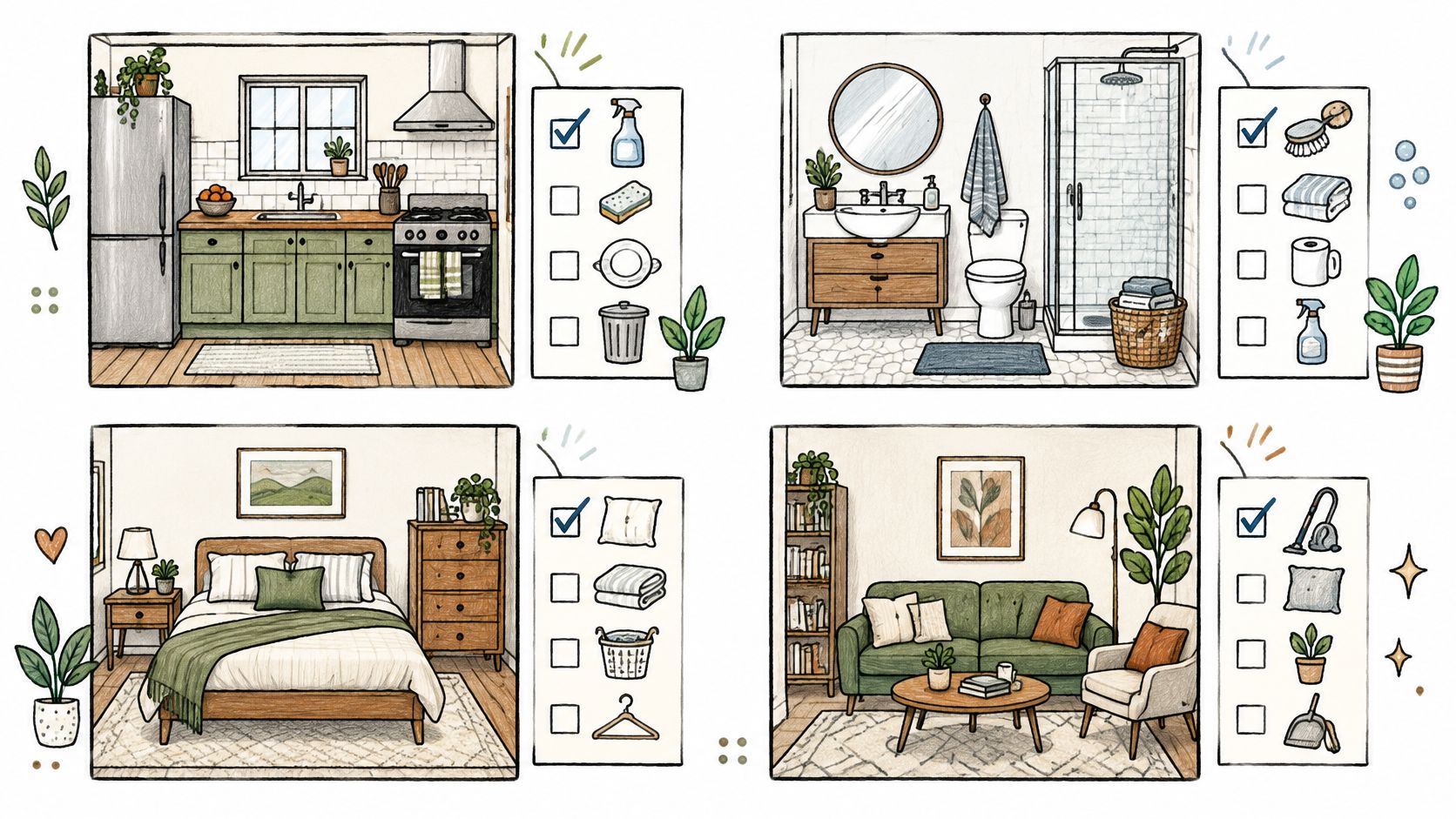
Start with the spaces you share, not every cupboard in the house. Write observable actions beneath each room name, and separate routine cleaning from occasional deep cleaning.
- Kitchen: Wash dishes, clear and wipe counters, clean the sink, and sweep visible debris.
- Bathroom: Clean the basin and toilet, wipe the mirror, and clean the floor.
- Living room: Return belongings, clear surfaces, and vacuum accessible flooring.
- Bedroom: Put clothing away, change bedding when due, and clear the floor.
Define Done Before Assigning Rooms
Say a couple divides weekend cleaning by room. One takes the kitchen and the other takes the bathroom, using separate lists that both can see. They agree that finishing includes putting equipment away, not leaving a mop bucket beside the door.
This works well when moving between unrelated tasks causes distraction. Keep cleaning supplies accessible, and work through the room in a sensible order: remove clutter, clean surfaces, then finish the floor.
The trade-off is unequal room size and effort. A lightly used bedroom isn't equivalent to a busy kitchen, so don't assume assigning a room to each person creates fairness.
Keep personal belongings separate from shared cleaning responsibilities. In a student flat, everyone can put away their own food and dishes even when someone else owns the kitchen clean.
Remove irrelevant preset tasks rather than keeping them for completeness. Review the lists when someone moves in, starts working from home, or changes how a room is used.
2. Recurring Chore Schedules
The bins don't need a fresh household discussion every collection day. Bedding, bathroom cleaning, and appliance maintenance also benefit from a schedule that returns without someone rebuilding it.
Recurring lists suit predictable work and households that forget jobs between cleans. Set each task to repeat according to actual use, with an owner and a due point.
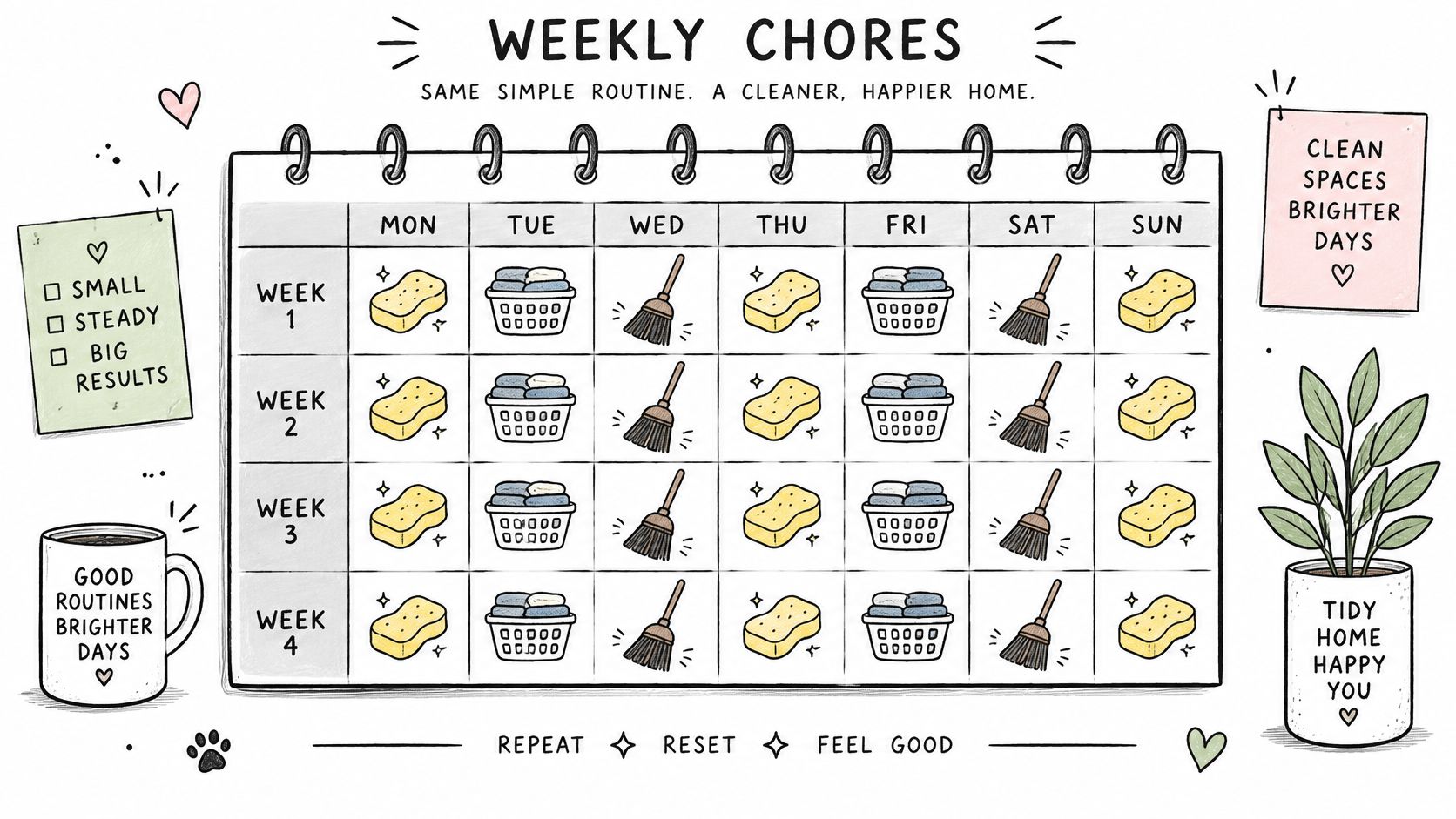
A systematic review of reminder interventions found that reminders supported daily behavioral goal attainment, although it wasn't specifically a household-cleaning study. The practical application is to connect a reminder to an action, rather than send a vague instruction to clean.
Schedule the Action, Not the Intention
Replace a broad kitchen reminder with loading and running the dishwasher after dinner. Put the bins on the schedule before collection, not after everyone has left for work.
For a household with shift workers, the collection deadline stays fixed while ownership changes around availability. A shared chore schedule should make both the due work and upcoming commitments easy to see.
- Use meaningful triggers: Connect dishes to meals and bin preparation to collection.
- Distinguish recurrence types: Collection follows a calendar; some maintenance can be scheduled from its last completion.
- Notify the owner: Don't send every reminder to everyone unless a backup needs it.
- Allow an explicit reschedule: Moving a task should preserve its owner and new due point.
The main failure is scheduling an ideal household rather than your actual one. If an unused guest bathroom keeps appearing as urgent, change its frequency.
Don't create reminders for every visible crumb. Reserve notifications for work people need help remembering, or they'll start dismissing the whole list.
3. Shared Household Chore Rotation
A rotation suits roommates, couples, and families who want to share the unpopular work. It's particularly useful when the same person always gets the bathroom or has become the default cleaner.
In a 2019 Gallup survey of U.S. married and cohabiting heterosexual couples, women were reported as primarily responsible for laundry in 58% of households, according to Gallup's household-task analysis. A visible rotation makes those recurring responsibilities available for discussion rather than leaving them assumed.
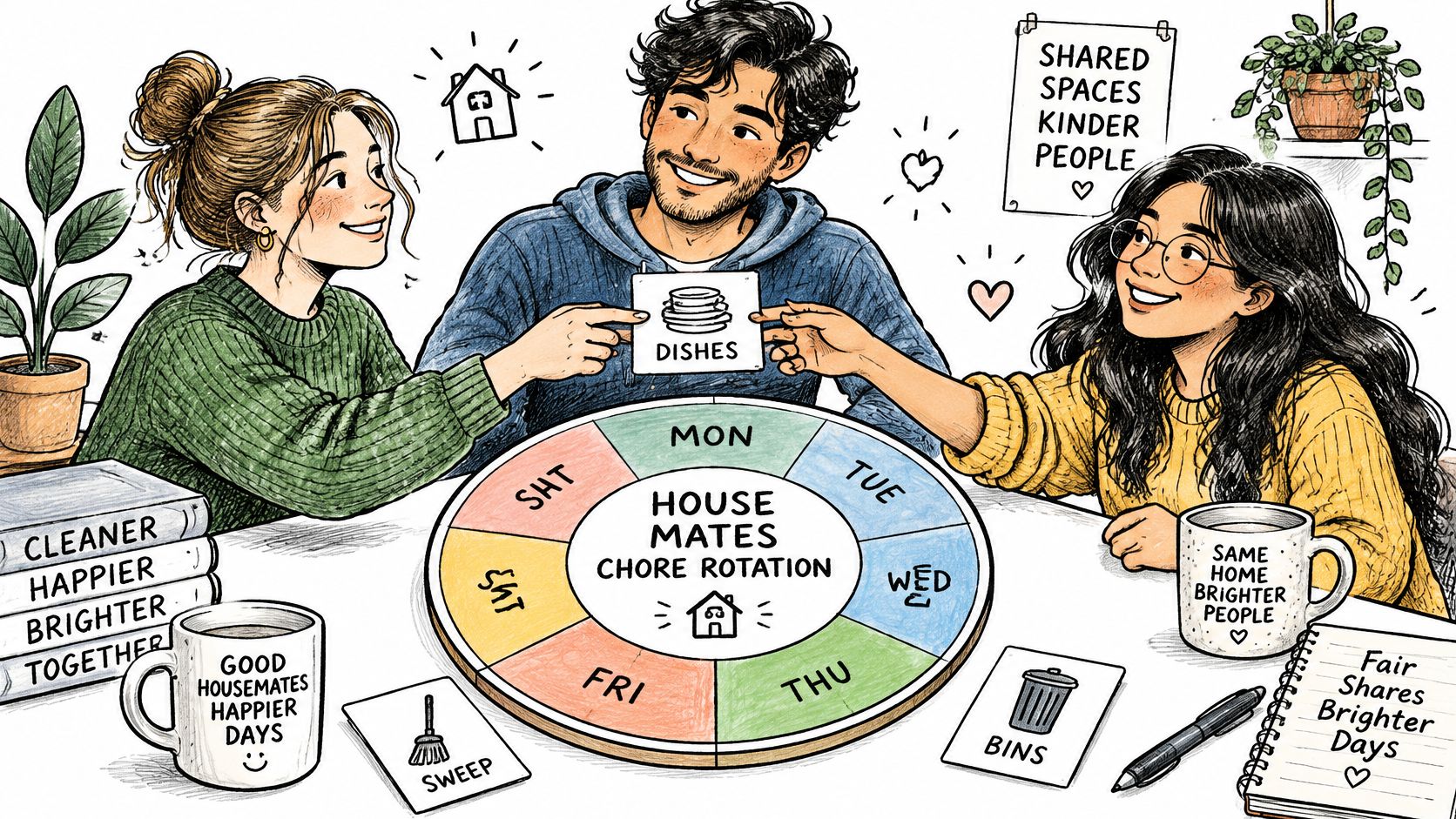
Suppose housemates rotate bathroom cleaning, kitchen cleaning, bins, and shared floors. Before starting, they compare effort and bundle lighter jobs together, rather than treating every label as an equal contribution.
Rotate Ownership, Not Just the Final Step
The person responsible for laundry should know whether detergent is running low, not merely operate the machine after someone else prepares everything. If planning and execution belong to different people, record both roles.
A peer-reviewed study of mothers with young children found that greater cognitive household workload was associated with poorer mental health and relationship quality. That association supports making remembering, organizing, and following up visible alongside physical work.
Fairness rule: Compare time, frequency, difficulty, and planning effort. Equal task counts aren't enough.
Allow swaps, but record who accepted the work and when it's due. For a practical starting point, use this guide to splitting chores with roommates to agree on responsibilities before building the rotation.
Don't rotate tasks someone can't safely perform. Fairness means an agreed, workable contribution, not identical duties regardless of health, ability, or schedule.
4. Game-Based Chore Rewards
A child finishes putting toys away and adds a token to the family jar. A couple checks off their cleaning tasks and moves a shared progress marker toward a planned movie night.
Game-based chore lists suit people who like visible progress or struggle to start repetitive work. The reward can be physical, such as tokens, or digital, such as points and a virtual pet.
Make the Rules Clear Enough to Ignore
A reward system shouldn't require more negotiation than the cleaning. Decide what earns credit, what finished means, and how rewards are redeemed before anyone starts.
- Reward completed work: Credit the agreed task, including returning supplies and clearing the work area.
- Recognize effort: Give demanding or unpleasant jobs more weight than quick, easy ones.
- Keep rewards practical: Choose something the household can realistically provide.
- Include shared progress: A joint goal can avoid making every chore a competition.
For a family, sorting laundry might earn credit only after the clothing reaches the agreed baskets. Demonstrate the task first, especially when children are learning, so the reward doesn't depend on guessing an adult's expectations.
For adults, a shared reward can work better than a leaderboard. Otherwise, someone may collect easy jobs while another person handles the bathroom, meal planning, and supply checks.
The trade-off is administration. If everyone spends the evening debating point values, simplify the scheme or remove it.
Keep ordinary household responsibility separate from endless bargaining. A reward can make progress enjoyable, but it doesn't replace a clear agreement about who contributes.
Avoid public rankings when household members have different capacities. Someone recovering from illness shouldn't have to compete with someone who has more energy or free time, and children shouldn't handle unsuitable tasks just to earn more credit.
5. Timed Cleaning Sessions
A timer is useful when starting feels harder than doing. It replaces an open-ended instruction with a defined work period and a narrow target.
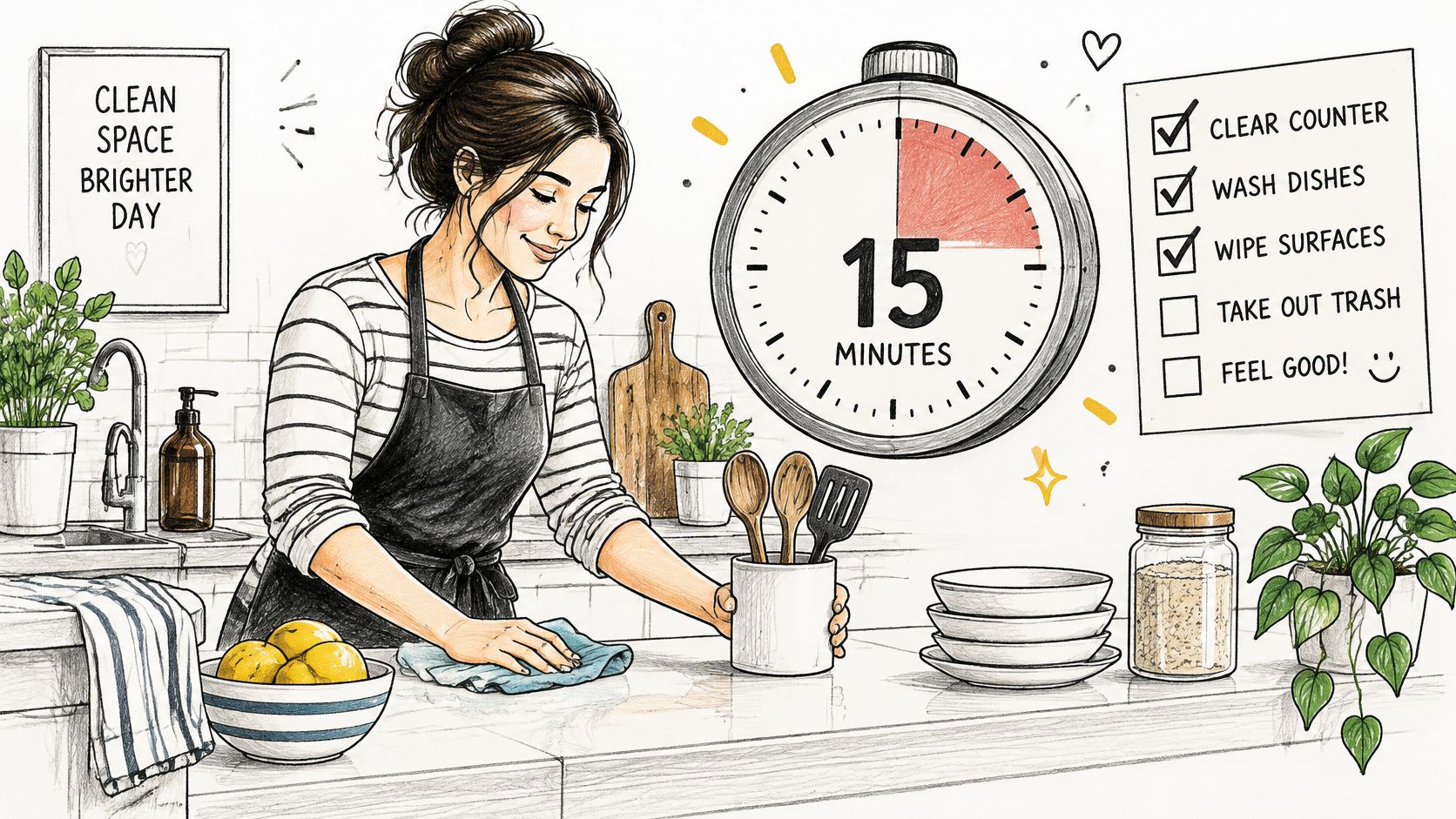
Say a parent has a short window before bedtime. Instead of attempting the entire living room, they collect dishes, put toys into their storage baskets, and clear the walking route.
A person working from home might use a break to unload the dishwasher and wipe the counter. They leave the oven for a separate session rather than starting a job they can't reasonably finish.
Set a Boundary and a Stopping Point
Choose the task before starting the timer. Gather the cloth, cleaner, waste bag, or vacuum first, so the work period doesn't disappear into searching for equipment.
- Narrow the area: Clear the dining table rather than tidy downstairs.
- Choose a finish condition: Put away the clean laundry rather than make progress on laundry.
- Leave the area usable: Don't empty every cupboard if you can't put everything back.
- Record unfinished work: Name the next action so restarting doesn't require another decision.
The timer limits the session. It doesn't determine whether a surface is clean or a task is safely finished.
When the timer ends, stop at a sensible boundary. Put cleaning products away, leave floors safe to walk on, and don't shorten a product's required contact time to beat the clock.
Timed sessions work especially well alongside room lists. The list provides direction; the timer prevents a quick clean from expanding into an exhausting overhaul.
They're less useful for jobs with unavoidable waiting or machine cycles. For laundry, time your active work separately from the washing cycle, and keep a reminder for transferring wet clothes.
6. Zone or Routine Cleaning (FlyLady Method)
A room list tells you what belongs in a space. A zone routine tells you when that space gets attention. It suits people who want a predictable route through the home without attempting a full-house clean at once.
The FlyLady approach is associated with small routines and focused cleaning. You can borrow that small-start principle without treating a customized weekday rota as the official method.
This video offers a visual introduction to the approach.
Separate Daily Upkeep From Zone Work
A household might focus on the kitchen early in the week, bathrooms next, then bedrooms and living areas. Dishes, food spills, and essential bathroom hygiene still get handled when needed, regardless of the featured zone.
That distinction matters. Otherwise, people may interpret kitchen day as permission to ignore a spill until the next scheduled visit.
- Define useful boundaries: Treat an entryway and hallway as a zone if that matches how you clean.
- Keep the zone list modest: Choose maintenance tasks before adding detailed scrubbing.
- Separate specialist jobs: Schedule awkward work with the supplies and attention it needs.
- Resume rather than restart: If you miss a zone, assess what's urgent and continue the routine.
For example, a bathroom zone session can cover the basin, toilet, mirror, and floor. Persistent shower marks belong on a separate task with suitable instructions, such as this guide to removing hard-water stains from glass shower doors.
The trade-off is rigidity. If your work pattern changes constantly, fixed weekday zones may become another source of overdue tasks.
Use a rolling sequence instead: complete the next zone when you have capacity. Keep the order visible, but let the calendar move.
7. Chore Picker or Random Assignment
Put suitable tasks on cards, fold them into a jar, and draw one when there's time to help. A chore picker suits quick shared cleans when deciding what to do takes longer than doing it.
For example, housemates preparing for guests could draw from a jar containing clearing the coffee table, wiping cupboard fronts, sorting the shoe rack, and dusting accessible shelves. Essential work, such as clearing food waste, stays assigned rather than depending on luck.
Random Doesn't Automatically Mean Fair
Build the picker from jobs with reasonably comparable effort. Don't place a quick mirror wipe beside a full kitchen clean and call the draw balanced.
- Separate demanding tasks: Use a different pool for heavier jobs or pair lighter tasks together.
- Check suitability: Exclude work requiring equipment, knowledge, or physical effort the person can't safely manage.
- Remove completed cards: Return them only when the task needs doing again.
- Allow a clear redraw rule: A missing supply or inaccessible area is a practical reason to choose something else.
Keep a name attached to the card once it's drawn. Returning an unwanted task without telling anyone recreates the same uncertainty as an unassigned sticky note.
For a family, adults can prepare a child-appropriate set of cards with pictures or simple action words. Demonstrate unfamiliar jobs before including them, and keep cleaning chemicals under adult control.
The picker works best as an optional layer over a dependable schedule. Bins, dishes, and time-sensitive maintenance need owners and deadlines, not a chance of being selected.
It's also a poor way to settle an ongoing workload dispute. Agree on fair contributions first, then use randomness to add variety within those boundaries.
8. Holiday and Illness Adjustment Modes
A useful chore system has a reduced version. Illness, disability, caregiving demands, travel, and exhausting work periods shouldn't turn a manageable schedule into an intimidating backlog.
The Open Data Watch time-use advocacy brief summarizes substantial unpaid-work demands across countries. For household planning, the practical response is to match expectations to available capacity rather than keep adding tasks.
Say a parent becomes unwell. The household keeps dishes, food waste, necessary laundry, and bathroom hygiene on the active list, while postponing dusting and cupboard organization.
Agree on a Minimum Before You Need It
Create distinct levels of work so reducing the schedule doesn't require a debate during a difficult week.
- Essential: Handle food waste, wash necessary dishes, keep toilets usable, and maintain safe walking routes.
- Maintain: Clean frequently used surfaces, manage routine laundry, and keep shared spaces functional.
- Deep-clean: Defer detailed scrubbing, decorative dusting, and nonessential organizing when capacity drops.
Assign temporary owners to essential tasks. Don't transfer every responsibility to the person who remains at home, especially if they're caring for someone.
Recovery principle: Resume from the home's current needs, not from a pile of missed checkboxes.
Before travel, remove perishable waste and deal with dishes. When you return, prioritize what needs attention rather than performing every clean that would have happened while the home was empty.
Set a review point for the reduced schedule, but don't confuse that with a recovery deadline. If someone still has limited capacity, extend the adjustment and redistribute work openly.
For persistent low energy, keep smaller task versions permanently. A sustainable minimum is more useful than an ambitious routine that repeatedly becomes impossible.
How the eight chore list systems compare
| Item | Best for | Setup effort | Works best with | Shared-home fit |
|---|---|---|---|---|
| Room-Based Chore Lists | Organizing cleaning by room | Moderate: create a list for each room | Short cleaning sessions and room presets | Good: makes completed and overdue rooms visible |
| Recurring Chore Schedules | Keeping routine tasks from being forgotten | Low: set tasks and intervals | Reminders and predictable routines | Good: everyone can follow the same schedule |
| Shared Household Chore Rotation | Distributing tasks fairly over time | Moderate: agree on assignments and rotation | Shared task tracking and flexible swaps | Excellent: clarifies ownership and helps reduce disputes |
| Game-Based Chore Rewards | Making chores more engaging | Moderate: set points and rewards | Progress tracking and varied rewards | Good: makes contributions visible to everyone |
| Timed Cleaning Sessions | Getting started on chores in short periods | Low: choose a time limit | Room lists and short breaks | Good: household members can fit tasks into limited time |
| Zone or Routine Cleaning (FlyLady Method) | Building predictable whole-home cleaning habits | Moderate: divide the home into zones and set a routine | Recurring schedules and short daily tasks | Good: zones can be shared across household members |
| Chore Picker or Random Assignment | Choosing flexible chores without negotiation | Low: prepare a jar, cards, or task pool | Fixed schedules for essential recurring tasks | Fair with review: random draws can unevenly distribute work |
| Holiday and Illness Adjustment Modes | Adapting chores during absence or low energy | Low: pause or reduce tasks and set an end date | Essential-task priorities and flexible scheduling | Good: helps rebalance work when someone is unavailable |
Pick Two Systems to Start With This Week
Don't adopt all these chore list ideas at once. Start with a way to organize the space and a way to organize responsibility over time.
Choose room-based lists if you need clear instructions for each space. Choose zones if you'd rather follow a repeating route through the home. Then add recurring scheduling for predictable jobs, or a rotation when sharing unpleasant work is the main concern.
Build a Small Working Version
Begin with a handful of core chores, not a complete inventory of everything anyone could clean. Include the work that causes the most friction: dishes, bins, bathroom cleaning, shared floors, or laundry.
- Name the action: Replace tidy up with a task someone can observe and finish.
- Assign an owner: Everyone should be able to see who's responsible without asking.
- Set the timing: Use a deadline, recurring interval, or household trigger.
- Define completion: Agree on what must be done before the task is checked off.
Make planning work explicit too. Someone needs to notice missing supplies and arrange occasional maintenance, and that person shouldn't automatically become the household supervisor.
Review the Workload, Not Just the Checkmarks
Once you've used the system through an ordinary cycle, discuss what didn't fit. Ask whether the tasks were clear, whether reminders arrived at useful moments, and whether anyone had to chase other people to get work finished.
Change the list before blaming someone's motivation. A repeatedly missed task may need a smaller scope, a different owner, or a better time.
Add timers if starting is the problem. Try rewards if visible progress appeals to the household, or a picker if small optional jobs need variety. Keep an adjustment mode available so illness or travel doesn't undo the routine.
Benny's core chore schedule, reminders, timers, and shared homes are free, so you can test room-based lists and visible assignments before deciding whether to upgrade. Optional Premium features include holiday and sick modes, plus protected snoozing and skipping for disrupted routines.
The shared list matters most when nobody has to guess who owns the next step. A plain list that everyone understands is more useful than an elaborate system that only its creator maintains.
Benny brings room-based chore lists, recurring schedules, reminders, timers, and shared assignments into one household app. Visit Benny to set up your core chores, give each task an owner, and try a routine your household can maintain.