Two people stand in the same kitchen at nine at night. The sink is full, the recycling is spilling, and each of them is certain they've done more this week than the other. On the fridge, a chore list printed in March has four boxes ticked.
That isn't a discipline problem. It's a design problem.
Chore charts ideas are everywhere, and most of them answer the wrong question. They ask what a chart should look like instead of what keeps going wrong in your home. A grid built for forgotten recurring jobs won't fix a house where one person carries all the planning. A sticker system that motivates a seven year old will insult a roommate. A laminated schedule collapses the week someone gets ill and falls four tasks behind.
So this is a toolkit, not a ranking. Each format below is matched to a friction point: forgotten recurring jobs, uneven workloads, low motivation, tasks too big to start, or invisible management work. Every entry names the household it fits and the point where it breaks down. Find your friction point and start there tonight.
Table of Contents
- 1. Room-Based Zone Chore List
- 2. Recurring Frequency Schedule (Daily, Weekly, Monthly)
- 3. Rotating Chore Wheel
- 4. Kanban Chore Board (To Do, Doing, Done)
- 5. Points-Based Reward Chore Chart
- 6. Virtual Pet Progression Chore System
- 7. Timed Tidy Sprint Chore Chart
- 8. Shared Household Dashboard
- How the Eight Chore Chart Formats Compare
- Pick the Format That Fixes Your Household's Real Problem
1. Room-Based Zone Chore List
Best for: the home where "clean the house" gets said out loud and nobody moves, because the job is too big to picture.
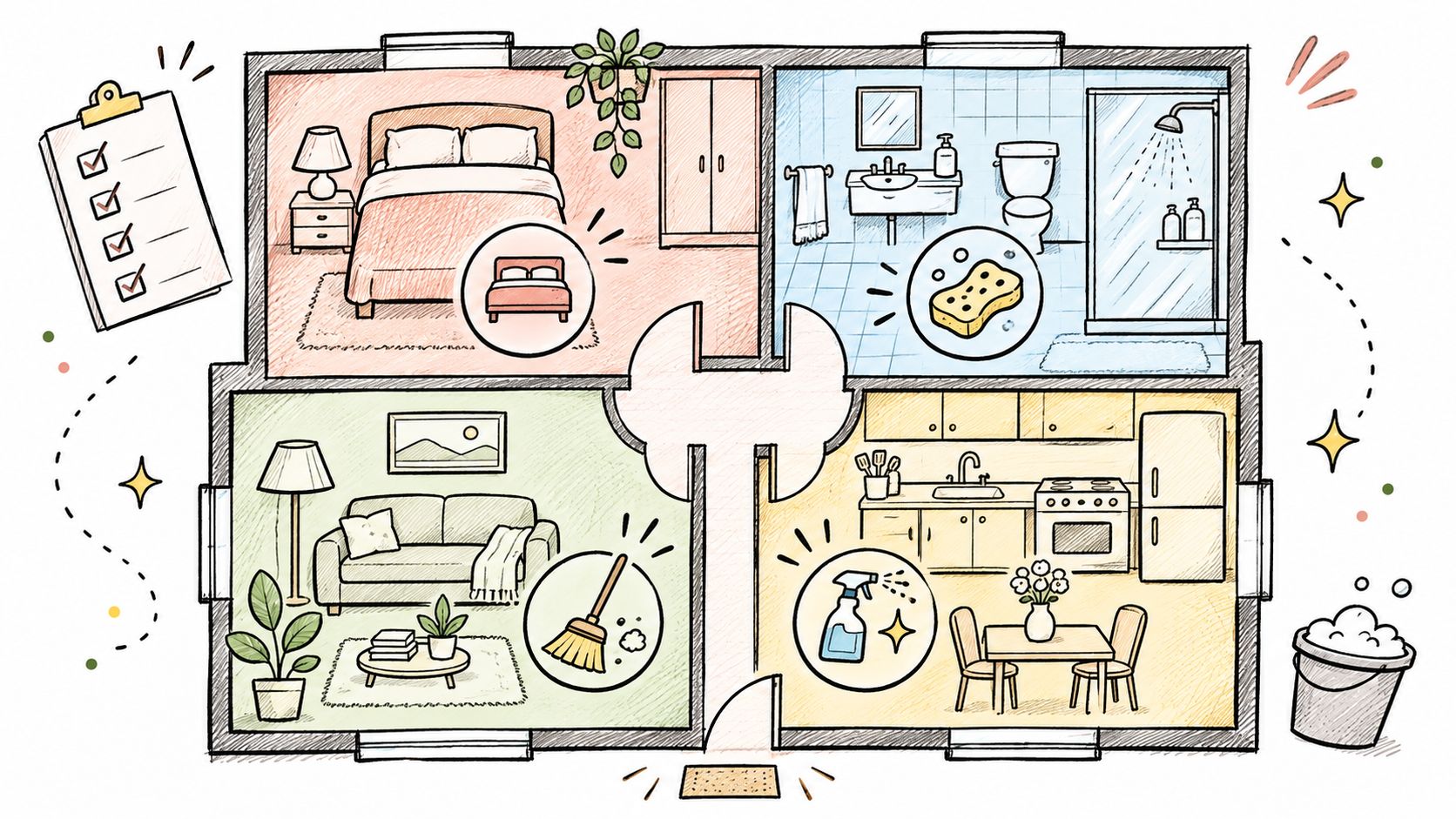
A zone list organizes chores by location instead of by day or by person. The kitchen carries its own set of tasks (counters, sink, hob, fridge shelf, floor). The bathroom carries another. Nothing on the list says "clean the house", and that's the point. A room holds a finite number of jobs, so each task becomes a defined activity with a start and a finish.
The FlyLady method popularized zone cleaning by attaching a different zone to each week, and households who split Saturday morning into a kitchen block, a bathroom block, and a living-area block are running the same idea with less ceremony.
Here's the shape of it before you commit anything to an app:
Set it up in one sitting
- Start lean: four to six zones cover most homes. Add a laundry zone or a hallway zone only once the first set runs smoothly.
- Time-box each zone: a 15 to 30 minute timer stops a zone becoming a whole-house project, and it gives you an honest figure for how long the work takes.
- Add one whole-home category: laundry, mail, toys and dishes cross rooms. Without somewhere to sit, they pollute every zone.
- Rebalance monthly: one bathroom shared by four people isn't the job of a guest bathroom used twice a month.
Where it breaks down
Solo, this is the fastest of the eight formats to run. In a shared house, a zone list shows what a space needs but never who does it, so assignments have to be layered on top. It also struggles in homes with small children, where a tidy living room is undone by four in the afternoon. Preset room lists, like the kitchen, bathroom, bedroom and living room templates in Benny, save the setup work if you'd rather not build the zones by hand.
2. Recurring Frequency Schedule (Daily, Weekly, Monthly)
Best for: forgotten recurring jobs. The bins went out last Tuesday because someone remembered, not because the system said so.
This format maps chores to cadence. Counters wiped daily, floors vacuumed weekly, fridge cleaned monthly. Each task carries an interval and returns on its own, so the chart stops being a piece of paper you rebuild every Sunday.
That structure matches how domestic work lands across a week. The U.S. Bureau of Labor Statistics' American Time Use Survey reported that in 2024, 80% of people engaged in household activities on an average day, and participants spent approximately two hours on them, with housework more common on an average weekend day (41%) than an average weekday (36%). Household work is a daily commitment for most adults, not a weekend event, and a list that resets itself fits that rhythm better than memory does.
What to put on it
- A daily minimum of three to five tasks: dishes, counters, one laundry load. Anything longer gets skipped on a bad day.
- Day anchors for weekly jobs: bins on Tuesday, bathroom on Saturday. The anchor does the remembering for you.
- A monthly list you don't have to look at: fridge, oven, shower head, under the bed. Set the interval and forget it.
Digital scheduling handles this without a weekly rebuild, which is the job Benny's recurring chore schedule is designed for.
Where it breaks down
Frequency schedules have no awareness of your week. If three monthly jobs land in the same seven days, the plan is technically correct and practically miserable. Spread monthly work by hand when you set it up. Use holiday and sick settings during absences so a week away doesn't greet you with a wall of overdue items.
3. Rotating Chore Wheel
Best for: uneven workloads and the argument that follows them.
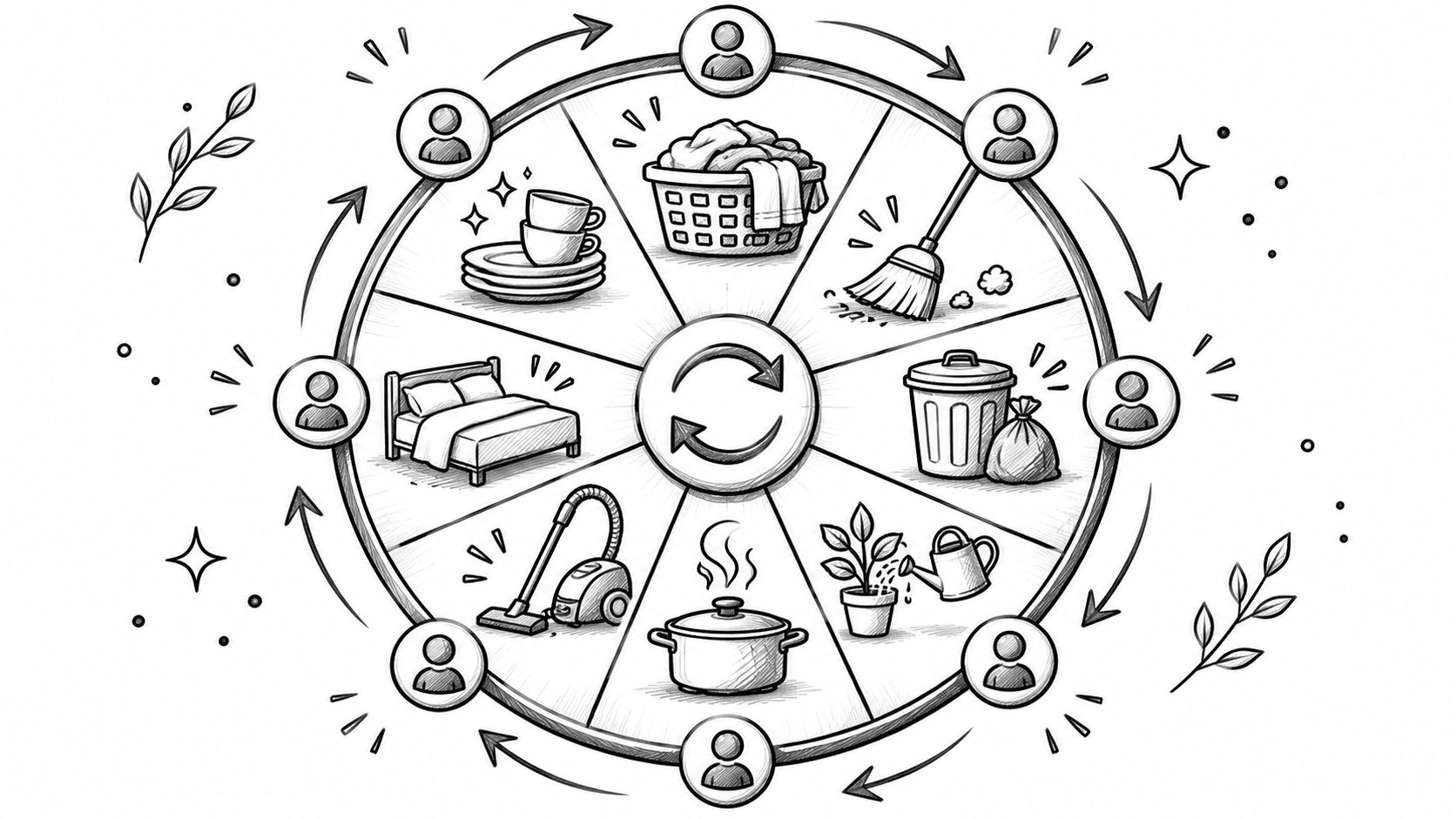
Rotate tasks between members on a fixed cycle. Each person passes through the full set over time, so whoever always cleans the bathroom eventually takes the bins too. Drawn as a wheel or a rotating table, the format's real product is visible fairness and less negotiation.
Uneven allocation is the norm rather than the exception. A 2023 FReDA survey reported by Germany's Federal Institute for Population Research found that women were primarily responsible for routine laundry in 71% of cohabiting couples, for cleaning in 66%, and for cooking in 58%. Among women in asymmetrically divided relationships, roughly one in five reported considering ending the relationship. A wheel can't fix a household's habits, but it can make the split visible.
A circular version makes the rotation obvious at a glance:
Make rotations genuinely equal
- Weight by effort, not by count: one point for bins, three for the bathroom. Rotate on total effort points rather than task numbers.
- Fix the rotation day: the same day each week or fortnight, so nobody has to announce the switch.
- Rotate the unpleasant jobs first: the toilet, the bin juice, the shower drain. If those rotate and the rest doesn't, the system still feels rigged.
Where it breaks down
Roommates and families with teenagers get the most from a wheel. Couples with young children usually find it too rigid, because who can clean is decided by who's holding the baby. Solo households don't need it at all. Any wheel fails when one member travels or works nights and the cycle keeps turning without them. The full handover process is covered in this guide to splitting chores with roommates.
4. Kanban Chore Board (To Do, Doing, Done)
Best for: tasks that get started and then abandoned, the half-cleaned bathroom, the laundry that never reached the drawer.
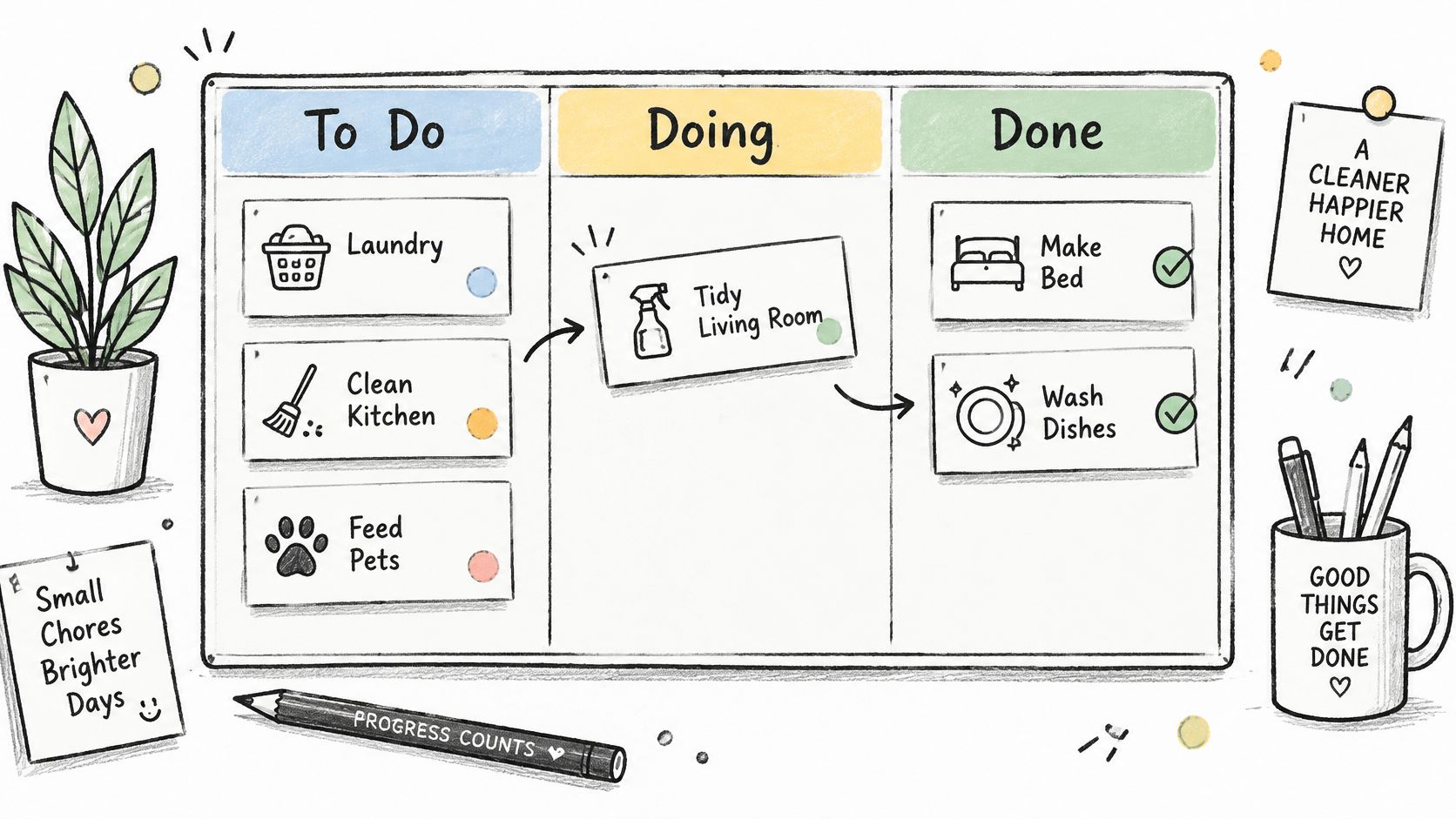
Three columns, one card per chore, cards moving left to right. The method came out of lean manufacturing at Toyota before it was adapted for personal task management. The household version earns its wall space for one reason: it shows work in progress, which a checklist cannot.
A ticked box tells you a job finished. A stalled card tells you the job still exists. In a shared home, a half-finished task is often worse than an untouched one, because everyone assumes someone else is mid-way through it.
A fridge whiteboard is enough to start:
Keep it from becoming a second job
- Cap the Doing column at two or three cards: beyond that, the board shows intention rather than progress.
- Clear Done weekly: a Done column that fills up stops being a reward and turns into clutter.
- Colour-code by room or by person: by person for accountability, by room for planning. Pick one scheme and stick to it.
The uncomfortable part: a board makes execution visible and hides management. Noticing the loo roll is low, deciding the bathroom needs doing before guests arrive, checking a teenager actually scrubbed the sink. None of that appears as a card.
That gap is where equal card counts hide an unequal home. Studies of partnered households keep finding the same pattern: the noticing, planning and remembering sit mostly with one person, even when the physical chores look evenly split. If you run a board, add cards for the management work itself: meal planning, restocking, arranging repairs, school paperwork.
Where the board breaks
Solo households juggling several parallel jobs get the most from it, and couples do too, provided both agree on what counts as a card. Roommates benefit as long as one fixed rule governs who moves cards, or the Doing column turns into a parking spot nobody empties. Families with young children struggle most: kids too small to read or move their own cards make the adult updating the board the bottleneck. The format fails outright when nobody maintains the board, because a stale board reads as a clean house.
5. Points-Based Reward Chore Chart
Best for: low motivation, especially with children, and any household where effort needs a currency.
Assign points by difficulty or time, then redeem them for privileges, treats or screen time. A completion carries a consequence beyond "it's done", which is often the missing piece with a reluctant participant.
The simplest version converts effort into a visible balance:
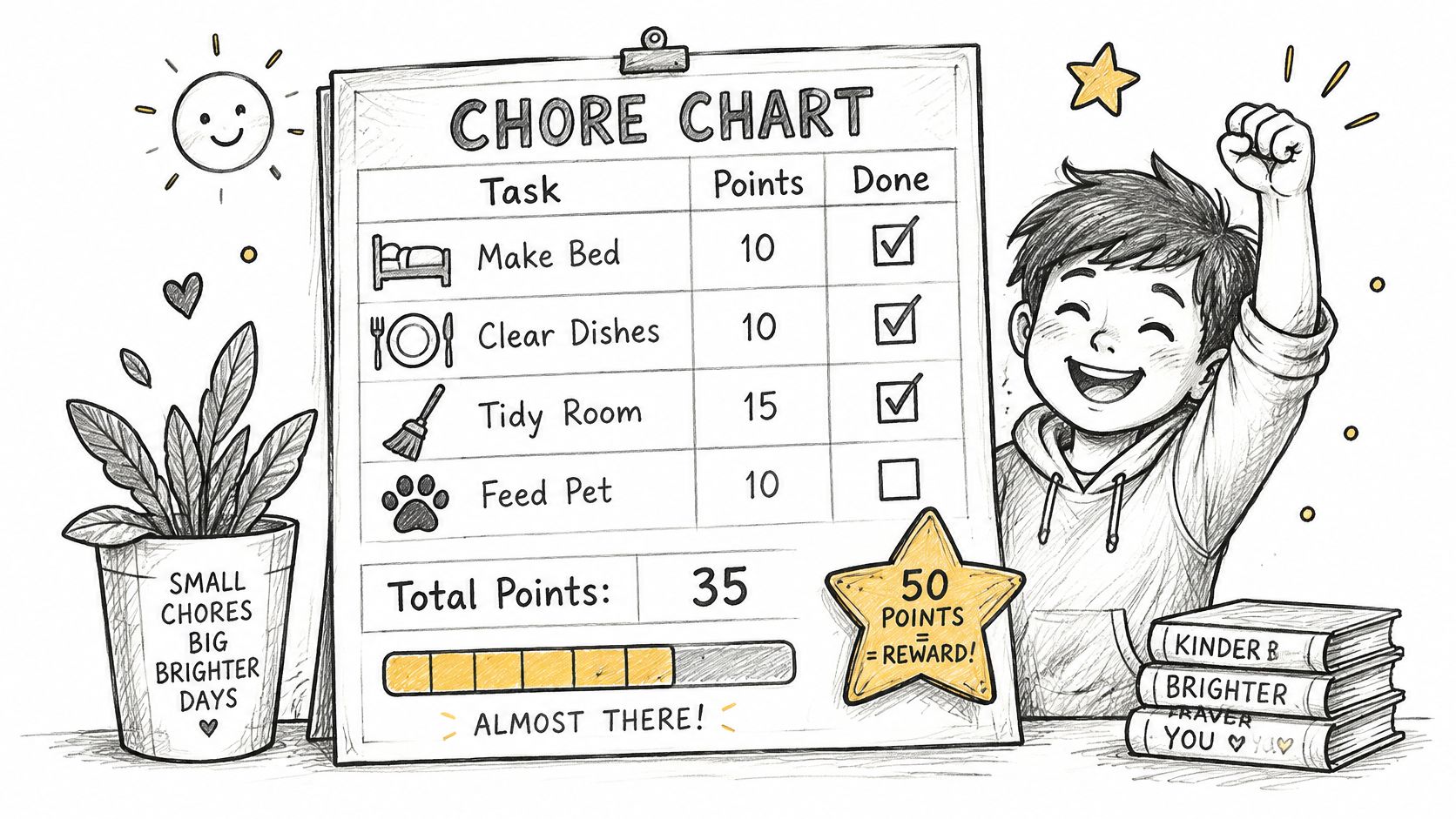
Point systems that survive week three
- Price by effort: one point for emptying the dishwasher, five for a deep clean. Flat rates push everyone toward the easy jobs.
- Run two reward tiers: something small this week, something bigger this month. Weekly-only rewards die the moment someone misses a week.
- Publish the exchange rate: if screen time costs 20 points, write it on the chart. Shifting goalposts is what kills these systems.
The wear-out problem
Novelty fades, and it fades measurably. A systematic review of adult ADHD self-management strategies published in Issues in Mental Health Nursing found that external aids such as phone alarms, clocks and planning calendars are among the most commonly used supports, and noted mobile-app research where accumulated tenure reduced gameplay incidence by 18% and gameplay time by 50%. A reward that worked in February can be wallpaper by April. Rotate the rewards, retire point values that stop motivating anyone, and keep the base chores outside the points system so the house still runs during a slump.
Where it breaks down: adults in shared homes often find points infantilising. Use them for children, or for one shared goal, rather than as the permanent currency between partners.
6. Virtual Pet Progression Chore System
Best for: consistency with younger children, and anyone who starts tasks more easily when something responds immediately.
The pet grows as chores get done. Feed it, level it up, earn accessories. The Tamagotchi tradition of the 1990s proved that a persistent digital creature creates a pull a checklist never does, and habit-tracking games such as Habitica apply the same loop to real tasks.
The loop looks like this in practice:
Design rules that hold
- Tie progress to completed chores, not time in the app: the pet should respond to the house, not to scrolling.
- Set milestones at fixed intervals: a new accessory every 50 points keeps a goal in view without new content every night.
- Pair it with a real-world reward: the pet carries the daily nudge, a Friday treat carries the week.
Where it breaks down
The novelty curve is predictable. A pet system usually carries a child through the first month, then needs a rework, either fresh milestones or a shift to a points chart with tangible rewards. It does nothing for a household of adults unless everyone opts in, and a virtual hamster holding a roommate's chores hostage isn't a fairness system. Benny uses this model through Sponge Points from completed chores, which level up a customisable hamster.
7. Timed Tidy Sprint Chore Chart
Best for: tasks too big to start, and homes where energy is unreliable.
Short, timed sessions of 10 to 30 minutes, with a clear start and stop. The method borrows from the Pomodoro Technique developed by Francesco Cirillo, which pairs focused intervals with breaks. The household version schedules cleaning into available pockets of time instead of one exhausting Saturday.
It works because it removes the finish-line problem. "Clean the kitchen" has no natural end. Fifteen minutes on the kitchen does.
How to run a sprint
- Match the timer to the job: 10 to 15 minutes for daily resets, 25 to 30 for weekly jobs.
- Stop when the timer rings, even mid-task. The unfinished sink belongs to the next sprint, not to your willpower.
- Name the target narrowly: "clear dishes from the sink for five minutes", not "clean the kitchen". Broad labels are hard to start.
Pressure is the real risk
Rigid daily routines punish anyone whose capacity changes week to week. An Ipsos study of Danish households found that 78% of respondents experienced mental load at least weekly, and twice as many women as men reported feeling it several times a day. A chart that treats a missed task as personal failure adds to that load rather than reducing it.
So build three versions of every routine: a minimum version for bad days, a standard version, and a reset version for after illness, travel or a disrupted week. Choose by energy, not by weekday.
8. Shared Household Dashboard
Best for: uneven workloads and disputed fairness in couples and shared homes.
One board everyone can see and update, showing assignments, what's done, and what's still outstanding. It replaces "I thought you were doing that" with a record. That can be a whiteboard with names beside each recurring task, or an app that syncs across devices.
The case for visibility is strong. In many couples, caregiving and housework stay unevenly divided even when both partners earn similar incomes, and the gap persists regardless of who earns more. Domestic labour doesn't rebalance itself on its own. That is why a dashboard needs a weekly review, not just a list.
What a dashboard has to show
- An owner for every recurring task: assigned to a person, never to "the household".
- Completion history: who did it, and when. History ends most disputes.
- Management work as real items: meal planning, restocking, appointments, school forms.
The weekly review does the work: ten minutes, everyone present, three questions. What's overdue, what's unfair, what changes next week. A dashboard nobody reviews becomes fridge wallpaper within a month.
Where it breaks down: it needs buy-in. One person maintaining the board for everyone else has moved the mental load into an app. It also adds little for a solo household, where a single-user list carries the same information with less overhead. For couples, roommates and families, shared homes in Benny's shared chores feature work this way, with every member seeing the same list, the same assignments and the same completion status across iPhone and Android.
How the Eight Chore Chart Formats Compare
| Item | Best For | Main Strength | Main Drawback |
|---|---|---|---|
| Room-Based Zone Chore List | Individuals with overwhelming routines, couples, and roommates dividing space | Breaks cleaning into manageable, location-specific tasks | Can overlook chores that span rooms and needs initial setup |
| Recurring Frequency Schedule (Daily, Weekly, Monthly) | Individuals and stay-at-home parents managing predictable chores | Keeps recurring tasks on a predictable schedule | Ignored reminders can lead to a backlog |
| Rotating Chore Wheel | Families, roommates, and couples dividing chores fairly | Rotates responsibilities to reduce repeated negotiation | Workloads may feel uneven if chores differ in effort |
| Kanban Chore Board (To Do, Doing, Done) | Couples, roommates, and families who want a visual overview | Makes task status and progress easy to see | Requires regular updates to stay useful |
| Points-Based Reward Chore Chart | Families with children and adults motivated by rewards | Provides clear incentives and makes effort measurable | Points can be gamed without verification |
| Virtual Pet Progression Chore System | Children, families, and individuals motivated by game mechanics | Makes progress engaging through a growing virtual pet | The novelty may fade over time |
| Timed Tidy Sprint Chore Chart | Busy individuals, stay-at-home parents, and people with limited free time | Makes chores easier to start with short sessions | Deep cleaning may require multiple sessions |
| Shared Household Dashboard | Couples, roommates, and families seeking shared visibility | Makes assignments and progress visible to everyone | Requires all household members to keep it updated |
Pick the Format That Fixes Your Household's Real Problem
Back in that kitchen at nine at night. The answer isn't a better-looking chart. It's the chart that targets the thing that broke, and the only way to know which one that is, is to name the friction in a single sentence before you print or download anything.
- Solo and quiet households: a recurring frequency schedule, with timed sprints for the weeks when the flat gets away from you.
- Couples and roommates: a shared dashboard for visibility, plus a rotating wheel if the same argument keeps repeating.
- Families with younger children: points or pet progression to get the work moving, with room zones to define what the jobs are.
- Anyone with unreliable energy, ADHD, chronic illness or shift work: sprints with minimum, standard and reset versions of every routine.
Then run the chosen format for two to four weeks before you judge it. Three days tells you nothing, because week one is always driven by novelty. Watch two signals instead: is the work getting done without anyone issuing a verbal reminder, and is anyone resentful at the end of the week. If the first is no, the format doesn't fit the household's rhythm. If the second is no, the split is unfair, and no amount of reminders will fix that.
Most homes end up running two formats at once, and that's fine. A room-based list defines the work, a frequency schedule keeps it recurring, and a shared dashboard keeps it honest. Pick one to start, add the second only when the first is running without discussion.
You can test any of these inside one app before committing to a method. Benny's scheduling, reminders, timers and shared homes are free to try on iPhone and Android, so the only cost of experimenting is a fortnight of your attention.
Chore charts only work when the schedule lives somewhere everyone can see it, and that's what Benny is built for: recurring chores that come back on their own, timers on every task, room-based lists and a shared home where each member sees the same assignments and completion status. Try the format that matches your friction point, whether that's a frequency schedule for forgotten jobs or Sponge Points for a reluctant nine year old. Run it for two weeks, then review what's overdue and what's unfair.