The chore chart on the fridge worked for a week. Everyone collected stickers, someone enthusiastically emptied the dishwasher, and you briefly stopped reminding people about laundry. Now the chart's half-filled, the rewards feel less exciting, and you're back to asking who was supposed to take out the bins.
Before choosing a bigger reward, look at the task itself. Empty the dishwasher before dinner is clear. Help more around the kitchen isn't. A reward also needs to reflect the effort involved and appeal to the person doing the work. A virtual pet might motivate a child who couldn't care less about saving money. A teenager might prefer allowance, while roommates may want their contributions recognized.
A useful chore chart with rewards makes those agreements visible without turning every household contribution into a negotiation.
These seven options suit different people and reward styles, from playful hamster progression and parent-defined privileges to allowance and shared-household competition. Choose according to what your household will keep using, not which app has the longest feature list.
Table of Contents
- 1. Benny
- 2. S'moresUp
- 3. Homey
- 4. Joon
- 5. Nipto
- 6. ChorePoints
- 7. BusyKid
- Chore Chart with Rewards Options at a Glance
- Choose the Reward Your Household Will Still Use in Month Three
1. Benny
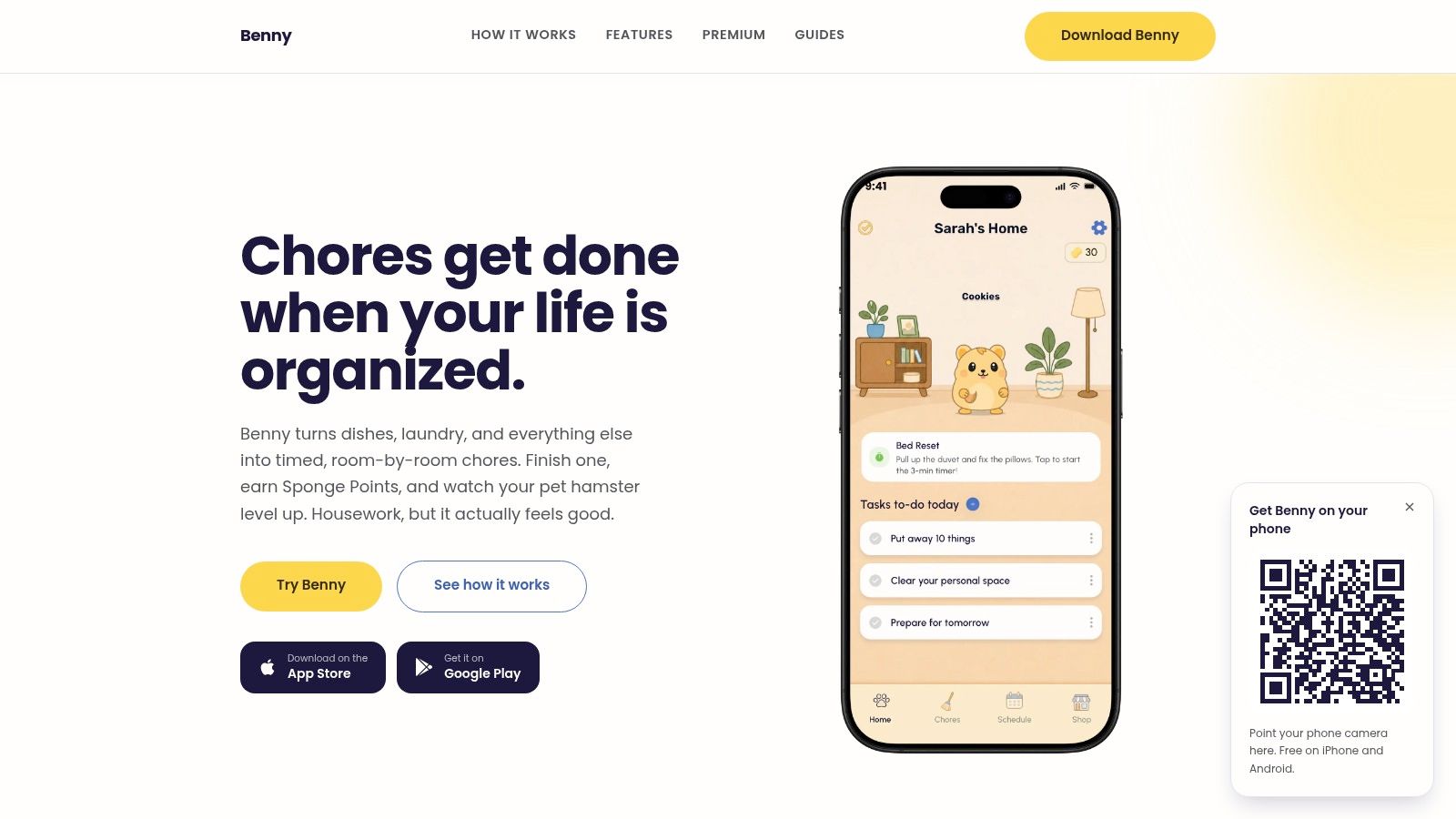
Best for people who want playful rewards alongside practical cleaning coordination. Benny combines room-based chores, timers, recurring schedules, and a shared household view on iPhone and Android. It works for an individual cleaning routine as well as families, couples, and roommates who need to see who's responsible for what.
Start with kitchen, bathroom, bedroom, or living-room presets, or create your own chores. Give each job a realistic timer, choose whether it's one-off or recurring, and assign it to someone in the shared home. Everyone sees the same schedule, including completed and outstanding work.
Make the timer achievable
The important reward condition is that a chore earns Sponge Points only when it's completed before its timer runs out. Those points support virtual hamster progression and accessory purchases. Set enough time for careful work rather than treating cleaning as a speed contest, especially when someone is learning.
For example, separate wiping bathroom surfaces from a full bathroom clean. A narrow task is easier to understand, time, and finish properly than a vague instruction to clean everything.
Practical rule: Use the timer to define a manageable job, not to pressure someone into rushing.
Where it fits and where it doesn't
- Useful free foundation. Scheduling, reminders, timers, and shared chore assignments are included in the free app.
- Optional flexibility. Premium adds custom effort points, widgets, filters, protected snoozing and skipping, holiday and sick modes, mood-based smart chores, multiple-home management, and an ad-free experience.
- Meaningful trade-off. The free app includes ads, and the optional subscription is billed through the mobile app stores. No Premium price is stated here.
- Personal preference matters. The hamster adds a light incentive, but it won't suit someone who dislikes game-based task management.
For lasting use, establish a clear completion standard before focusing on points. Custom effort points can make bigger jobs count for more, but even a well-weighted reward won't resolve an assignment that household members consider unfair.
2. S'moresUp
Choose S'moresUp when children want rewards they can help define. Rather than relying only on a built-in game, S'moresUp lets family members earn S'mores for completed chores and exchange them for household-selected rewards. Choosing a movie or planning a family treat can be more relevant than accumulating a currency with no appealing use.
The app also includes family-planning and communication tools. That makes it worth considering if chore assignments belong alongside broader family coordination, but less attractive if you only want a short checklist.
Build the reward menu together
Start with rewards you can deliver reliably. Let children suggest options, then agree on which ones fit your household's time, budget, and existing boundaries.
- Choice-based rewards. Picking the family movie or choosing a shared activity gives children some control without requiring a purchase.
- Clear instructions. Describe what finished means, including where supplies belong afterward.
- Predictable redemption. Decide when children can request rewards so you're not negotiating during bedtime or the school run.
Non-cash rewards aren't an unusual alternative to allowance: 26% of parents in a 2012 survey used non-monetary rewards instead of monetary allowance, according to the Poughkeepsie Journal's account of the survey.
The trade-off is administrative effort. Someone still needs to maintain assignments, explain rewards, and follow through when children redeem them. If you don't need the wider family tools, that extra organization may feel like another responsibility.
To keep it useful beyond the initial enthusiasm, replace rewards children no longer want rather than continually increasing their value. A small reward that gets delivered beats an impressive promise that keeps being postponed.
3. Homey

Clearing your own plate and taking on an optional garden job don't have to belong in the same payment category. Homey's strongest distinction is between unpaid responsibilities and paid jobs. Homey combines that distinction with recurring chores, allowance tracking, savings goals, rewards, and IOUs.
That makes it a useful candidate for older children and teens who want to work toward a purchase. It's less suitable if your main aim is a playful reward without financial bookkeeping.
Decide what earns money before assigning work
Child psychologist guidance published by Psychology Today cautions against relying on external rewards at the expense of children's motivation to contribute. A practical response is to separate ordinary household participation from optional earning opportunities.
Put personal tidying and agreed shared duties in the responsibilities category. Offer paid work separately, with the scope and payment agreed before someone starts.
Keep the distinction stable. Don't turn an unpaid responsibility into a paid job just because someone refuses to do it.
Homey also supports household-device syncing and bank-transfer functionality for eligible U.S. users, subject to plan and availability. Treat transfers as a financial feature to evaluate separately, not a requirement for making the chore system work.
For the unpaid side, a clear approach to shared chore responsibilities matters just as much as allowance tracking. Include who notices that work is due, who gathers supplies, and who finishes the cleanup.
Review savings goals with the child, but don't renegotiate every chore around their next purchase. The useful lesson is that some work earns money, while everyone still contributes to the home.
4. Joon

Joon is the game-first choice for children who enjoy caring for a virtual pet. In Joon, parents turn chores and routines into Quests, review completed tasks, and award coins. Children use those coins within the pet game and can work toward family-defined real-world rewards.
The appeal is straightforward: completing a real task creates visible progress in something the child enjoys. The trade-off is equally clear. A parent who wants only a chore checklist may find the game unnecessary, and a child who loses interest in the pet may stop caring about the coins.
Keep Quests smaller than projects
Use a Quest for an observable action, such as putting books on the shelf or placing dirty clothes in the hamper. Avoid combining an entire evening routine into a single assignment that's difficult to review fairly.
- Teach before reviewing. Demonstrate the task and let the child practise before expecting independent completion.
- Adjust the incentive. Match coin rewards to effort and difficulty rather than treating every Quest as equivalent.
- Approve consistently. Don't leave completed work waiting indefinitely for review.
Household participation can include varied skills: more than 60% of children in a 2024 French study of 10-year-olds reported helping with cooking or cleaning, according to the Population & Societies study. Build assignments around the child's actual ability, with appropriate supervision, rather than choosing tasks solely because they're easy to score.
Joon's free version limits daily Quest verification, so consider your intended routine before committing. Adult households looking for ways to split chores with roommates should prioritize agreed ownership and workload visibility instead of a child-facing approval system.
5. Nipto
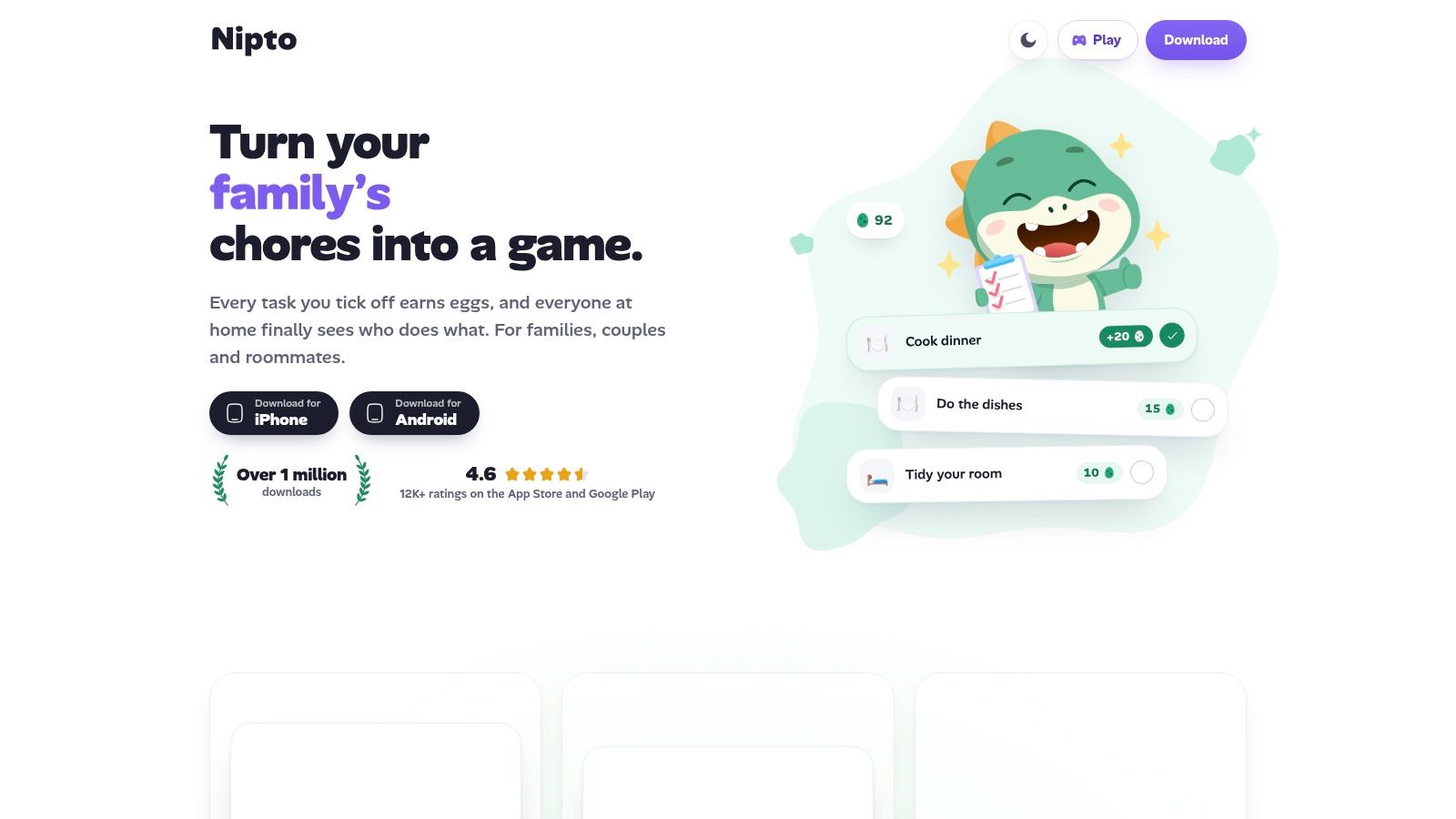
A weekly competition can make housework more engaging, provided everyone wants to compete. Nipto uses eggs, a weekly race, and gems connected to household-selected rewards. Unlike tools built primarily around parent-child approval, it also serves couples and roommates.
Members can assign chore values, track contributions, and make turns visible. It's available on iPhone, Android, and the web, with managed profiles for younger children using a shared device.
The main risk isn't the game itself. It's treating the score as proof that the division of work is fair.
Agree on effort before starting the race
The United Nations Sustainable Development Goals report states that women perform, on average, two and a half times as many hours of unpaid domestic and care work as men. A household scoreboard should make overlooked work visible, not just reward the easiest tasks to record.
Include planning, checking supplies, and finishing the less visible stages of a job. Laundry isn't complete when someone starts the washer if another person must remember to dry, fold, and put everything away.
- Rotate undesirable work. Don't let the same person permanently inherit the bathroom because they're more thorough.
- Respect different capacity. Adjust assignments around illness, working hours, and caring responsibilities.
- Choose rewards jointly. A household reward shouldn't create extra work for the person already doing more.
Widgets, advanced statistics, and other features require Premium. Skip the competitive format if it encourages arguments, task cherry-picking, or scorekeeping between partners.
Nipto fits willing competitors, not households that need to be persuaded that fairness matters. Keep the race playful and discuss the underlying workload separately.
6. ChorePoints
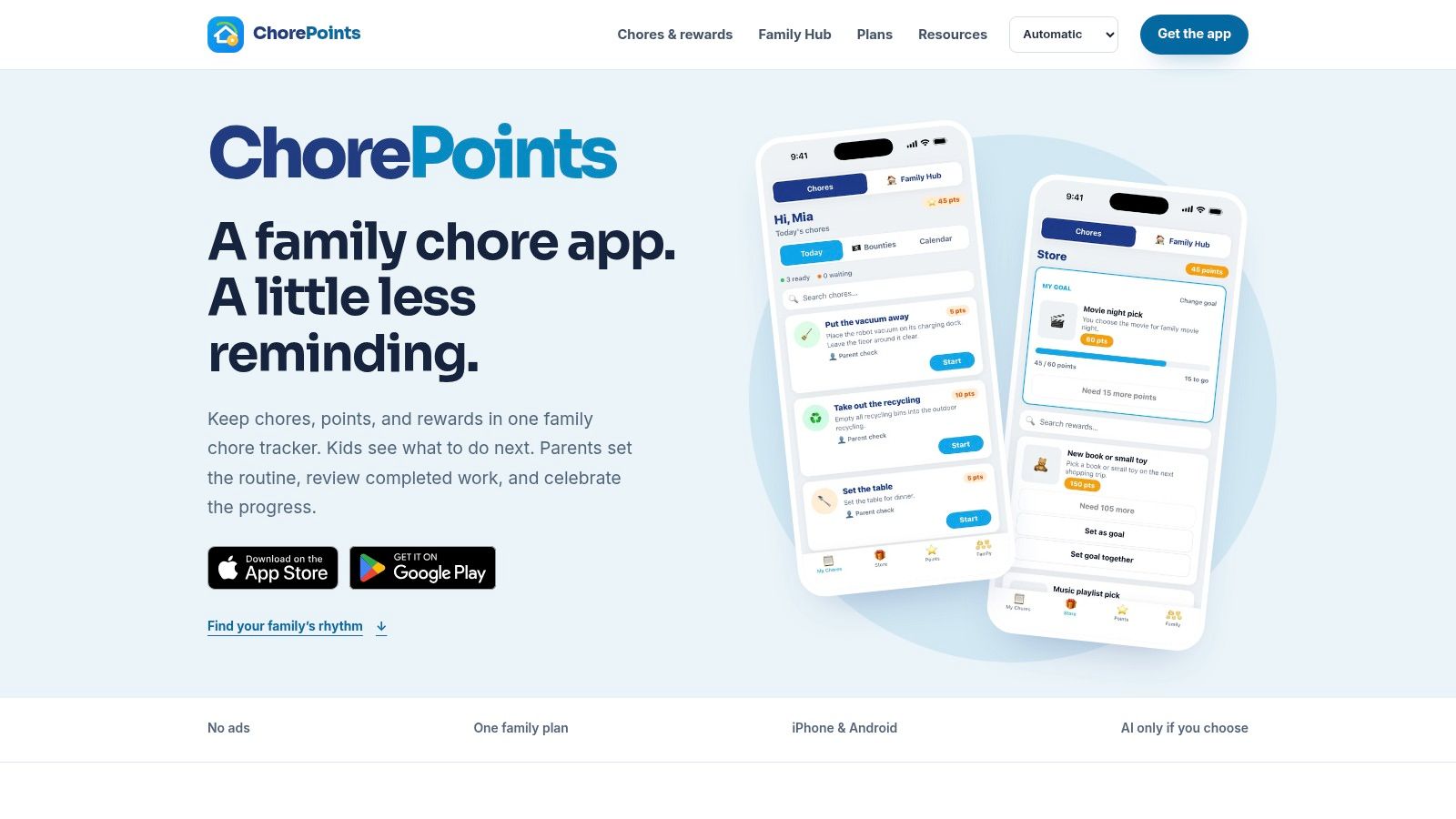
ChorePoints suits families who want a straightforward approval-and-redemption system. Parents set chore instructions, schedules, and point values in ChorePoints, then review completed work. Children exchange approved points for rewards from a parent-created catalog.
Shared-device profiles mean children don't each need a phone. The Family Hub adds broader household tools, although the full family plan requires a subscription after the trial.
Set a standard you can explain
Say the chore is putting away clean laundry. Write down that clothes belong in the correct drawers and the empty basket returns to its storage spot. That gives the child a concrete finish line and gives the parent something specific to review.
Manual approval can support learning, but it can also become a bottleneck. Choose a regular review point that fits your routine, and explain unfinished work calmly rather than rejecting it without guidance.
Approval rule: Review against the agreed task, not a higher standard introduced after the child finishes.
Optional photo proof may help with visible results, such as a cleared desk. It's less useful for proving that someone used the right cleaning method, and optional AI photo review won't suit every family. Keep manual review if that's simpler or more comfortable.
- Strong fit. Children who understand points and want a choice of household-defined rewards.
- Weaker fit. Adult roommates who don't want another adult approving their work.
- Ongoing responsibility. Parents still need to maintain rewards and respond to redemption requests.
Build a manageable recurring chore schedule before adding a large reward catalog. If children repeatedly miss assignments, check whether the timing, instructions, or workload need changing before increasing the points.
7. BusyKid
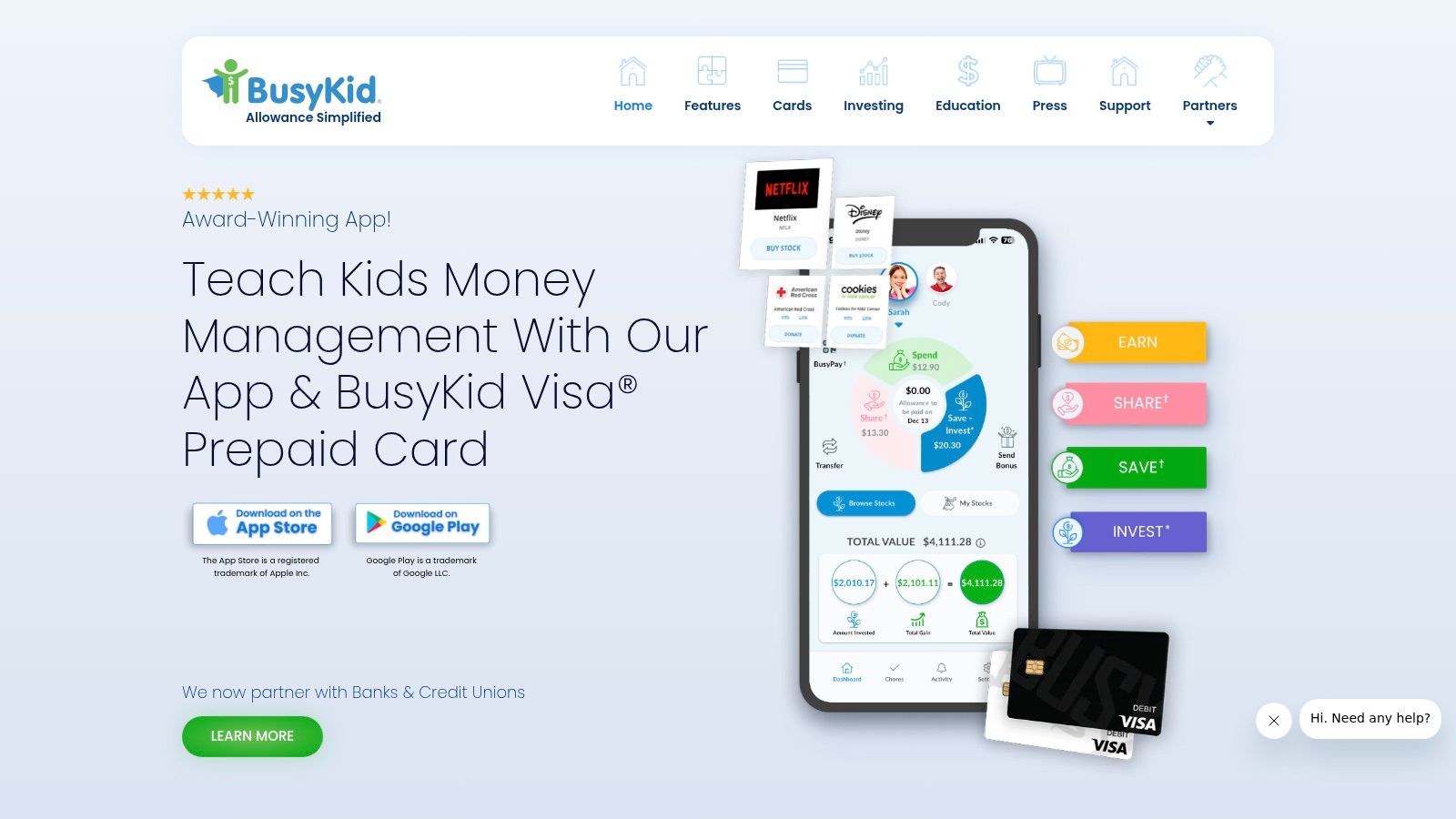
For a child saving toward something tangible, virtual coins may feel beside the point. BusyKid connects assigned chores to real allowance, with children marking tasks complete and parents approving a weekly payday. Allowance can be divided among saving, sharing, and spending.
It also offers optional prepaid-card and investing features, subject to terms, eligibility, and availability. Those features make it more financially involved than a conventional chore chart, so don't add them just because they're available.
Make payday predictable
Use the editable chore and allowance suggestions as a starting point, then match assignments to your household. Agree on what completion requires, when parents review work, and how missed or partly completed jobs will be handled.
- Define the boundary. Make clear which household contributions are unpaid and which assigned jobs affect allowance.
- Explain the balances. Help the child understand what saving, sharing, and spending mean before directing money between them.
- Keep promises affordable. Choose an allowance arrangement you can sustain without repeatedly changing the agreement.
The reward has a concrete purpose, but so does the parent's commitment. A child can't learn much about planning if payday depends on whether an adult remembers to approve it.
BusyKid is a stronger fit for families explicitly teaching money management than for those seeking light encouragement for daily tidying. Younger children who prefer visual play may find a pet-based app more appealing, while some teens will appreciate having an understandable financial goal.
To keep it useful after the novelty fades, discuss the goal rather than raising payment whenever enthusiasm dips. The system should teach a dependable relationship between agreed work and agreed compensation, without making every helpful action a billable service.
Chore Chart with Rewards Options at a Glance
| Item | Best For | Reward Type | Free Option | Shared Household Access |
|---|---|---|---|---|
| Benny | Roommates, couples, and families coordinating chores | Sponge Points, hamster levels, and accessories | Core features are free with ads | Shared homes, assignments, and completion tracking |
| S'moresUp | Families combining chores with planning and communication | S'mores redeemable for family-defined rewards | 45-day access to premium features | Family chore assignments and coordination |
| Homey | Families connecting chores with allowance and money skills | Allowance, rewards, savings goals, and IOUs | Basic functionality for up to three accounts | Syncs across household devices |
| Joon | Children motivated by game-based routines | Coins, virtual pet progress, and family-defined rewards | Up to seven Quest verifications per day | One subscription covers multiple children, adults, and devices |
| Nipto | Families, couples, and roommates sharing housework | Eggs, weekly race, gems, and household rewards | Not specified in the provided information | Shared tasks, contribution tracking, and visible rotations |
| ChorePoints | Parents managing children's chores and rewards | Points exchanged for parent-created rewards | Two-week trial | Two parent logins and up to ten child profiles |
| BusyKid | Families using chores to teach allowance and money habits | Real allowance split among spending, saving, and giving | Not specified in the provided information | Family access included with subscription |
Choose the Reward Your Household Will Still Use in Month Three
Choose the reward style before choosing the interface. Points and virtual pets may suit younger children who enjoy visible progress. Allowance and savings goals may suit older children who want something concrete. Shared visibility and agreed turns are usually a better starting point for roommates and couples than parent-style approvals.
Those are starting points, not rules about age. A teenager might enjoy a virtual pet, while a younger child might care most about choosing a family activity. Ask the person doing the work what they'd value.
The reward also can't compensate for an unfair arrangement. In a Pew Research Center survey of U.S. adults, 59% of women living with a spouse or partner said they did more household chores than their partner. Before celebrating completion scores, check who notices unfinished work, organizes supplies, and picks up skipped assignments.
Review the agreement, not just the points
After a few weeks, discuss what's working without turning the conversation into a performance review. Look at specific missed chores and ask whether the task was unclear, badly timed, too difficult, or tied to an unwanted reward.
- Keep rewards small and predictable. Offer something you can deliver consistently.
- Recognize learning. Acknowledge careful effort, cooperation, and increasing independence, not just speed.
- Adjust the workload first. Don't offer more points to disguise an unreasonable assignment.
- Keep ordinary contribution visible. Praise helpfulness even when no payment or points are involved.
You don't need to digitize every household responsibility immediately. Start with a short list of recurring chores, give each a named owner and clear finish line, and choose the tool whose reward style fits those people.
Run a brief trial before building a complicated catalog or adding financial features. Keep what makes responsibilities clearer, change what causes friction, and drop any reward that requires more negotiation than the chore itself.
Benny brings room-based chores, recurring schedules, timers, and shared assignments together with Sponge Points and virtual hamster progression. Visit Benny to set up a manageable cleaning routine and try a chore chart with rewards that makes both the work and the progress visible.
Prepared with the Outrank app