The fridge chart says make bed, put toys away, and feed the cat. Your preschooler recognizes their name at the top but can't read the jobs underneath. You still have to explain every task. Across the kitchen, the adults' shared cleaning note has a different problem: everyone can read it, but nobody remembers to check it.
A chore chart with pictures helps when the image makes the job recognizable. But pictures don't solve every coordination problem. Pre-readers need clear visual instructions. School-age children may need pictures only as a fallback. Adults often need shared assignments and reminders more than illustrated cards.
The options below serve those different readers. Some are printable sheets you'll reset by hand. Others use movable magnets or digital task cards. The final option prioritizes household scheduling rather than picture-first instructions. Choose by who reads the chart, where they'll see it, and who will maintain it, not by which design looks nicest.
Table of Contents
- 1. Tic Tac Teach
- 2. Printablesmith
- 3. SCAFLI
- 4. TinyTasks
- 5. Quokka Chart to Finish
- 6. Blueprint by JK Preschool Magnetic Chore Chart Kit
- 7. Benny
- How the 7 picture-based chore chart options compare
- Pick the Chart Your Household Will Actually Use
1. Tic Tac Teach
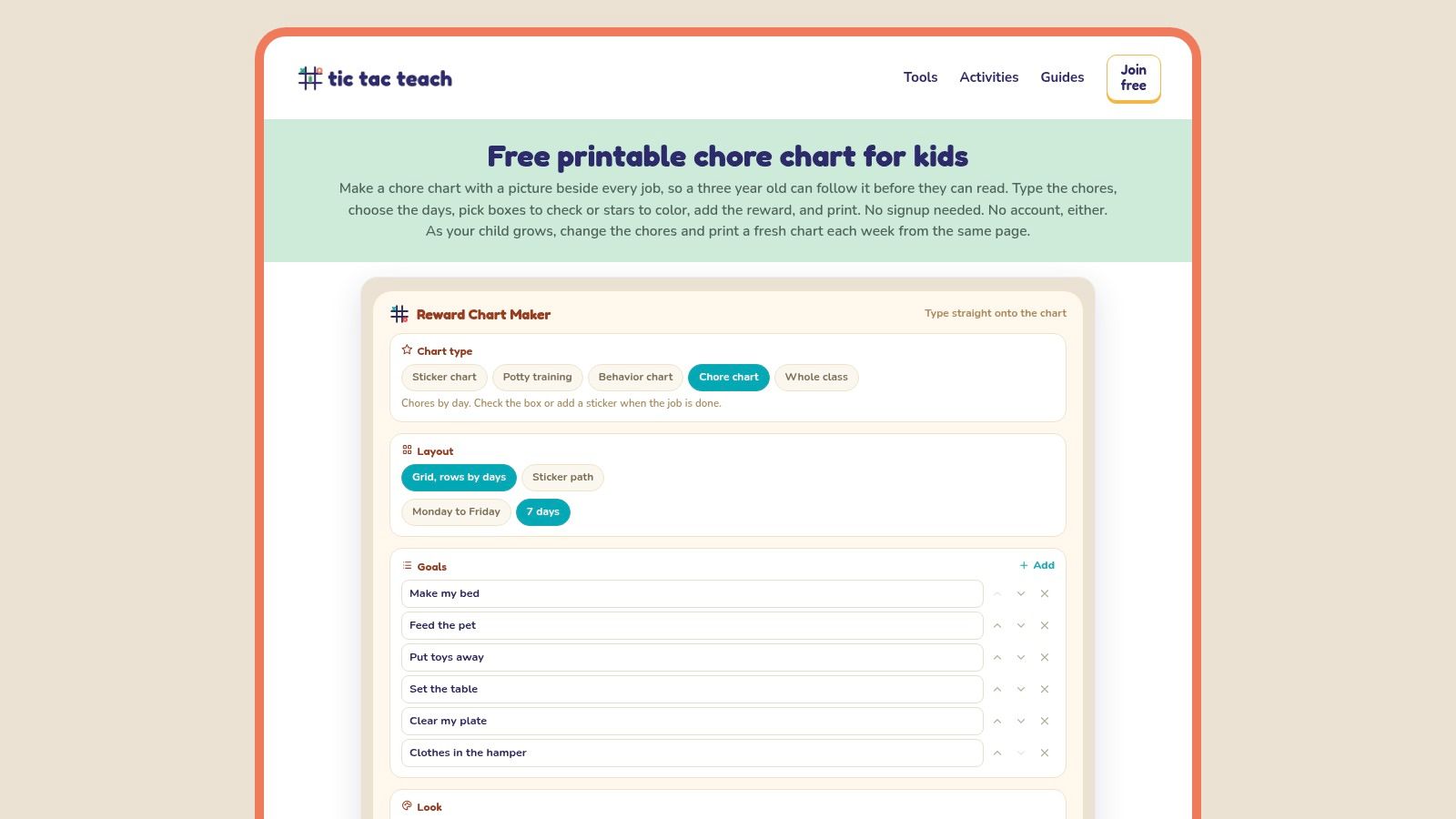
Best for pre-readers who need a simple fridge chart. Tic Tac Teach lets you enter household chores, choose the days to display, and print a picture-supported chart without creating an account. Checkboxes or stars give children something concrete to mark, and an optional reward adds a visible goal.
The useful feature is customization without much setup. Replace broad instructions such as tidy up with an observable action such as put blocks in the basket. Then check that your child understands the accompanying image before expecting them to use it independently.
Keep the responsibilities narrow
A 2024 analysis of France's Elfe cohort found that about 90% of children aged 10 helped with at least one domestic task. The practical question isn't whether children should help, but how clearly you define their contribution.
- What works: A straightforward printable with household-specific chores and selected days.
- What needs upkeep: An adult must print replacements, reset completion marks, and explain changes.
- Where it falls short: Complex rotations and automatic reminders need a different system.
You can also create a family chart with a row for each person. Keep ownership obvious rather than crowding unrelated responsibilities into the same space.
If your main problem is remembering when jobs recur, a shared chore schedule addresses a different need from a printed visual prompt.
2. Printablesmith
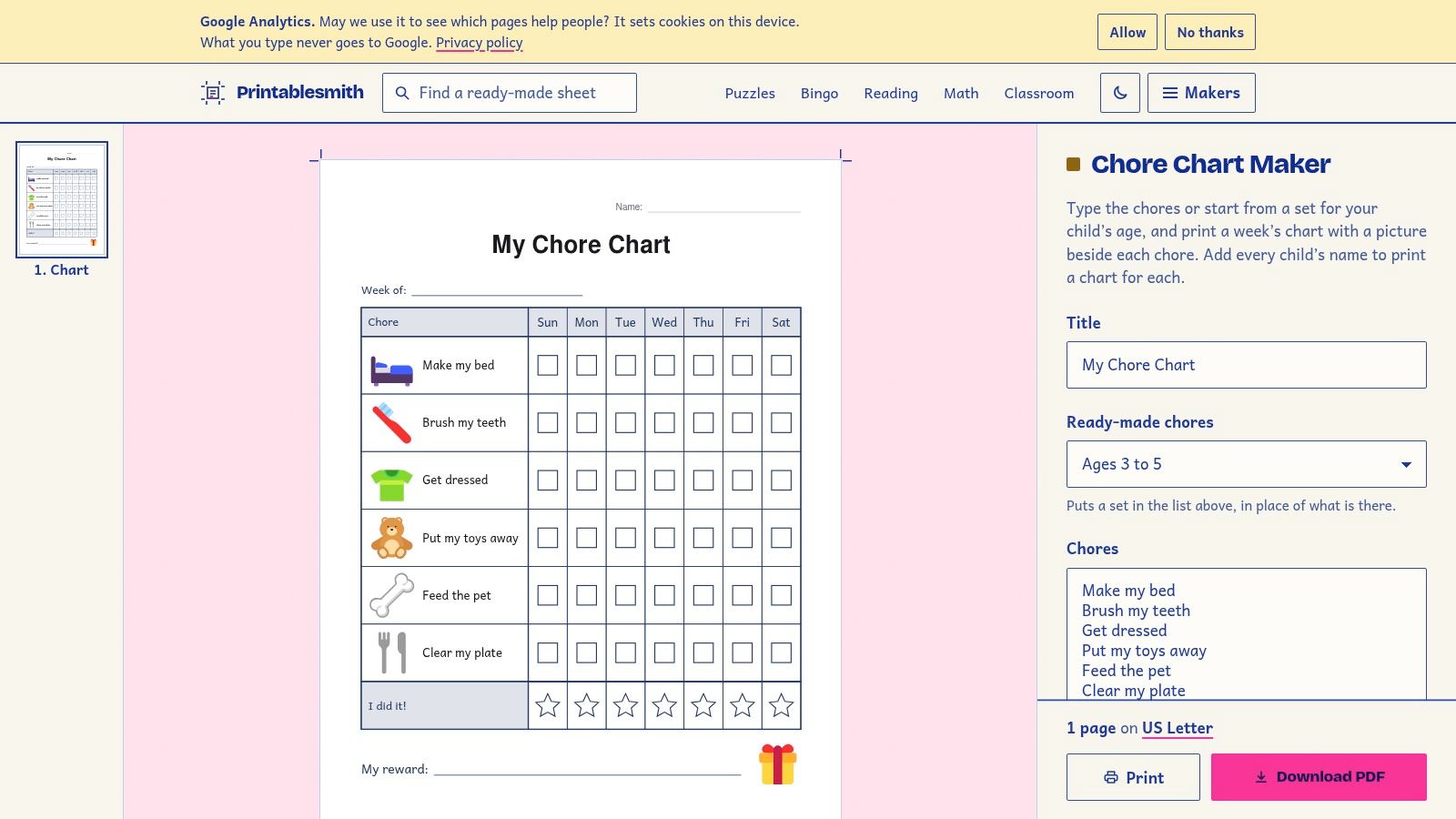
Not sure what to put on the chart? Printablesmith provides age-oriented chore suggestions as a starting point, alongside custom task entry. It produces named weekly PDFs, with weekday-only layouts and color or ink-saving black-and-white printing.
Its strongest fit is a school-age child who can read short labels. Common chores have pictures, including dishes, laundry, pet care, plants, and trash. Unmatched custom chores appear as words, so the finished sheet may not be fully usable by a pre-reader.
Test the finished chart, not just the template. Ask your child to point to the task you mean without reading its label aloud.
That test matters because adding an image isn't the same as making instructions accessible. What to Expect's chore-chart guidance recommends picture-supported charts for younger children; in practice, you still need to check whether the chosen pictures match your child's understanding.
A useful starting point, not an assignment rule
Treat age suggestions as ideas, not proof that a child can complete a job safely or independently. Demonstrate the task, make supplies accessible, and adjust the wording to match your home.
Printablesmith is free to download without an account or watermark, but it remains a manual print-and-reuse system. It's less suitable for adult housemates. Adults usually need agreement about ownership and frequency, as this guide to splitting chores with roommates explains, rather than child-oriented task suggestions.
3. SCAFLI
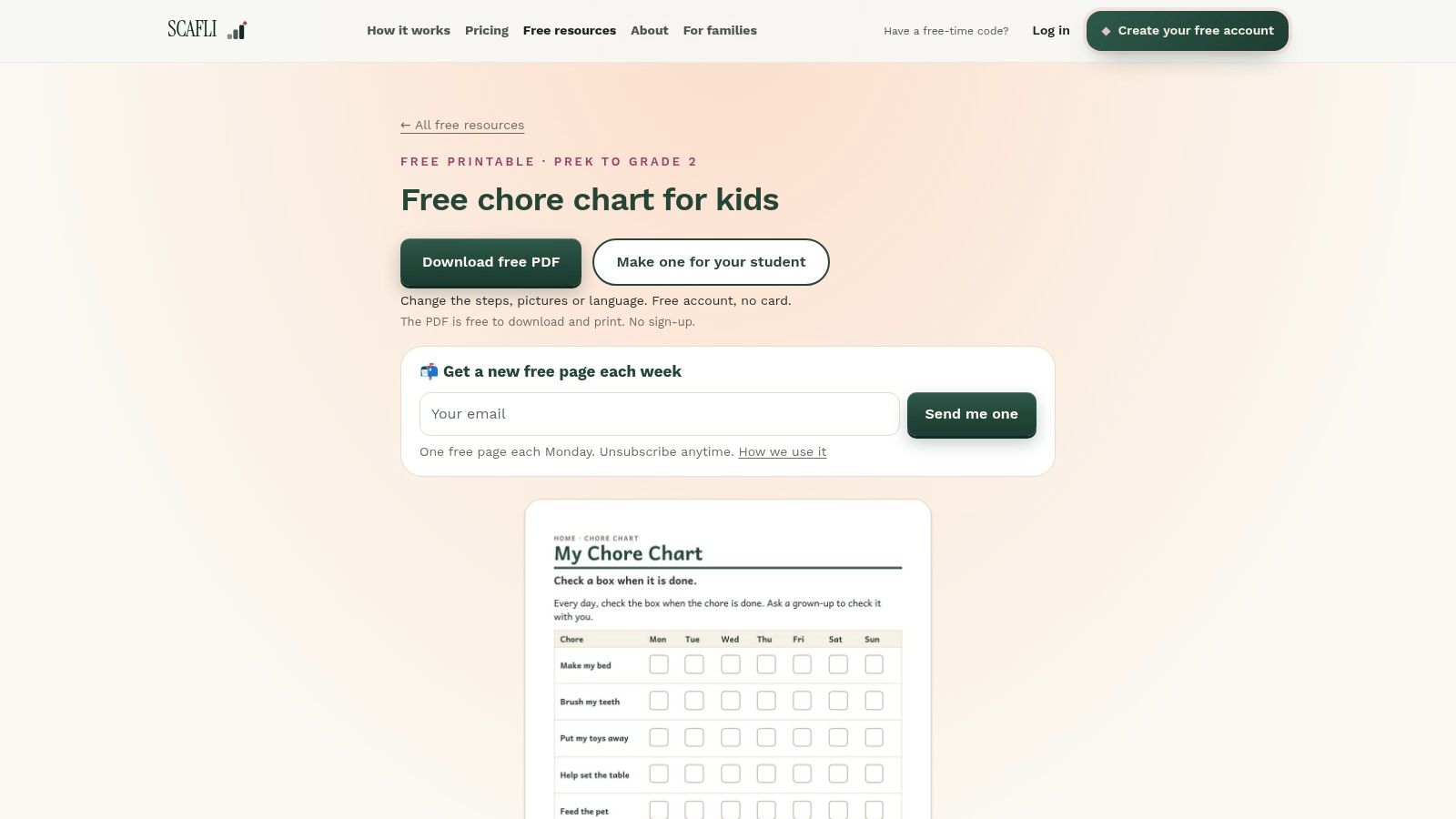
A child who needs the same visible routine each day may be better served by a stable printable than an app. SCAFLI offers a picture-supported weekly chore chart with daily checkboxes. Its sample includes familiar jobs such as making the bed, putting toys away, setting the table, and feeding a pet.
You can request custom chores and wording, which helps when generic instructions don't match your household. The listed PDF resource is available without signing up, and the site also offers visual routine and reward printables.
Use it as a sequence, not wallpaper
A 2022 systematic review of visual activity schedules for children with ADHD found only four eligible studies, with promising findings for on-task behavior and independence. That's a small evidence base, not proof that any picture chart will work for every child.
Make the routine teachable:
- Keep the order consistent: Follow the same direction across or down the chart.
- Show an observable action: Use put toys in the basket rather than clean the playroom.
- Demonstrate completion: Show when and how to mark the checkbox.
SCAFLI works best when the pictures carry the instruction and the routine changes infrequently. Custom wording won't help a pre-reader if the accompanying image is ambiguous, so inspect picture fit before using the chart.
There are no automatic updates or reminders. Someone still needs to introduce the chart, reset it, and help with transitions until the child understands the routine.
4. TinyTasks
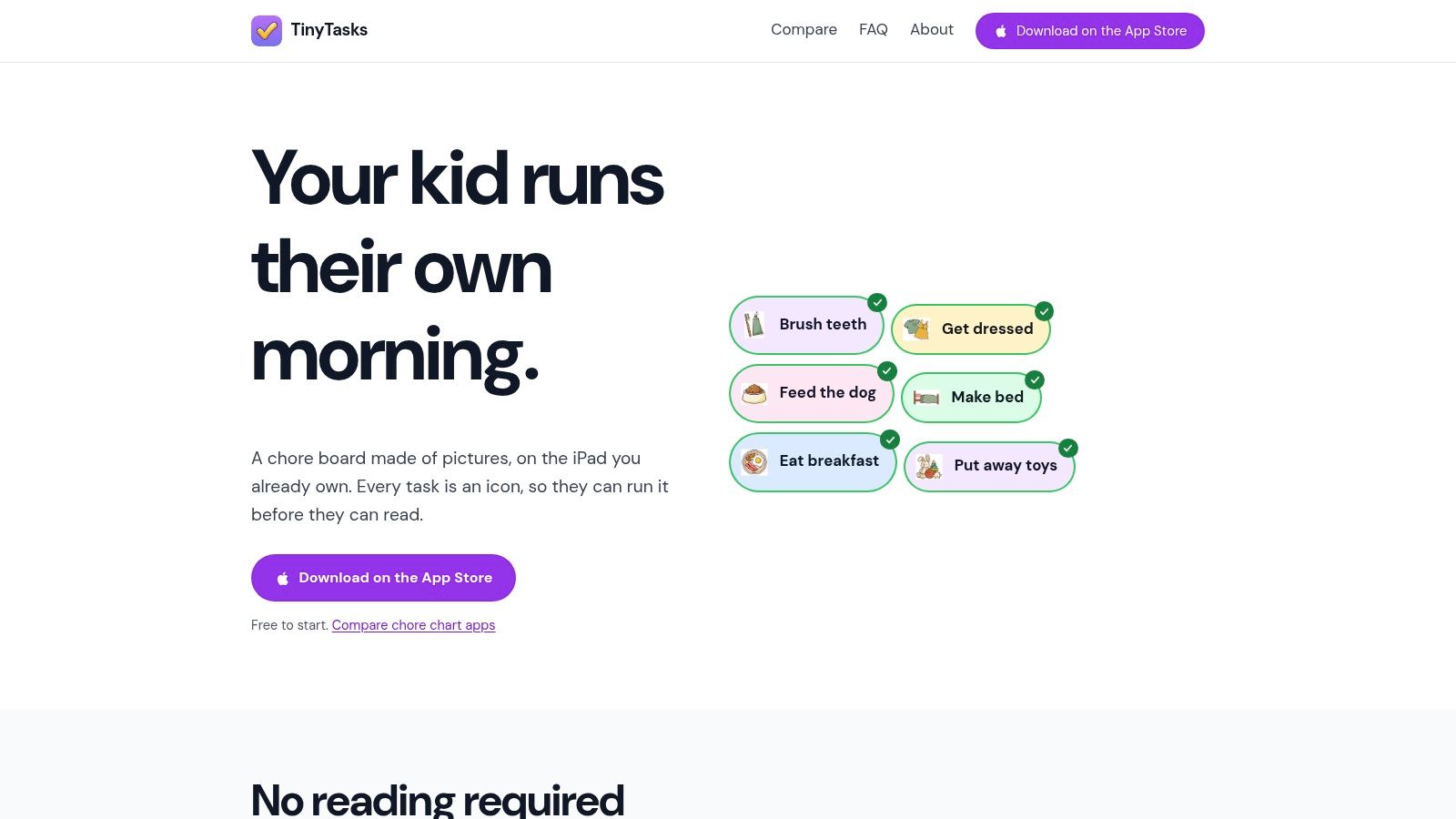
TinyTasks replaces the printed sheet with an interactive iPad board. Children use illustrated task cards and move work from to-do to done. TinyTasks also provides child profiles, a parent dashboard, scheduling, and celebrations when the day's tasks are complete.
This is the clearest digital choice here for children who depend on pictures rather than written lists. Daily, weekly, afternoon, and one-off scheduling lets parents maintain routines without rewriting a paper chart.
The trade-off is the device itself. An existing iPad can become a household display, but a tablet tucked into a drawer won't provide a visible cue.
Placement matters: Keep the board where the routine starts, and make sure the child can reach and use it without finding an adult's device.
Digital scheduling isn't the same as independence
Walk through the task cards together at first. Explain whether done means the child has finished the job or an adult has checked it. A completion celebration can encourage participation, but it can't establish what a properly completed task looks like.
A field-based intervention examining visual supports reported decreased adult prompting after implementation. That finding supports teaching a visual routine, not assuming a screen alone will remove reminders.
TinyTasks is iPad-focused, not a general Android household organizer. Free access is limited, with additional functionality requiring Plus. It's a stronger fit for children's routines than adult cleaning rotations.
5. Quokka Chart to Finish
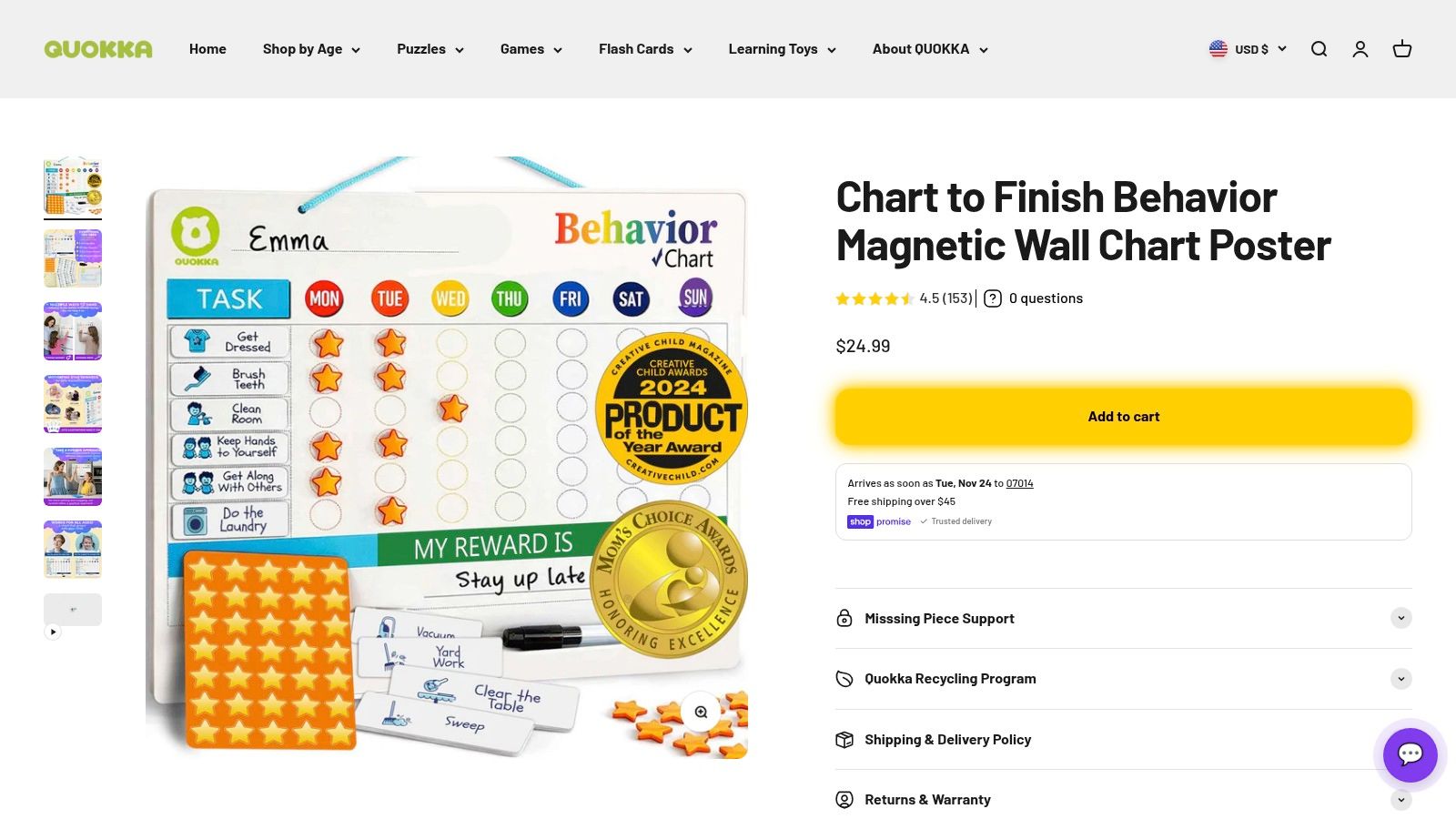
Choose Quokka Chart to Finish if you want a reusable physical board that combines illustrated tasks, goals, and rewards. Its magnetic and dry-erase format avoids repeatedly printing charts. You can place it on a magnetic surface or hang it on a wall.
The pictures help younger children identify jobs, while marker-based entries let you adapt the board as reading skills develop. Unlike a PDF, movable pieces make it easier to change the visible routine without replacing the whole chart.
Separate household jobs from behavior goals
Combining chores and behavior targets can be convenient, but the distinction should stay clear. Putting shoes away is a concrete action. Being helpful is open to interpretation and harder for a child to mark fairly.
- Use chore magnets for actions: Match the picture to something the child can do.
- Define rewards in advance: Avoid changing the conditions after work is complete.
- Keep assignments visible: Don't let reward tracking obscure who owns each job.
A child's board also shouldn't become the household's only record of responsibility. Adults coordinating cleaning need shared chore assignments, not just a view of children's completed tasks.
Quokka suits families comfortable with a reward-chart format and a permanent display space. It's less suitable if you want discreet adult coordination or remote access. Check the official product page for current price and availability, and plan who will reset the board.
6. Blueprint by JK Preschool Magnetic Chore Chart Kit
Moving a magnet may be easier than holding a marker and checking a small box. The Blueprint by JK Preschool Magnetic Chore Chart Kit is designed around that tactile interaction. It includes an illustrated magnetic dry-erase board, movable routine magnets, a marker, and a holder.
Its focus is toddler and preschool routines rather than a whole household's cleaning schedule. Add-on illustrated magnet sets offer more choices, though you'll still need to confirm that the pictures cover your child's actual tasks.
Match the magnet to the real action
A bed picture could mean make the bed, get into bed, or put pajamas away. Place the magnet beside a short, consistent label and demonstrate the intended action. If your child repeatedly misreads it, change the visual rather than repeating the same explanation louder.
A picture does the real work only when the child can use it to identify the next action.
This kit makes sense when you prefer a ready-made board to printing, cutting, and laminating your own materials. The included holder also gives the marker a designated place, which helps keep the system usable.
The limitations are physical and practical. Magnets can go missing, the board needs accessible display space, and household-specific jobs may not match the supplied illustrations. Follow the product's age and safety guidance, especially around small pieces.
Availability is another consideration. Check the live listing before planning your routine around this kit. If it's unavailable, a printable with clear pictures can test the same routine without waiting for a particular board.
7. Benny
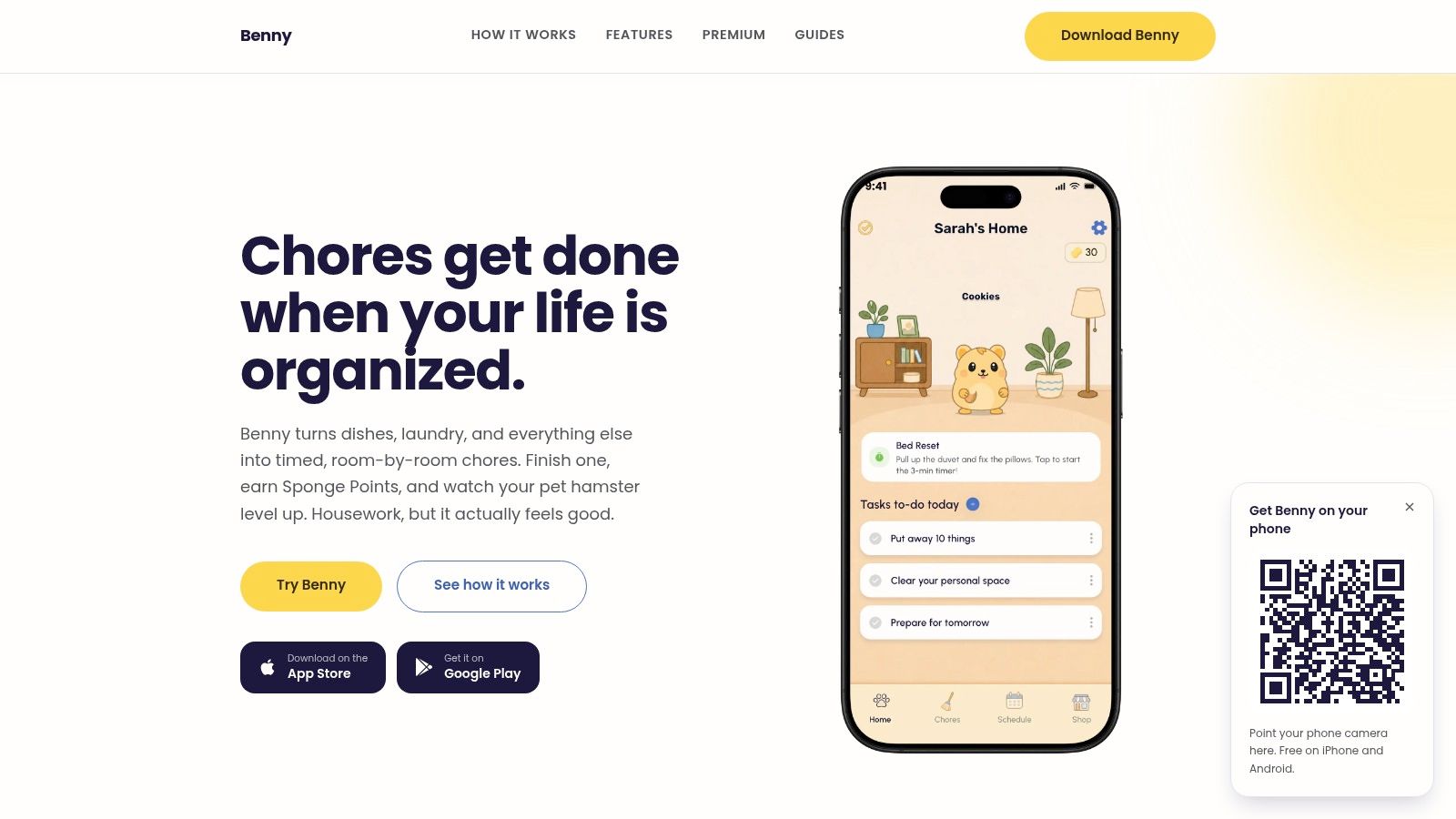
Benny is the adult-coordination option, not a picture-card chart for pre-readers. Our app organizes chores by room, supports custom tasks and recurring schedules, and gives household members the same view of assignments and completion. It works across iPhone and Android.
That makes it a better fit when everyone understands the task but forgets when it's due or assumes someone else will handle it. Reminders and timers support execution, while recurring chores return automatically rather than requiring a fresh weekly sheet.
Assign ownership, not just a checkbox
A study of 2,133 partnered U.S. parents found that mothers reported responsibility for 13.72 household-management tasks on average, compared with 8.18 for fathers. A shared completion record won't, by itself, redistribute the work of noticing and planning.
Use explicit agreements alongside the app:
- Name the owner: Assign a person rather than leaving routine jobs unclaimed.
- Define done: Agree whether laundry includes drying, folding, and putting clothes away.
- Include preparation: Decide who notices low supplies and arranges replacements.
Completed chores earn Sponge Points that advance a virtual hamster, with points awarded when work is finished before its timer expires. That can provide motivation, but it won't appeal equally to everyone.
Core scheduling, reminders, timers, and shared assignments are free. Optional Premium adds features such as widgets and extra schedule controls. The main limitation for this comparison is straightforward: it isn't designed around illustrated instructions for children who can't read yet.
How the 7 picture-based chore chart options compare
| Item | Best for | Format | Picture coverage | Reminders or live updates |
|---|---|---|---|---|
| Tic Tac Teach | Young children and simple family chore charts | Printable chart | Picture beside each chore | No built-in reminders or live updates |
| Printablesmith | Parents seeking chore ideas and printable charts for children | Weekly PDF | Pictures for common chores; unmatched chores appear as text | No digital reminders or live updates |
| SCAFLI | Young children who benefit from visual routine charts | Printable PDF | Pictures for listed chores; custom-task picture fit may vary | No automatic updates or reminders |
| TinyTasks | Children using an iPad-based visual chore board | Interactive iPad app | More than 90 chore icons | Scheduled tasks; no reminder details specified |
| Quokka Chart to Finish | Children using a reusable chore and reward board | Magnetic, dry-erase board | Illustrated chore and behavior magnets | No digital reminders or live updates |
| Blueprint by JK Preschool Magnetic Chore Chart Kit | Toddlers and preschoolers following daily routines | Magnetic, dry-erase kit | Illustrated routine magnets; household-specific coverage may vary | No digital reminders or live updates |
| Benny | Couples and roommates coordinating shared chores | Shared mobile app | Not designed around picture cards | Recurring schedules, reminders, and chore timers |
Pick the Chart Your Household Will Actually Use
Choose a chore chart with pictures by testing what the reader needs to do without your explanation. For a pre-reader, the picture should identify the action. For a school-age child, a picture can support a short label. For adult housemates, the more important requirement may be seeing who owns the job and when it's due.
A printable such as Tic Tac Teach, Printablesmith, or SCAFLI is a sensible starting point when the routine is stable. Magnetic boards suit children who benefit from handling the task pieces. TinyTasks adds interactive cards and scheduling when an iPad can stay accessible.
Run a short household trial
Try a two-week trial with a chart before adding more tasks or buying extra materials. That's a practical testing period, not a deadline for independent behavior. Watch what gets missed and identify the reason.
- The picture is misunderstood: Replace it with a clearer visual or a photograph beside the chart.
- The job is too broad: Split it into observable actions with an obvious finish.
- Nobody checks the chart: Move it to the place where the routine begins.
- An adult still manages everything: Reassign planning and resetting responsibilities, not just execution.
Show children how to use the chart before expecting them to follow it alone. Keep tools and supplies within appropriate reach, and review whether the task matches their abilities.
For adults who need reminders and visibility, use a shared digital schedule rather than expecting decorative icons to fix forgotten work. Core scheduling, reminders, and timers are free in the app described above, making that approach available alongside a physical children's chart.
The best choice isn't necessarily a single system for everyone. A visible picture board for a child and a shared digital list for adults can serve different needs, provided each responsibility has a clear owner.
Benny gives your household a shared chore list with recurring schedules, reminders, and timers, so adults can coordinate the work behind a child's picture chart. Visit Benny to set up room-based chores, assign responsibilities, and see what's due and what's finished.