You've printed a chart before, filled it in with good intentions, and watched it go blank again by the second Wednesday. That's normal. The template isn't the hard part, it's picking a layout that fits one child, several children, roommates, or a rotating household, then writing chores specific enough that nobody has to guess what done means.
This list sorts ten options by how households work, from plain weekly grids to chore cards, wheels, and an app. The International Labour Organization report estimates people perform 16.4 billion hours of unpaid care work every day, and that women perform 76.2% of all unpaid care-work hours globally. A Chore Chart Blank won't fix that scale of imbalance on its own, but naming tasks, owners, and frequency at least makes the work visible before it becomes an argument.
Table of Contents
- 1. Benny
- 2. Ready Set Printables
- 3. Canva
- 4. Made Good Designs
- 5. Choreeo Printables
- 6. Alpacto
- 7. Makefern
- 8. Utah State University Extension Mealtime Chore Chart
- 9. TidyTrackers
- 10. Edulist Chore Chart Maker
- Blank chore chart options at a glance
- Pick Your Chart, Then Make It Survive Week Two
1. Benny
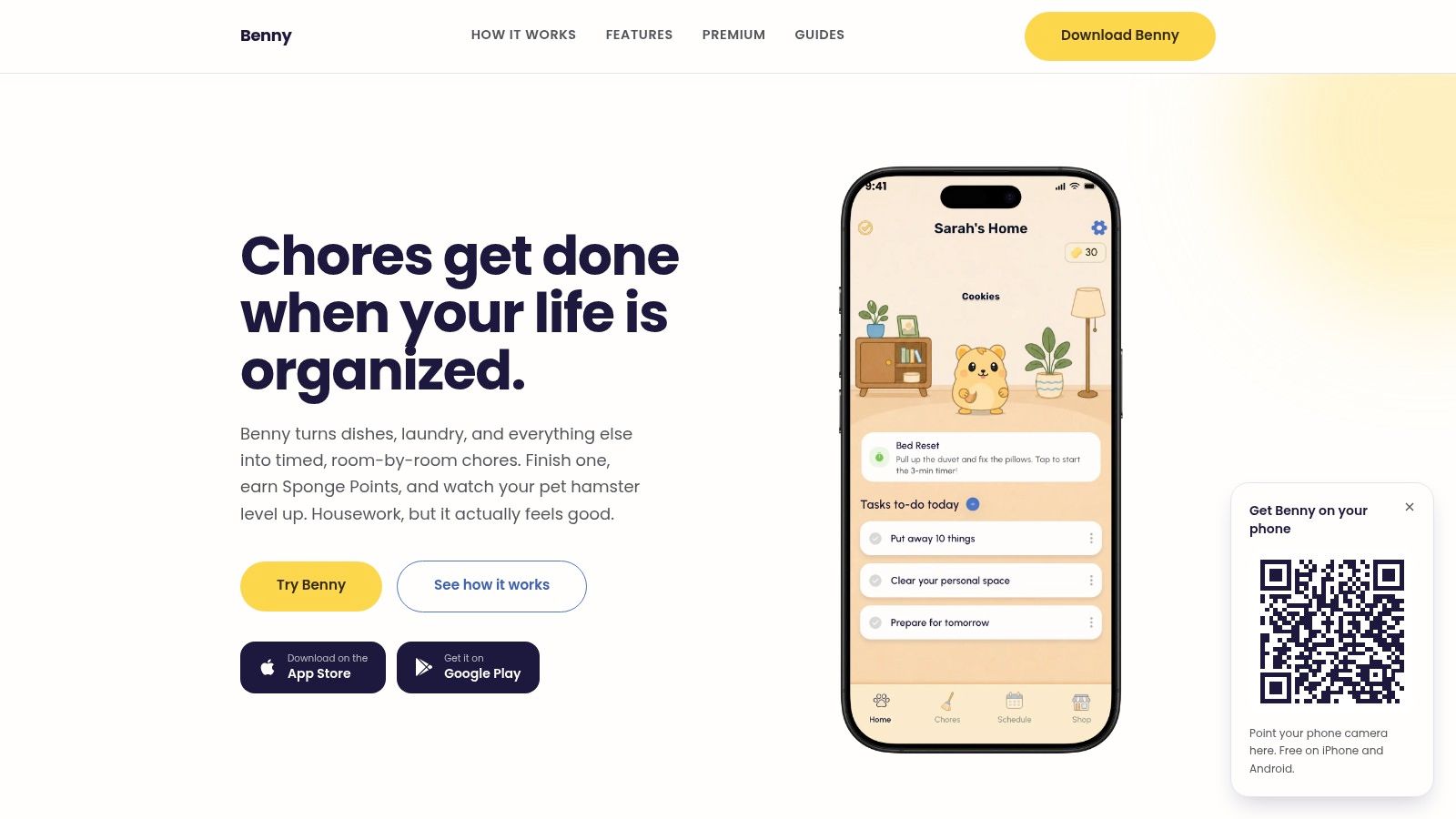
Benny is the one entry here that never touches a printer, and that's the point. You build the chart you'd otherwise handwrite, using room-by-room presets for kitchens, bathrooms, bedrooms, and living rooms, or you add custom chores from scratch. Each chore can be one-off or recurring, gets its own timer, and triggers a reminder when it's due. In a shared home, everyone sees the same schedule, who owns what, what's finished, and what's still waiting.
That matters because paper doesn't nag anyone. Participants in an arXiv study of time-management tools reported that pen-and-paper planning could cause missed tasks because it didn't provide reminders. Recurrence plus notifications means you're not rebuilding the same grid every Sunday night.
How to Fill It In
Start with one room, not the whole house. Pick the bathroom, set wipe sink and mirror to recur twice weekly with a short timer, assign it, and let the schedule repeat itself. Add a second room only once the first one holds.
- What's good: Free core scheduling, reminders, timers, and shared lists across iPhone and Android
- What's fun: Finish a chore before its timer runs out and it earns Sponge Points, which level up a virtual hamster and can be spent on accessories in the in-app shop
- What Premium adds: Widgets, chore and room filters, mood-based smart chores, and protected snoozing and skipping that keeps streaks intact
The trade-offs are real. The timer gate means a half-finished job earns nothing, and a hamster reward loop won't motivate every adult. I recommend it when forgetting, not willingness, is your actual problem.
2. Ready Set Printables
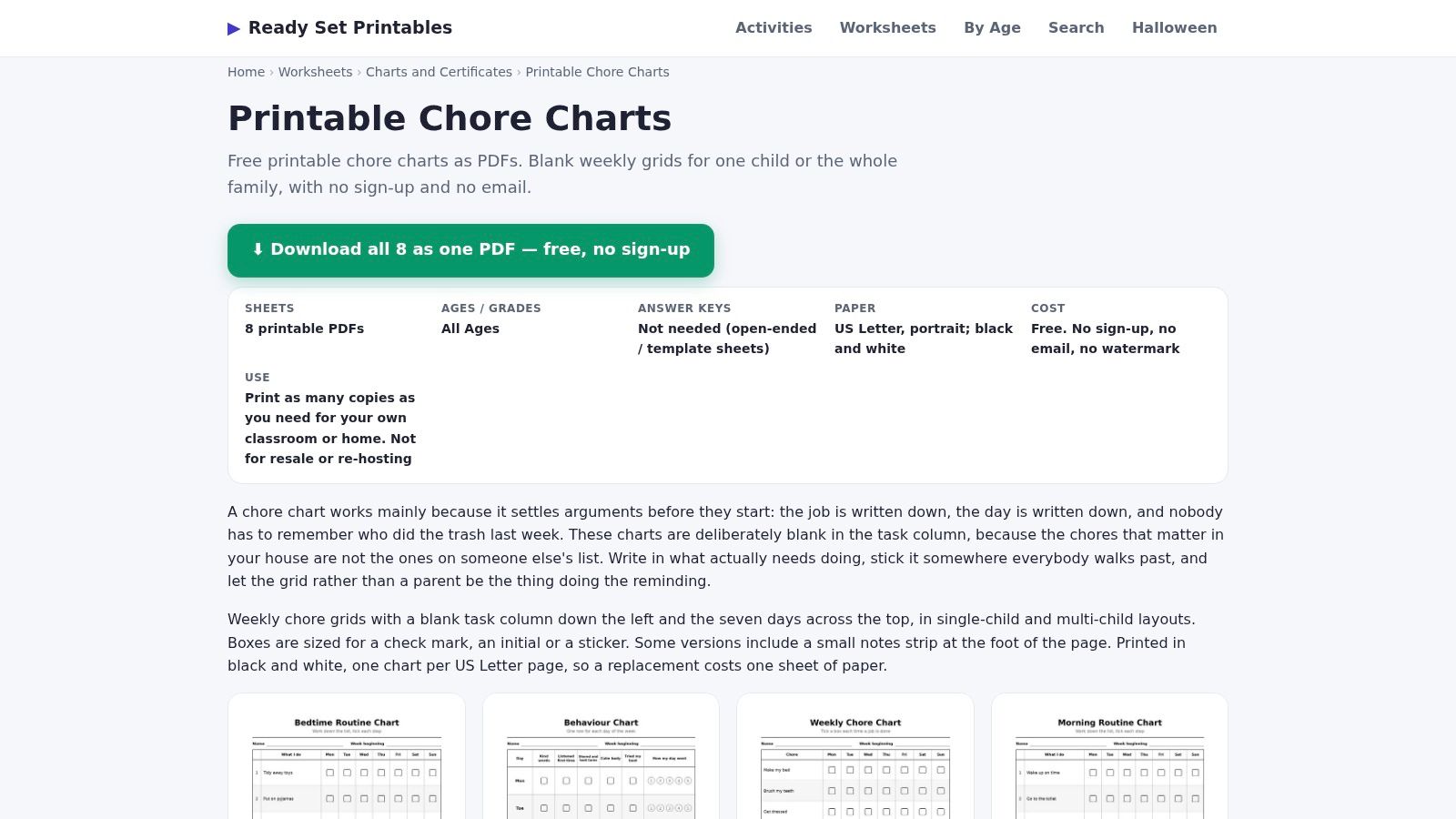
If you want ink on paper in five minutes, Ready Set Printables is the no-frills pick. The free PDFs give you blank task rows, a seven-day grid, and boxes sized for checks, initials, or stickers, in single-child and multi-child layouts. Some versions add a small notes strip. There's no sign-up indicated and the black-and-white US Letter design won't drain a color cartridge.
Fill it in with verbs, not room names. Write empty dishwasher before breakfast instead of kitchen. Keep the first week to four or five rows, laminate the sheet, and use a dry-erase marker so a bad week doesn't mean reprinting.
Where It Falls Short
It's built for handwriting, not digital editing, and it's framed for children rather than adults. Roommates sharing adult cleaning will outgrow the layout fast, which is why a written split matters more than the grid itself, something covered in this guide to splitting chores fairly with roommates.
The U.S. Bureau of Labor Statistics release reports that in 2024, 87% of U.S. women and 74% of U.S. men performed household activities on an average day. A simple grid makes that daily work recordable, but only if you check the boxes.
3. Canva
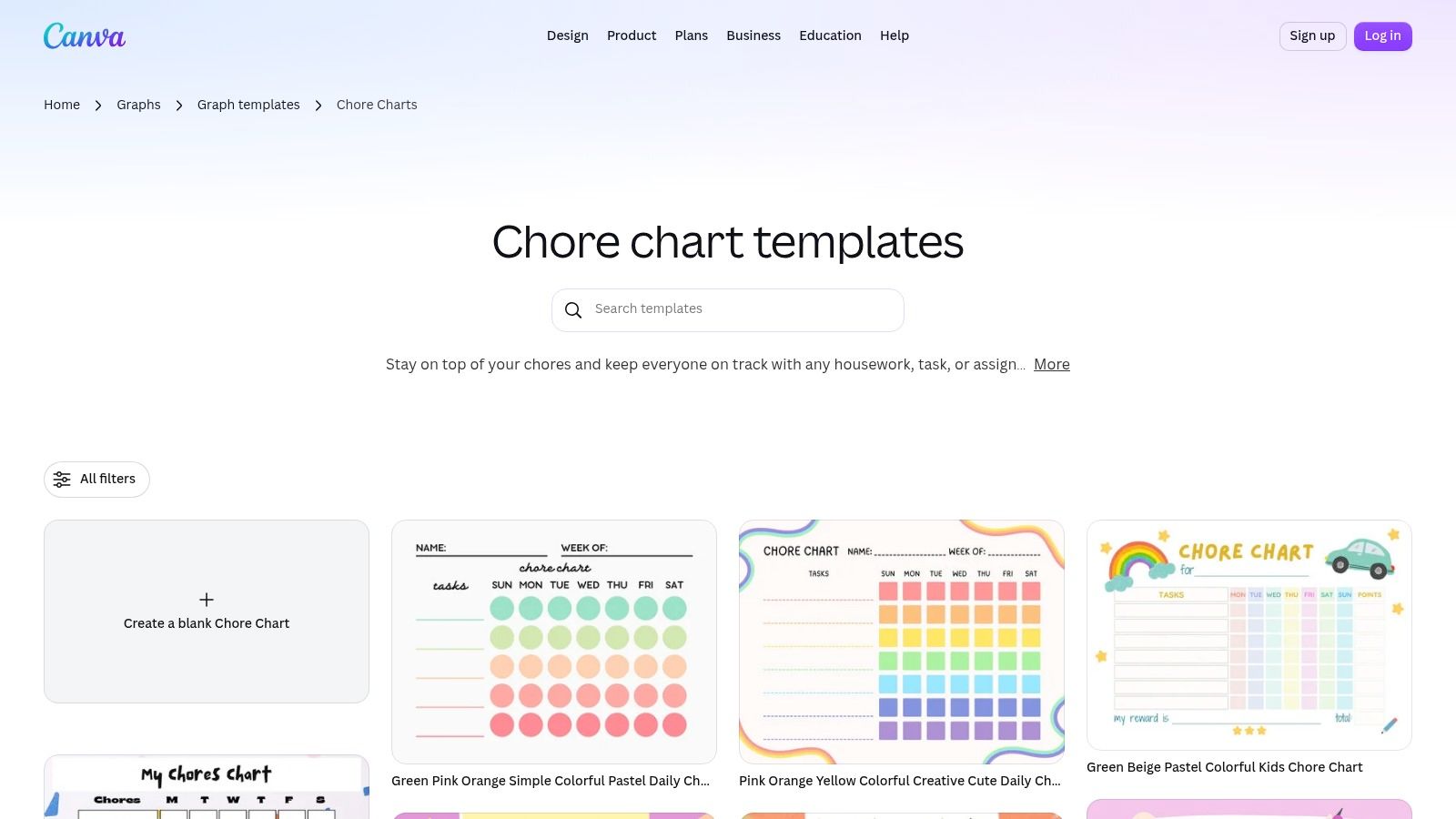
Canva suits households that reject every pre-made layout. You can start from a blank design or customize a ready-made template, changing labels, colors, fonts, and columns with drag-and-drop editing. Several people can edit the same file online, then export a polished printable.
That flexibility is useful when your household needs columns printables don't offer, like estimated minutes or supplies needed. Build those columns in from the start rather than squeezing notes into margins later.
Practical rule: Design for the fridge door, not the screen. If you can't read a chore from three steps away, your font is too small.
The cost is setup time. You need an account to save work, and some content or features may sit behind a paid plan. Canva makes sense when you'll reprint the same customized chart for months. If you just need a grid tonight, it's overkill, and a pre-made PDF will beat an hour of choosing fonts every time. Save a master copy before you start tweaking colors each month.
4. Made Good Designs
Made Good Designs offers the widest format choice in one free browser tool. Beyond individual child charts and shared family charts, it generates cut-out chore cards and a rotating chore wheel, with optional points, rewards, and icons. You enter names and chores, configure print settings, and download a printable PDF without a sign-up indicated.
Choose the format by your failure mode. Cards work when kids do better drawing one job at a time. A wheel works when the same person keeps landing the bathroom and everyone knows it. Rotation settles the fairness argument mechanically instead of weekly.
The Mental Load Gap
Most charts track who does a task, not who notices, plans, and checks it. A British Psychological Society summary reports mothers handled 71% of household mental-labor tasks versus 45% for fathers. Use the tool's custom fields to name an owner for supplies and follow-up, not just an executor.
The trade-off is configuration time, and the points system won't suit families who don't want rewards attached to basic contribution. Turn points off if that's you. The formats still earn their place without them.
5. Choreeo Printables
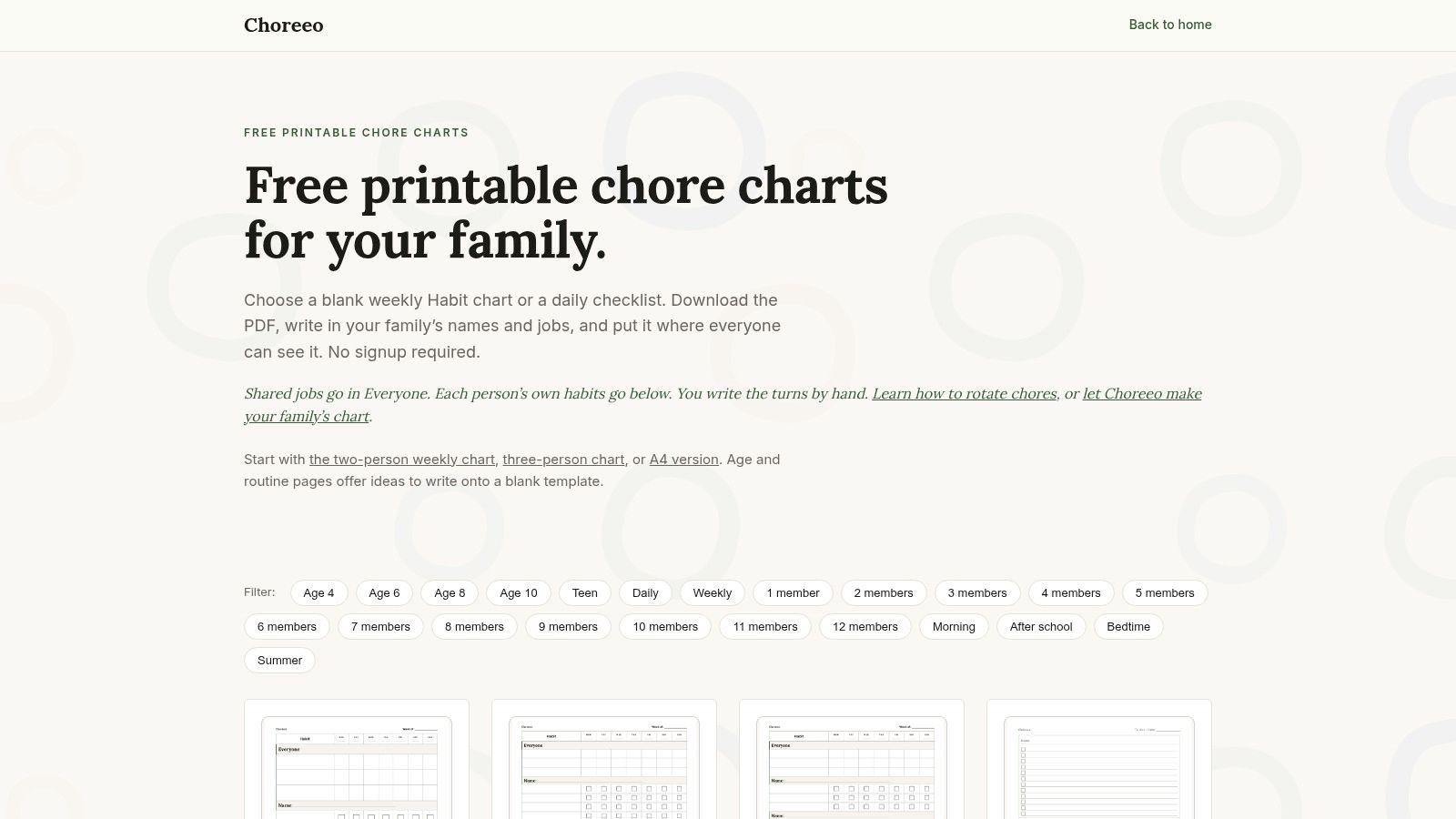
Choreeo Printables covers households that plain one-child grids don't, with layouts for one to twelve people in US Letter and A4. The useful distinction here is separation. Some charts split shared household jobs from personal habits, and separate morning, after-school, and bedtime checklists keep routines from crowding the chore grid. There's also a small 5×7 option for a desk or bathroom mirror.
That split matters in practice. Brush teeth and scrub the shower shouldn't compete for the same checkmarks. Put personal routines on their own checklist where your child sees them, and keep shared jobs on the family chart in the kitchen.
The Australian Bureau of Statistics time-use release reports Australian parents living as a couple with children under 15 spent an average of 6 hours 16 minutes per day on unpaid work in 2024. With that much work in a day, a chart covering everyone beats one tracking only the kids.
Charts are completed by hand, the variant range takes browsing, and the site asks you to keep its name on the paper and not sell the files.
6. Alpacto
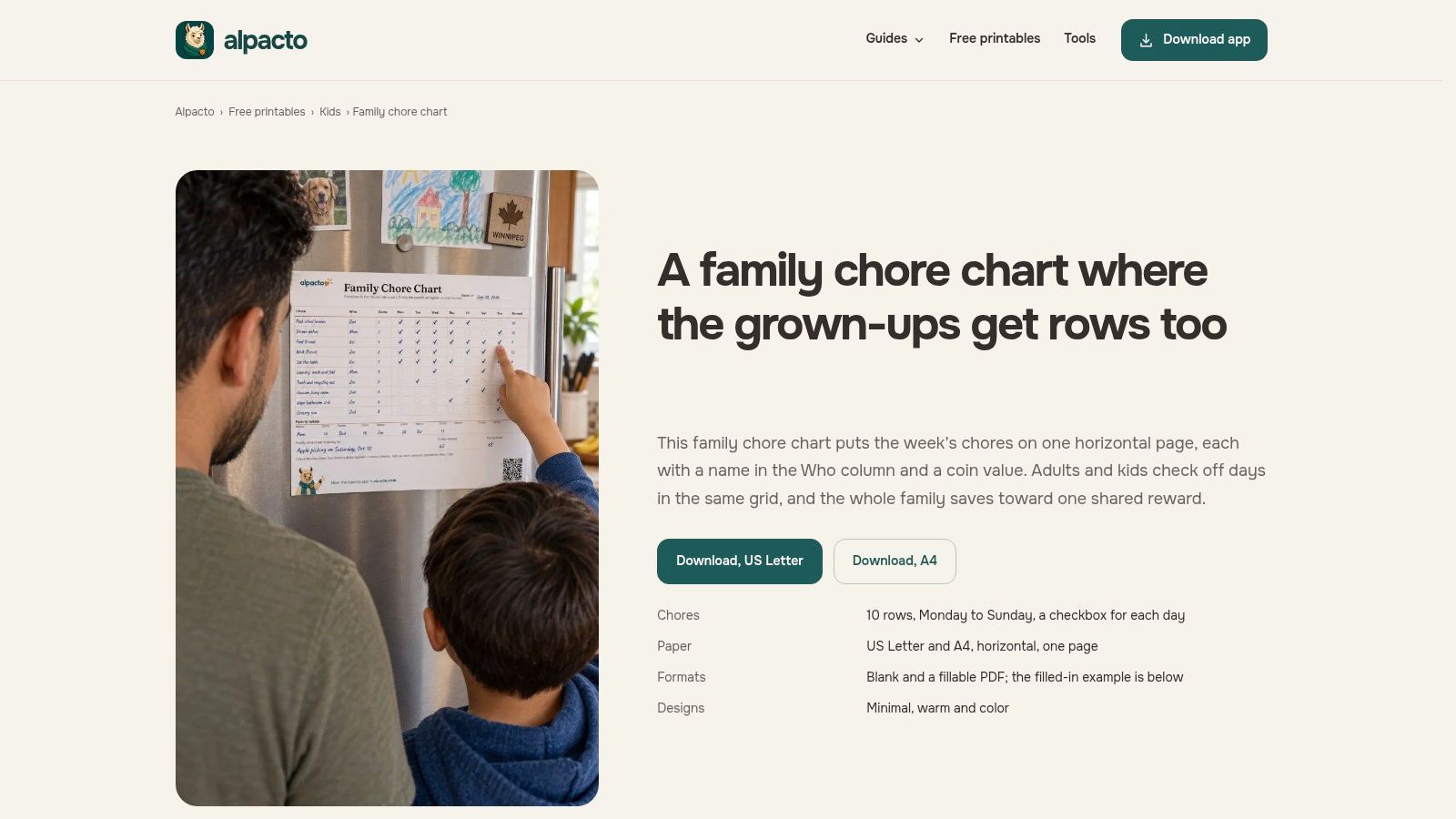
Alpacto puts adults and children on one shared chart instead of giving each child a separate sheet. The layout includes a Who column, daily checkboxes, a shared total, and optional coin or point tracking. Both blank and fillable PDFs come in Letter and A4, across several design styles.
That single shared view addresses a real pattern. Germany's FReDA family panel summary found women were primarily responsible for laundry in 71% of couples, cleaning in 66%, and cooking in 58%. When everyone appears on one page, that kind of concentration gets harder to miss.
How to Balance the Rows
Count minutes, not rows. A daily ten-minute kitchen reset outweighs a monthly garage tidy, so write an estimated time beside each chore when you fill the chart in. Rebalance weekly based on totals, not task counts.
- Best for: Mixed-age households wanting one visible chart
- Watch out for: Point systems that turn every job into a negotiation
The fixed weekly layout offers less customization than an editor, and coins won't fit every family. The fillable version at least saves re-handwriting recurring jobs.
7. Makefern
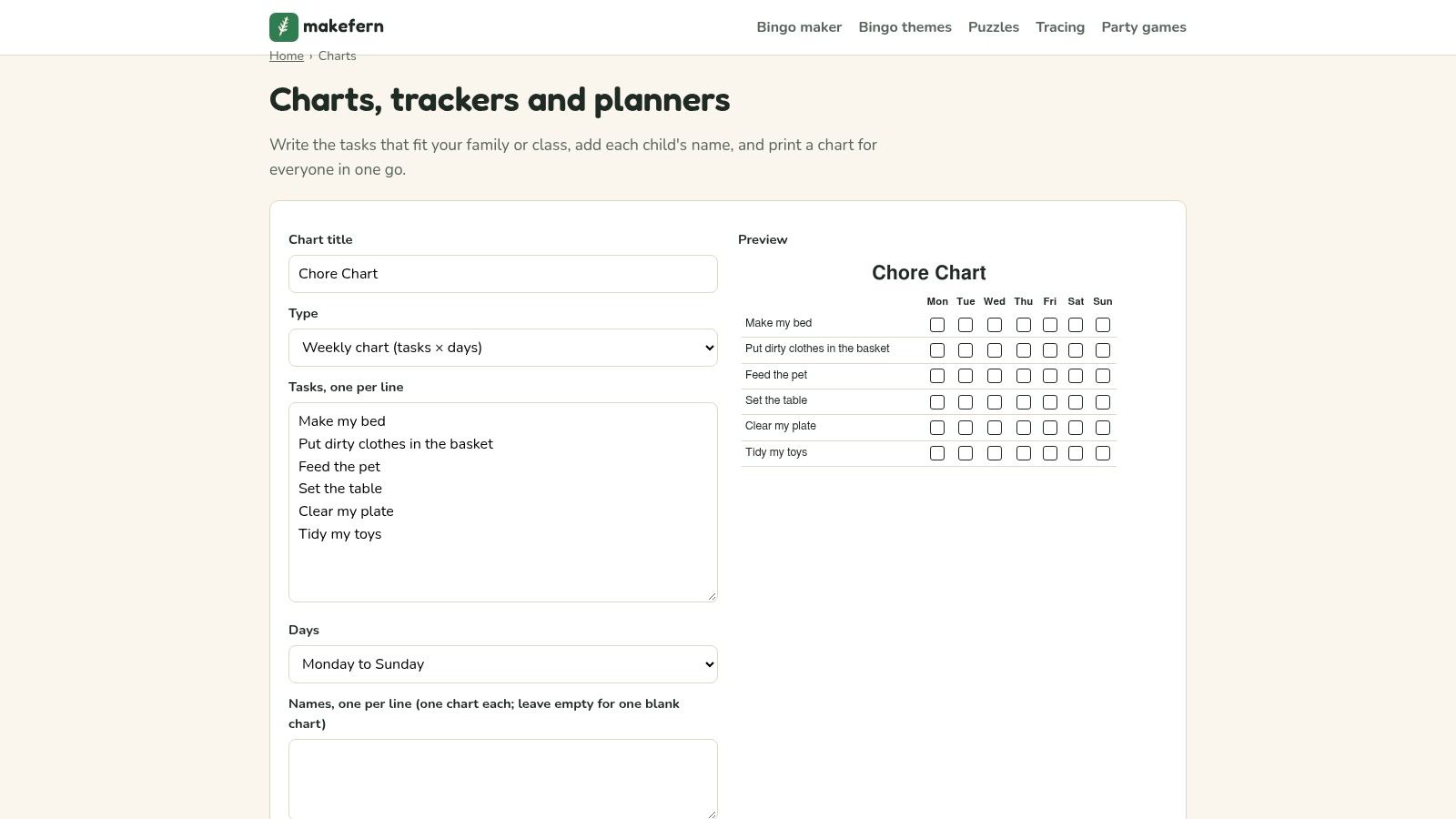
Makefern is the batch-production option. Enter tasks, days, and names, or leave the name field empty to generate a blank chart, and it produces multiple personalized charts in one PDF, up to 40 per file according to the site. Optional goal and reward fields are built in, alongside routine and habit tracker formats, with no sign-up or watermark indicated.
That's useful for three or four children with different jobs. Generate each child's chart in one session, print the set, and nobody's arguing that a sibling got an easier sheet because you made them on different days.
Personalization also helps you grade difficulty. A six-year-old's chart shouldn't carry the same jobs as a twelve-year-old's, and separate sheets let you write age-appropriate versions of helping in the kitchen without cluttering one grid.
A chart per child works only if each child can find their chart. Same spot, same magnet, every week, or you're printing decorations.
Makefern generates printables rather than managing live coordination, and adults or roommates aren't its main audience. For one child, a single plain PDF is faster. For several, the batch output saves real time.
8. Utah State University Extension Mealtime Chore Chart
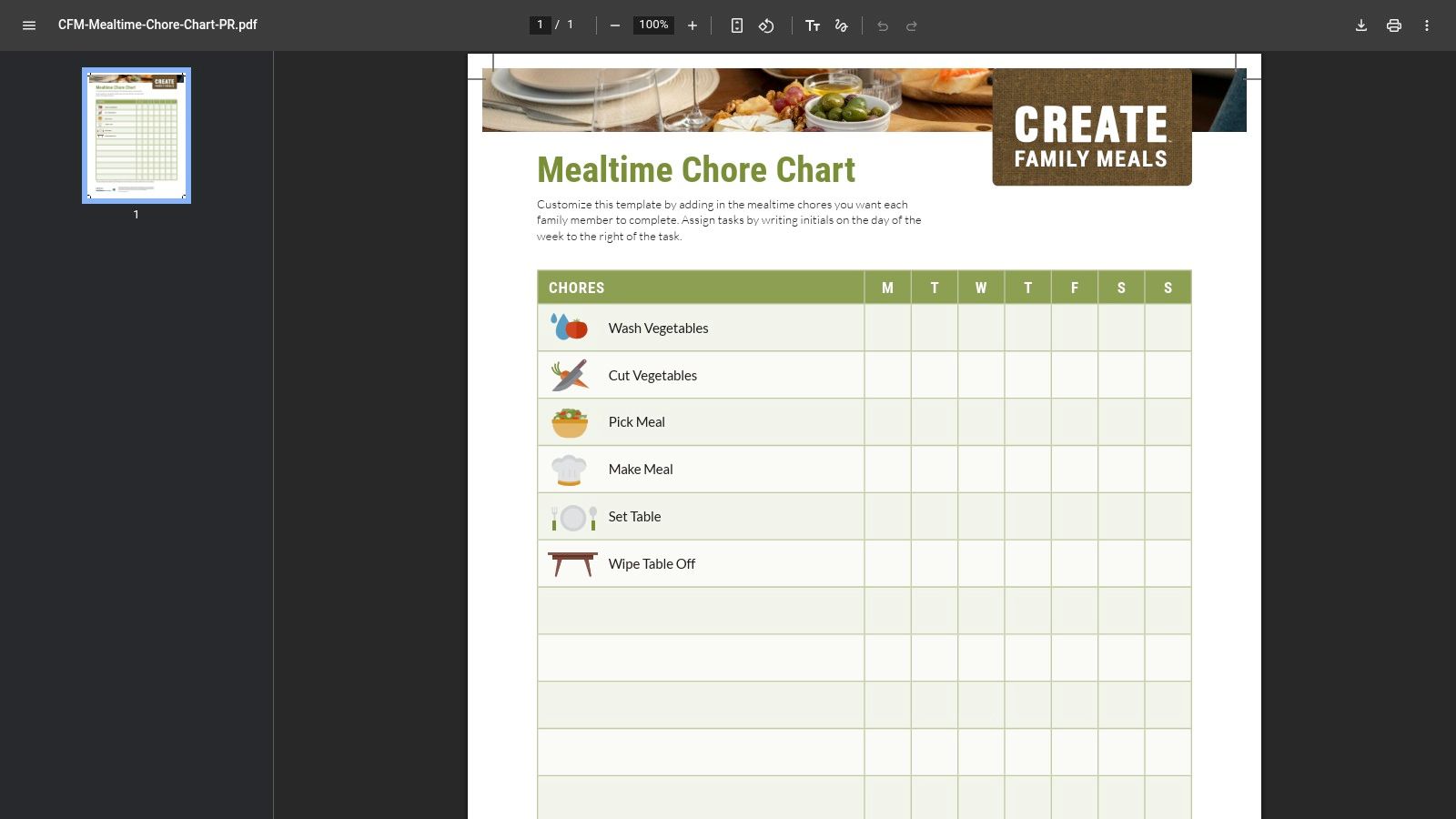
The Utah State University Extension mealtime chart does one job narrowly and well. It covers meal preparation and cleanup across weekly day columns, with example tasks, blank rows for your own, and assignment by initials beside each day. It's a free PDF from a university extension program, printed and completed by hand.
Narrow charts survive longer than ambitious ones. If dinner cleanup is your household's nightly flashpoint, charting only that routine, who cooks, who clears, who wipes counters, beats a whole-home system nobody maintains. The example tasks give you a starting vocabulary for the blank rows.
The OECD household services report reports women devote an average of 158 minutes per day to non-care housework across OECD member countries, while men devote 72 minutes. Mealtime work is a large daily slice of that gap, which is exactly why initials-by-day assignment helps.
The limits are obvious. It won't organize bathrooms or laundry, there's no digital editor, and coordination across a full home needs something broader, along the lines of shared chore lists for the whole household. Use it as one module, not your whole system.
9. TidyTrackers
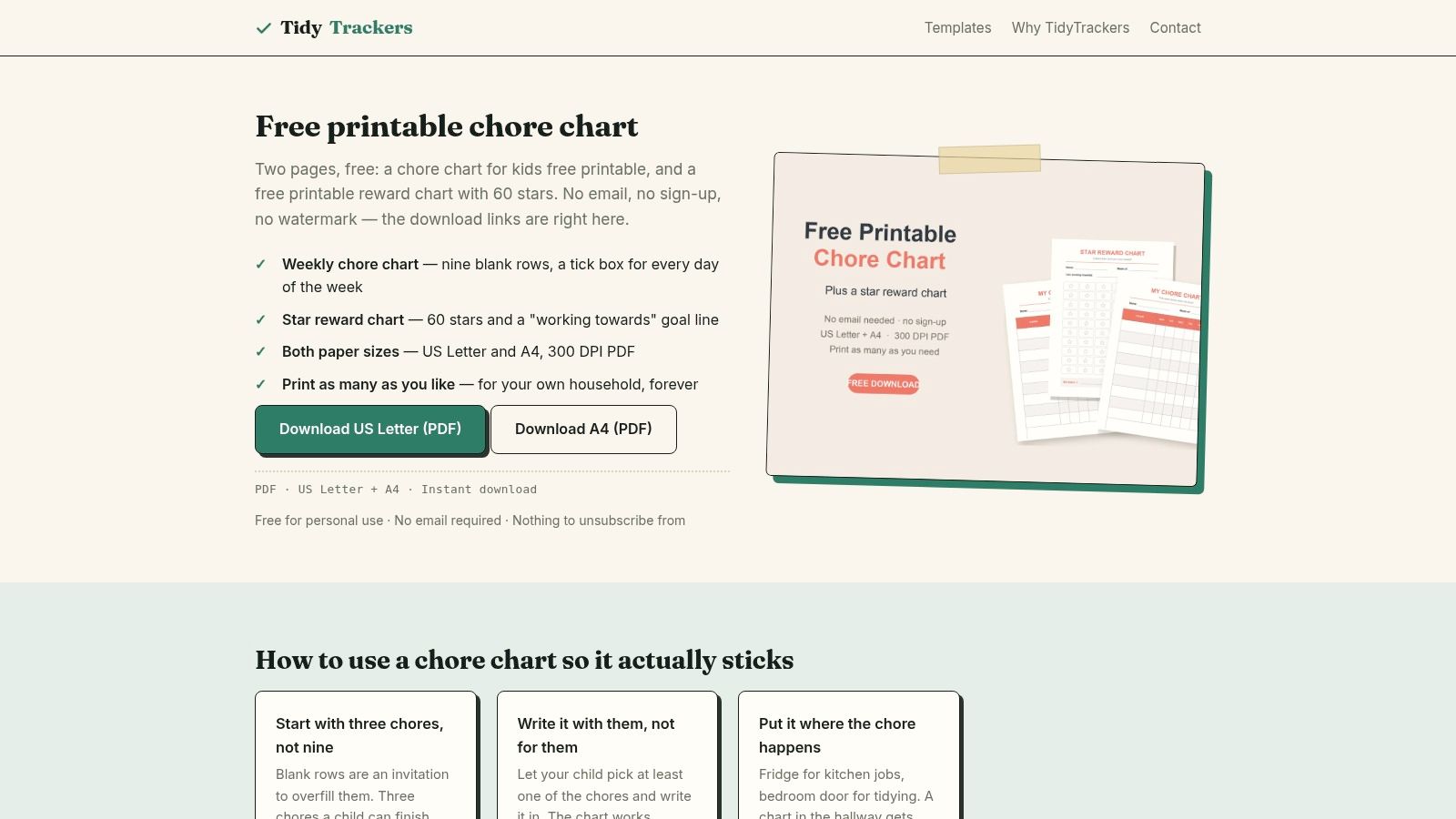
TidyTrackers keeps the commitment deliberately small. You get a weekly chart with nine blank rows, a checkbox per day, and a separate 60-star reward chart, in US Letter and A4. Files are free for personal household use, with no email sign-up or watermark indicated.
Nine rows is a feature, not a limitation, for a child starting out. Fill five rows in week one and leave the rest empty. A chart that's mostly checked builds the habit, while a full grid with gaps reads as failure by Thursday.
Using the Star Chart Sensibly
Tie stars to effort, not just tallies. An Ipsos mental load survey found 78% of respondents experienced mental load at least weekly, which is a reminder that the remembering counts too. Let your child earn a star for starting a chore without being asked, since that noticing is the skill you want.
The fixed nine-row design won't grow with a teenager, it's aimed at children, and files aren't for resale. As a starter chart, though, quick and small beats elaborate and abandoned.
10. Edulist Chore Chart Maker
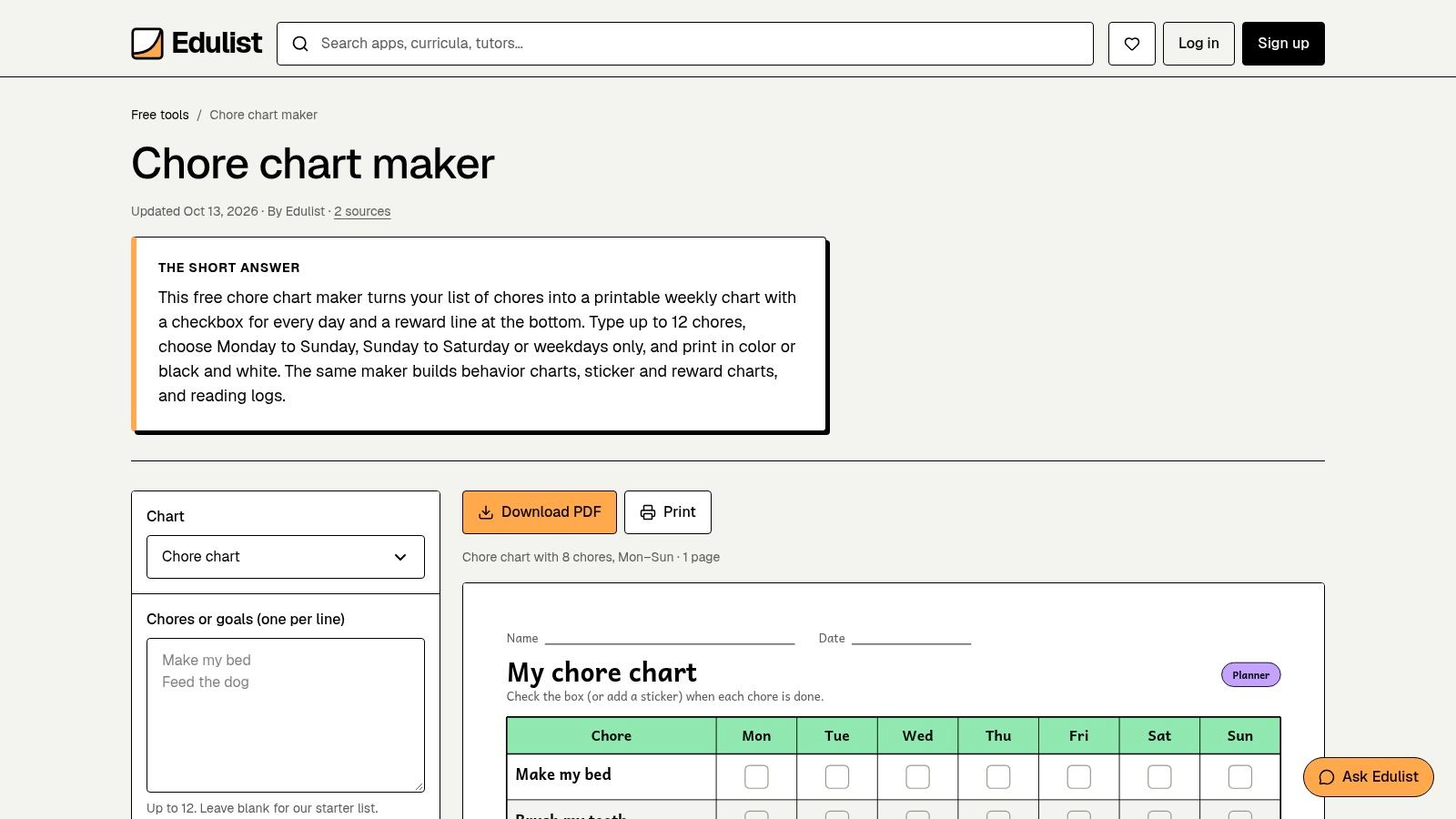
Edulist Chore Chart Maker gives you schedule choices most printables skip. Enter up to twelve chores, or leave the field blank for a starter list, then pick a Monday-start, Sunday-start, or weekdays-only layout. Output comes in Letter or A4, portrait or horizontal, color or black and white, with an optional reward line.
Weekdays-only is the underrated option. If weekends run on sports and family visits, a seven-day grid fills with empty boxes that look like missed chores. Matching the chart to your real planning cycle, the same principle behind a proper recurring chore schedule, keeps the record honest.
Roy Morgan reporting of the Taking the Pulse of the Nation survey found Australian women performed an average of 22.3 hours of unpaid domestic work per week in March 2024, compared with 15.3 hours for men. Weekly totals like that are why the chores you write in matter more than the template's colors.
It's framed mainly for children, offers less design flexibility than Canva, and generates a static printable with no reminders. Sticker, behavior, and reading charts on the same site are a bonus.
Blank chore chart options at a glance
Every option here gives you a blank chart. The main difference is who the chart was built for and how much you can change before printing, so read the Best for column before the design column.
| Format | Best for | Customization | Sign-up required | Cost |
|---|---|---|---|---|
| Benny (recommended), mobile app | Shared, recurring household chores | Room presets, custom chores, timers, schedules, and Sponge Point rewards | Yes, account needed for shared homes | Free core app; optional Premium subscription billed through the app stores |
| Ready Set Printables, PDF | Simple handwritten weekly charts for children | Blank rows; single- or multi-child layouts | No sign-up indicated | Free |
| Canva, online editor and printable exports | Polished charts with collaborative editing | Extensive templates, colors, fonts, labels, and layouts | Yes, to save work | Free options; some content or features may be paid |
| Made Good Designs, browser-based chart maker and printable PDF | Family charts, chore cards, or rotating assignments | Names, chores, points, rewards, icons, and formats | No sign-up indicated | Free |
| Choreeo Printables, printable charts and checklists | Different household sizes and daily routines | Choose from layouts and paper sizes; fill in by hand | No sign-up required on printable page | Free |
| Alpacto, blank and fillable PDFs | Shared family chore tracking | Multiple designs and paper sizes; fixed layout | No sign-up indicated | Free |
| Makefern, chart maker and printable PDF | Creating multiple personalized charts at once | Enter tasks, days, and names; optional goals and rewards | No sign-up indicated | Free |
| Utah State University Extension Mealtime Chore Chart, printable PDF | Assigning meal-preparation and cleanup tasks | Blank rows and initials-based assignments | No sign-up indicated | Free |
| TidyTrackers, printable PDFs | A simple weekly chart with a companion reward sheet | Fixed nine-row layout; US Letter or A4 | No sign-up indicated | Free for personal household use |
| Edulist Chore Chart Maker, printable PDF | Customizing a weekly children's chore chart | Choose chores, week format, paper size, and reward line | No sign-up indicated | Free |
Pick Your Chart, Then Make It Survive Week Two
Match the format to the household you have. A single child needs one visible weekly grid with a handful of rows. Several children need either one shared chart with a Who column or separate personalized sheets pinned in the same spot. Adults and roommates need assignment and rotation more than stickers, so cards, wheels, and shared layouts beat cute designs. If you rotate, write the rotation into the chart itself (week A and week B initials) instead of deciding it fresh every Sunday.
Whatever you print, fill it in the same disciplined way. Write chores as specific actions with a finish line, so clean the bathroom becomes wipe the bathroom sink and mirror. Add a frequency and a rough time estimate beside each job. Five daily ten-minute tasks outweigh one monthly hour, and balancing by row count alone overloads whoever holds the daily work.
A Filling-In Routine That Holds
- Start at half capacity: Fill roughly half the rows in week one and add jobs only after a mostly-checked week
- Assign a single owner: One person owns noticing, supplies, and completion for each chore; a job assigned to everyone belongs to no one
- Define done in the row: Two or three words, like counters clear and wiped, end most quality disputes
- Post it at the work: Kitchen charts live in the kitchen, not on a bedroom door nobody passes
- Review for five minutes weekly: Move, drop, or shrink any chore that failed twice instead of reprinting the same chart
Laminate a chart you'll reuse and keep a dry-erase marker attached to it. Protect one minimum version of each chore for sick or brutal weeks: wiping the sink counts when a full bathroom clean doesn't. Charts die when they demand a perfect week, so build the low-energy option in before you need it.
Paper has one hard limit: it can't remind anyone, reschedule a missed job, or show a partner at work what's already done. Start with a blank chart this week and fill it in. Upgrade only when forgetting is the thing that breaks it.
When your paper chart starts failing because nobody sees it, remembers it, or knows what's already done, Benny turns that same list into room-by-room recurring chores with timers, due-date reminders, and a shared schedule your whole household can see. The core scheduling and sharing features are free, and a chore finished before its timer runs out earns Sponge Points toward leveling up your virtual hamster.